For an object on a rough surface, the force of friction will always act to oppose the motion of the object along the surface. The maximum frictional force, FMAX, may be found by the formula
FMAX=μR
where µ is a constant called the coefficient of friction, and R is the normal reaction force exerted by the surface on the object.
If the object is at rest and the sum of other forces acting on the object parallel to the surface is less than or equal to FMAX, then the object will remain at rest. In that case the actual frictional force will be equal in magnitude and opposite in direction to the sum of the other forces. If the sum of the other forces in the parallel direction is greater than FMAX, then the object will begin to accelerate in the direction of those other forces. In that case the force of friction will be equal to FMAX, and it will act in the direction opposite to the direction of motion of the object.
For an object in motion, the force of friction will always be equal to FMAX, and will act in the direction opposite to the direction of motion of the object.
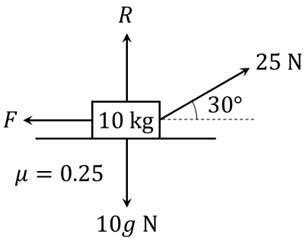
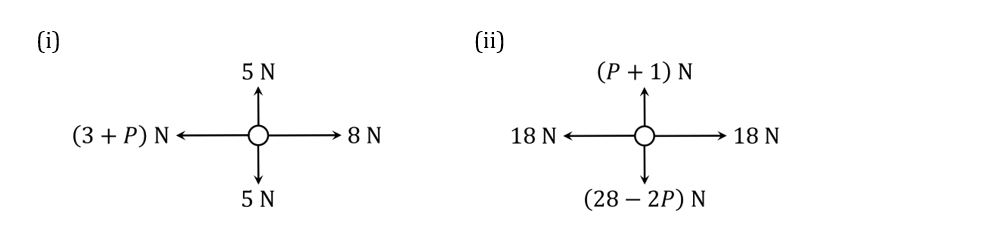
In each of the situations depicted below, the object is initially at rest. Find the magnitude of the frictional force F that will act upon the object in each case, and determine whether the object will remain at rest or begin to move.
(i)
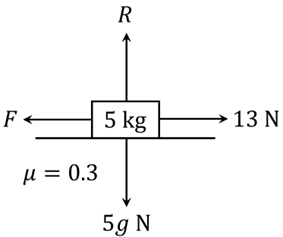
(ii)
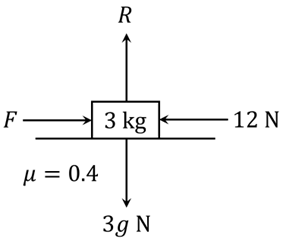
(iii)
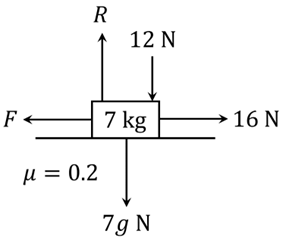
(iv)