Graph Theory (Edexcel IAL Maths)
Introduction to Graph Theory
What is graph theory?
-
Graph theory is the study of graphs, which are mathematical structures used to represent objects and the connections between them
- Graphs can be used in modelling many real-life applications, e.g. electrical circuits, flight paths, maps etc.
Edges (Arcs) & Vertices (Nodes)
Spec point —
2.1
What are the different parts of a graph?
-
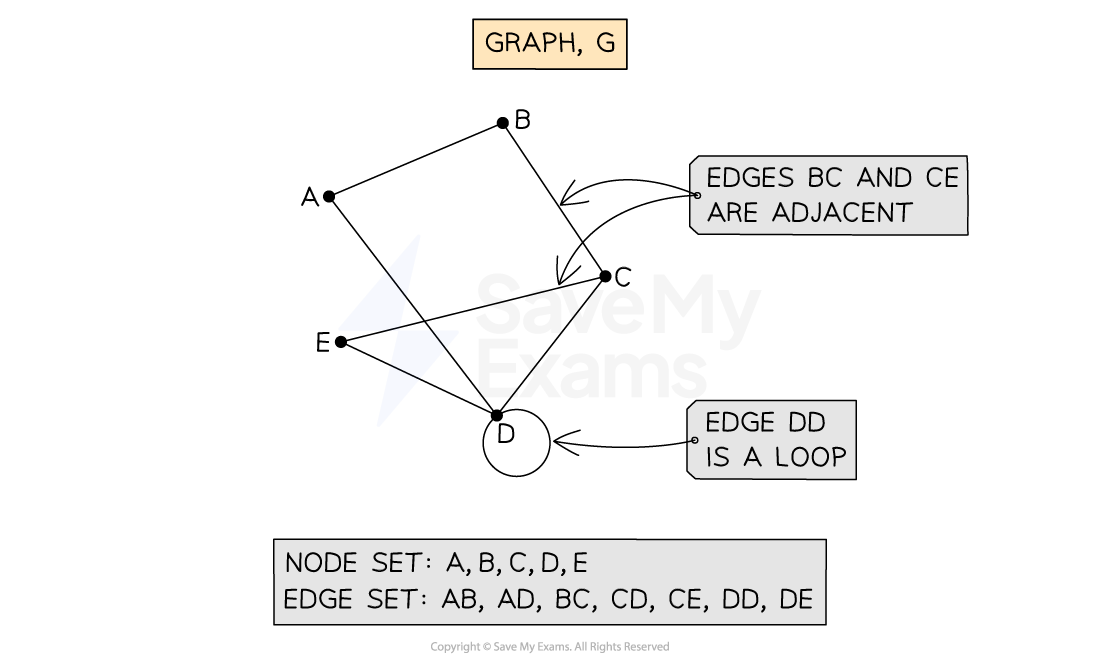
A graph is made up of a number of points (vertices or nodes) that are connected by lines (edges or arcs)
-
A vertex (node) can represent an object, a place or a person
-
Adjacent vertices are connected by an edge
-
Vertices are usually labelled with a letter, e.g. A, B, C...
- The list of vertices in a graph is sometimes called the vertex set
-
-
An edge (arc) forms a connection between two vertices
-
Edges are described by the nodes they connect, e.g. AB, AC, BE...
- The list of edges in a graph is sometimes called the edge set
-
Adjacent edges share a common vertex
-
There may be multiple edges connecting two vertices
-
An edge that starts and ends at the same vertex is called a loop
-
-
Typically a graph will be drawn such that edges do not overlap
- Note that if a graph is drawn with overlapping edges, the edges are not connected at points where they overlap
- Edges are only connected at vertices
Properties of Graphs
Spec point —
2.1
What are the properties of graphs?
-
The edges of a graph may be assigned a numerical value
- This value is called the weight (of an edge)
- Weight is often a measure such as distance, time or money
-
A walk is a finite series of edges in a graph that starts at one vertex and moves from vertex to vertex
- The (total) weight of a walk is the sum of the weights of the edges that it consists of
-
A path is a walk where no vertex is visited more than once
-
A trail is a walk where no edge is visited more than once
- Every path is also a trail but not every trail is a path
-
A cycle (or circuit) is a path that starts and finishes at the same vertex
- It is also known as a closed path
-
A tour is a walk that visits every vertex and returns to its start vertex
Types of Graph
Spec point —
2.1
What are the types of graph?
-
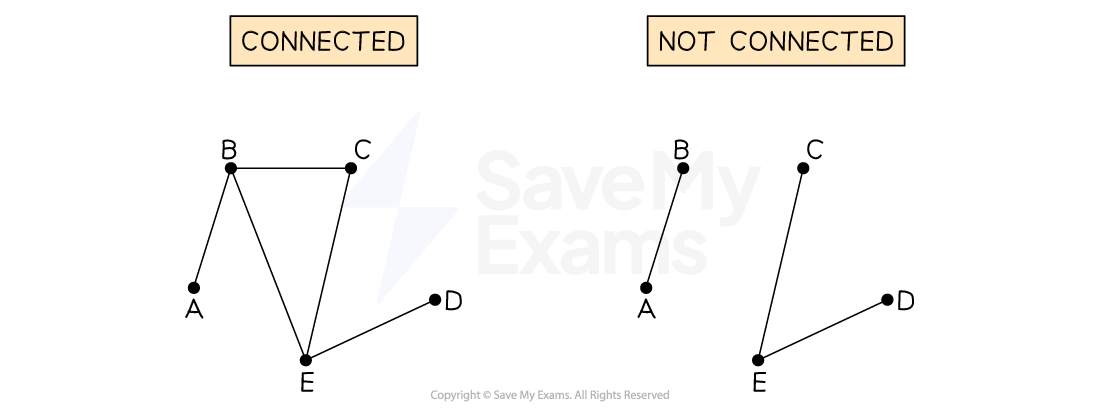
A connected graph is a graph in which all of its vertices are connected to each other
-
Two vertices are connected if there is a path between them
- There does not need to be an edge connecting the pair of vertices
-
-
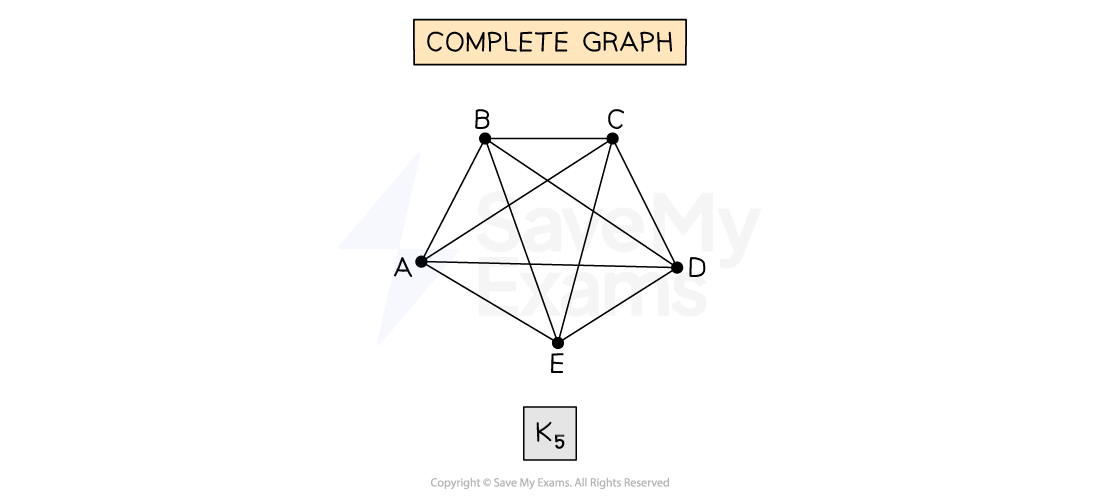
A complete graph is a graph in which each vertex is connected by an edge to each of the other vertices
- A complete graph with n vertices is labelled Kn
-
If the edges of a graph have a weight, the graph is known as a weighted graph (or network)
- Networks are not usually drawn to scale

-
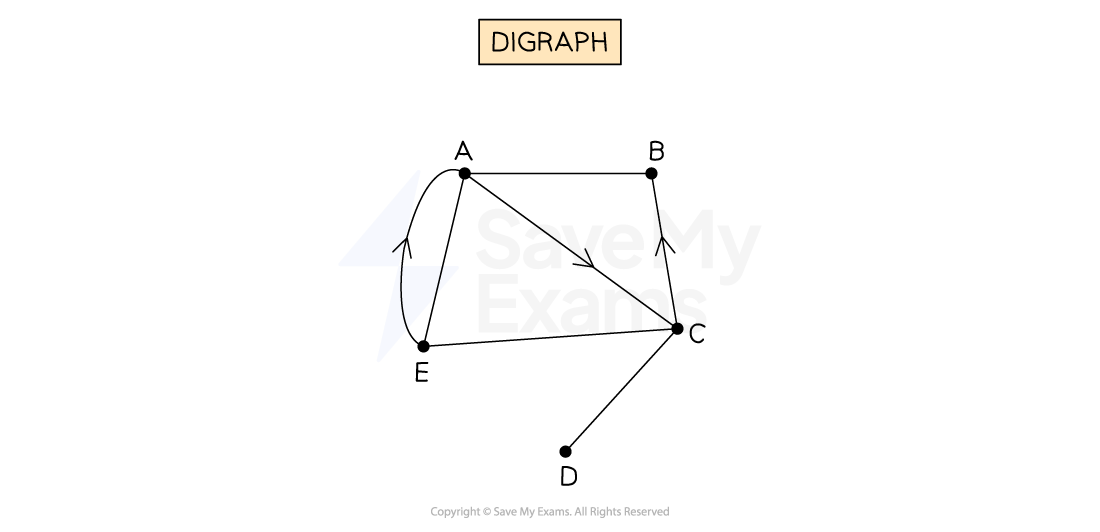
If the edges of a graph are assigned a direction, they are known as directed edges and the graph is known as a digraph
- Directed edges of a graph can only be traversed in the direction indicated
- A simple graph is undirected and unweighted and contains no loops or vertices connected by multiple edges
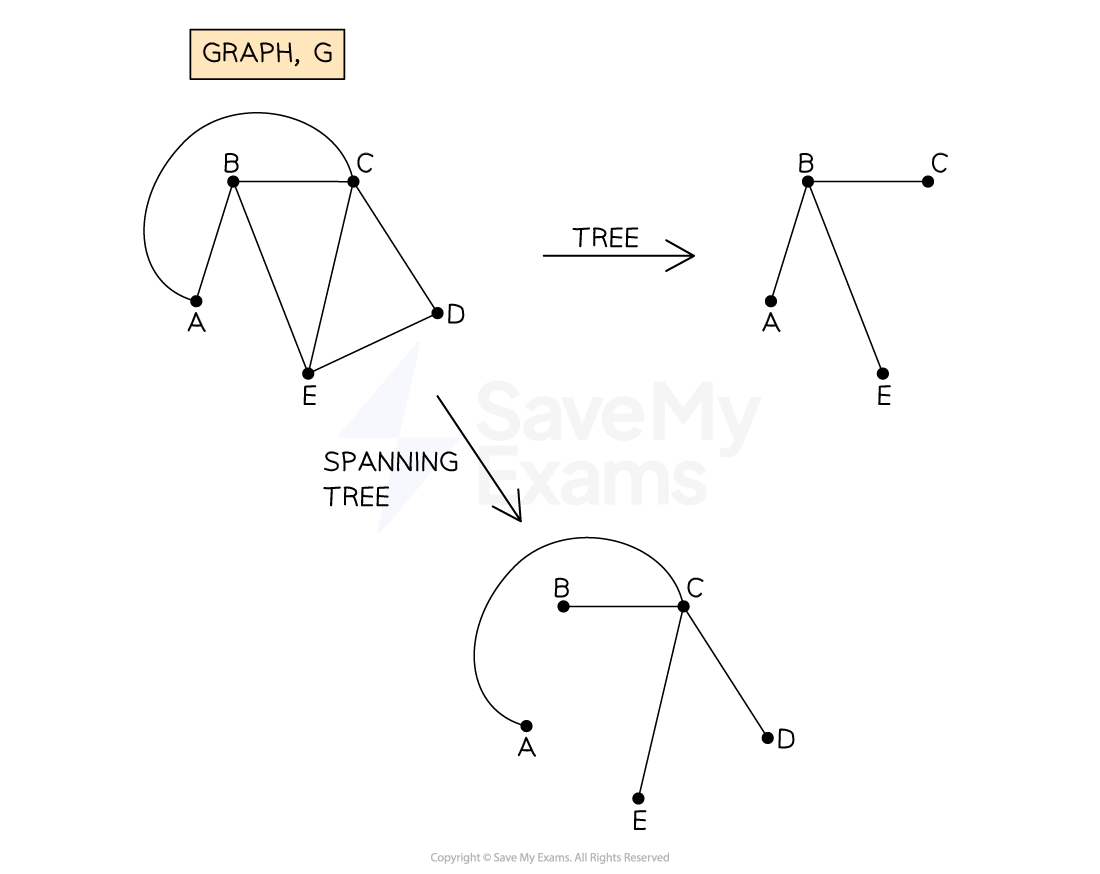
- Given a graph G, a subgraph is a graph which contains only edges and vertices that appear in G
- A tree is a connected graph that does not contain any cycles
- A spanning tree is a subgraph (of a graph G) which is also a tree, and which contains all the vertices from G
-
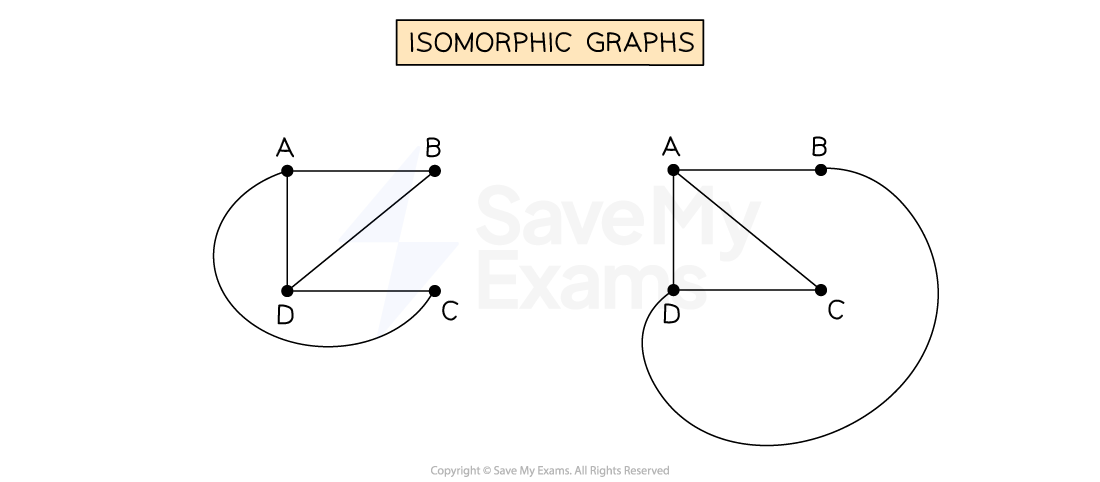
Isomorphic graphs are graphs which show the same information but which are drawn in different ways
- The number of vertices and the number of edges connected to each vertex are the same
Exam Hint
There are a lot of specific terms involved in graph theory
- You are often asked to describe these terms in an exam, so make sure you learn the definitions
- Note that in many cases there are two terms that describe the same thing!
Make sure that any graphs you draw are big and clear so they are easy for the examiner to read
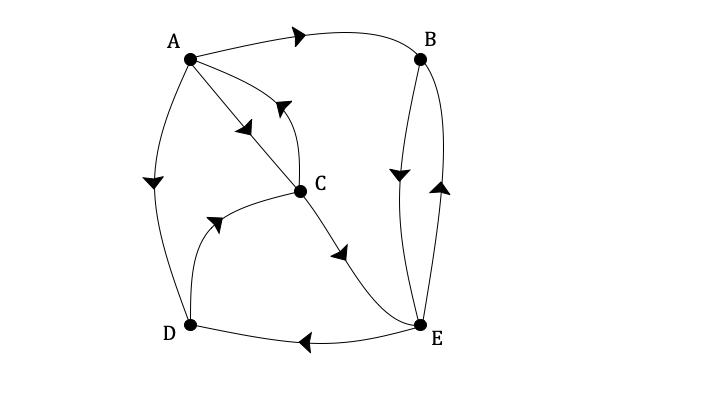
Worked Example The graph G shown below is a connected, unweighted, directed graph with 5 vertices.
a) Write down a cycle, starting at vertex A and visiting exactly 2 other vertices.
Answer:
A cycle starts and ends at the same vertex, with no other vertex visited more than once Two other vertices (from the 4 possibilities) need to be included The directed edges mean, in this case, there is only one such cycle
Final answer: ADCA
b) Write down a path, consisting of more than one edge, that starts at vertex A and ends at vertex B.
Answer:
A path is a walk that does not repeat any nodes
*You must only traverse edges in the directions indicated
Final answer: ADCEB
A path does not have to visit every node (so ACEB or ABEB, for example, are also acceptable)
Was this revision note helpful?
Build on this topic