The Travelling Salesman Problem (Edexcel IAL Maths)
The Classical & Practical Travelling Salesman Problem
Spec point —
3.2
What is the Travelling Salesman Problem?
-
In the Travelling Salesman Problem, the objective is to find the tour of least weight in a given network
-
A tour is a walk that visits every vertex in the network and returns to the start vertex
- A tour could visit a vertex more than once
- A tour is a Hamiltonian cycle if it visits each vertex (other than the start vertex)exactly once
-
-
For the classical travelling salesman problem
- Each vertex is visited exactly once before returning to the start vertex
-
For the practical travelling salesman problem
- Each vertex must be visited at least once before returning to the start vertex
-
There is no algorithm that will always provide an optimal solution
- A lower and upper bound can be generated for the tour of least weight
- If the lower and upper bound happen to be equal, an optimal solution has been found
What is a table of least distances?
-
A table of least distances shows the shortest distance between any two vertices in a graph
- In some cases, the direct route between two vertices may not be the shortest
-
The table of least distances creates a complete network
- Therefore it will contain a Hamiltonian cycle
-
The table of least distances turns a practical travelling salesman problem into a classical travelling salesman problem
How do I find the table of least distances?
-
For smaller networks, values in the table of least distances can often be found by inspection
-
Using Dijkstra's algorithm will always find the shortest routes between pairs of vertices
- An exam question will be clear if this is required but this is uncommon
-
-
A table of least distances is created by ensuring every entry satisfies the triangle inequality
-
The longest side of a triangle ≤ the sum of the lengths of the other two sides
-
'Sides of the triangle' could be made from one or more edges in a network
- There would be lots of them, even in small networks!
-
-
To construct a table of least distances follow the steps below
-
STEP 1 Put a line through each cell along the leading diagonal
- There will be no loops!
-
STEP 2 Complete the row for a particular vertex with the distance between that vertex and each adjacent vertex
- Check (by inspection) if the direct connections are actually the shortest distances and change as necessary
-
STEP 3 Complete the rest of the connections between that particular vertex and all remaining (non-adjacent) vertices Make sure the value used is the shortest route that can be travelled between each pair
-
STEP 4 Copy the values in the completed row down the corresponding column
- A complete network is undirected so the table of least distances will have symmetry
-
STEP 5 Repeat STEP 2 to STEP 4 for each vertex until the table is complete
Exam Hint
Remember that the table of least values has a line of symmetry along the leading diagonal for an undirected network
- Complete one half carefully first, then map over to the second half
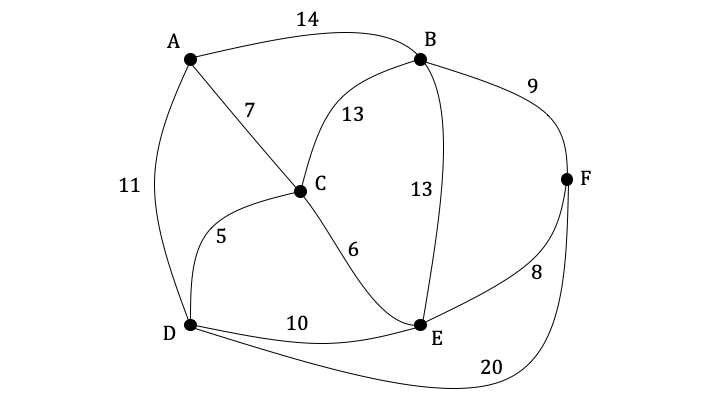
Worked Example The network below contains six vertices representing villages and the edges (roads) that connect them. The weighting of the edges represents the time, in minutes, that it takes to walk along a particular road between two villages.
a) Explain why the network in the diagram is not a complete network. Answer:
Final answer: It is not a complete network as each vertex is not connected to every other vertex by a single edge e.g. there is no single edge that connects vertices B and D
b) Complete the table of least distances for the network below.
A B C D E F A B C D E F Answer:
- STEP 1 Put a line through each cell on the leading diagonal
STEP 2 Fill in the table with the direct connections from the graph, starting from vertex A
- Check that the direct connection is the shortest route in all cases
A B C D E F A - 14 7 11 B - C - D - E - F -
STEP 3 Find the shortest routes between vertices A and E, and A and F, then fill these values in the table
- A*E: ACE = 13
AF: ACEF = 21
- *
A B C D E F A - 14 7 11 13 21 B - C - D - E - F -
- STEP 4 Complete column A with the values recorded in row A.
A B C D E F A - 14 7 11 13 21 B 14 - C 7 - D 11 - E 13 - F 21 -
STEP 5 The table is not complete so return to Step 2
STEP 2 Fill in the table with the direct connections from vertex B
A B C D E F A - 14 7 11 13 21 B 14 - 13 13 9 C 7 - D 11 - E 13 - F 21 -
STEP 3 Complete the table with the shortest route between the non-adjacent vertices B and D
- B*D: BCD = 18
A B C D E F A - 14 7 11 13 21 B 14 - 13 18 13 9 C 7 - D 11 - E 13 - F 21 -
- STEP 4 Complete column B with the values recorded in row B
A B C D E F A - 14 7 11 13 21 B 14 - 13 18 13 9 C 7 13 - D 11 18 - E 13 13 - F 21 9 -
STEP 5 The table is not complete so return to Step 2
STEP 2 Fill in the table with the direct connections from vertex C
A B C D E F A - 14 7 11 13 21 B 14 - 13 18 13 9 C 7 13 - 5 6 D 11 18 - E 13 13 - F 21 9 -
STEP 3 Complete the table with the shortest route between the non-adjacent vertices C and F
- CF: C*EF = 14
A B C D E F A - 14 7 11 13 21 B 14 - 13 18 13 9 C 7 13 - 5 6 14 D 11 18 - E 13 13 - F 21 9 -
- STEP 4 Complete column C with the values recorded in row C
A B C D E F A - 14 7 11 13 21 B 14 - 13 18 13 9 C 7 13 - 5 6 14 D 11 18 5 - E 13 13 6 - F 21 9 14 -
STEP 5 The table is not complete so return to Step 2
STEP 2 Fill in the table with the direct connections from vertex D The direct route between D and F is not the shortest route
DF = 20
- *
DEF = 18
A B C D E F A - 14 7 11 13 21 B 14 - 13 18 13 9 C 7 13 - 5 6 14 D 11 18 5 - 10 18 E 13 13 6 - F 21 9 14 -
- STEP 3 There are no non-adjacent vertices for D left to complete
- STEP 4 Complete column D with the values recorded in row D
A B C D E F A - 14 7 11 13 21 B 14 - 13 18 13 9 C 7 13 - 5 6 14 D 11 18 5 - 10 18 E 13 13 6 10 - F 21 9 14 18 -
STEP 5 The table is not complete so return to Step 2
STEP 2 Fill in the table with the direct connections from vertex E
A B C D E F A - 14 7 11 13 21 B 14 - 13 18 13 9 C 7 13 - 5 6 14 D 11 18 5 - 10 18 E 13 13 6 10 - 8 F 21 9 14 18 -
STEP 3 There are no other connections for vertex E
STEP 4 Complete column E with the values recorded in row E
STEP 5 The table is complete so stop
A B C D E F A Final answer: - Final answer: 14 Final answer: 7 Final answer: 11 Final answer: 13 Final answer: 21 B Final answer: 14 Final answer: - Final answer: 13 Final answer: 18 Final answer: 13 Final answer: 9 C Final answer: 7 Final answer: 13 Final answer: - Final answer: 5 Final answer: 6 Final answer: 14 D Final answer: 11 Final answer: 18 Final answer: 5 Final answer: - Final answer: 10 Final answer: 18 E Final answer: 13 Final answer: 13 Final answer: 6 Final answer: 10 Final answer: - Final answer: 8 F Final answer: 21 Final answer: 9 Final answer: 14 Final answer: 18 Final answer: 8 Final answer: -
Was this revision note helpful?
Build on this topic