11 markeasy
Which word describes an action by an organism that causes a change of position or place?
Choose your answer
excretion
growth
movement
sensitivity
25 questions · 60 marks · ≈ 60 min · spans 14 of 14 topics
Assembled from the topic question banks — not an official Cambridge International paperWhich word describes an action by an organism that causes a change of position or place?
Choose your answer
excretion
growth
movement
sensitivity
What is a type of tissue in a living organism?
Choose your answer
blood
heart
plasma
plasmid
The diagram shows an uncooked potato being used in an experiment. The skin of the potato was removed as shown.
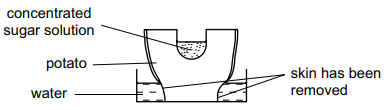
The experiment was left for a few hours.
Which diagram shows the result?
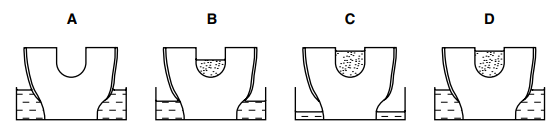
Choose your answer
A student investigates vitamin C in apple juice.
The student is provided with half an apple and some apple juice.
Fig. 1.1 shows the cut surface of the apple provided.
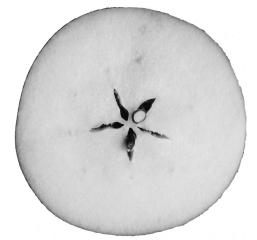
Fig. 1.1
In the box, make a large drawing of the cut surface of the apple shown in Fig. 1.1.
The student tests the apple juice using DCPIP.
DCPIP is a dark blue solution that turns colourless when vitamin C is added.
The greater the amount of vitamin C in the apple juice, the fewer the drops of apple juice needed to turn the DCPIP colourless.
Procedure:
The student:
The student repeats the procedure and records the volume of apple juice remaining in the syringe for experiment 2 in Table 1.1.
The student repeats the procedure again for experiment 3.
Fig. 1.2 shows the volume of apple juice remaining in the syringe in experiment 3.
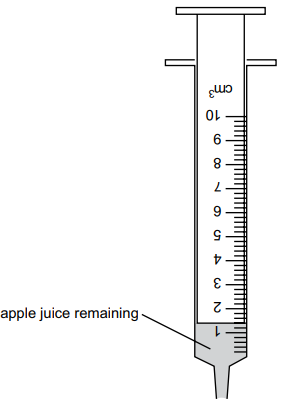
Fig. 1.2
(i) Record in Table 1.1 the volume of apple juice remaining in the syringe in experiment 3.
Table 1.1
| experiment | volume of apple juice remaining in syringe / cm³ | volume of apple juice added to the DCPIP / cm³ |
|---|---|---|
| 1 | 1.3 | 8.7 |
| 2 | 1.5 | 8.5 |
| 3 |
(1 mark)
(ii) Calculate the volume of apple juice added to the DCPIP in experiment 3.
Record your answer in Table 1.1.
(1 mark)
(iii) Calculate the average volume of apple juice added.
(1 mark)
(iv) Suggest why the student repeats the experiment.
(1 mark)
Fig. 3.2 shows the effect of pH on enzyme activity.
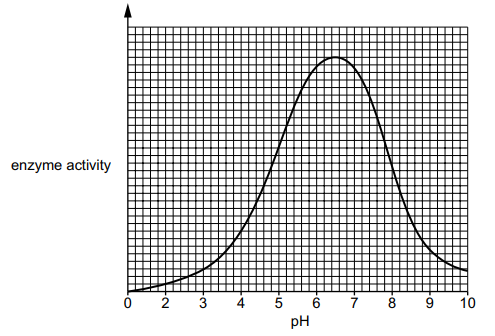
Fig. 3.2
(i) The enzyme in Fig. 3.2 is active in the mouth.
When the enzyme reaches the stomach, the enzyme activity changes.
Explain why the enzyme activity changes.
(3 marks)
(ii) Draw a curve on Fig. 3.2 to show the activity of a protease enzyme found in the stomach.
(1 mark)
An aquatic plant is placed in a beaker of water containing hydrogencarbonate indicator and kept in the dark.
Which colour will the hydrogencarbonate indicator be after 24 hours?
Choose your answer
blue
red
purple
yellow
Fig. 3.1 shows part of the human digestive system.
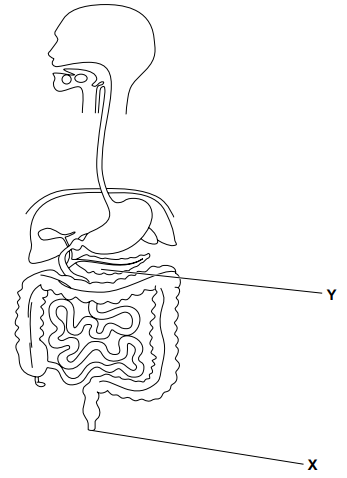
Fig. 3.1
(i) State the function of the part labelled X on Fig. 3.1.
(1 mark)
(ii) Complete these sentences about the part labelled Y on Fig. 3.1.
The part labelled Y is the .................................................. .
Part Y releases an enzyme to break down fats and oils. This enzyme is called .................................................. .
Fats and oils are broken down into smaller molecules called .................................................. and ..................................................
(3 marks)
The diagram shows a cross-section through a leaf.
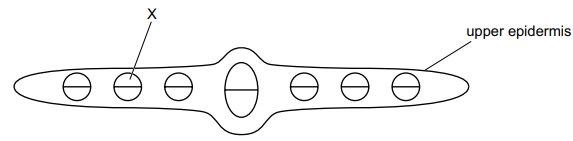
What are the functions of the tissue labelled X?
Choose your answer
1 and 2 only
3 and 4 only
1 and 4 only
2 and 3 only
The heart is the organ that pumps blood around the body.
(i) State the name of an upper chamber of the heart.
(1 mark)
(ii) State the type of blood vessel that transports blood to the heart.
(1 mark)
(iii) State the function of red blood cells.
(1 mark)
Fig. 1.1 shows a sign from a restaurant kitchen.
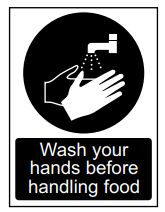
Fig. 1.1
Explain why the message in the sign is important for controlling the spread of disease.
A person is is given an initial vaccination for a disease. A few weeks later the person is given a booster vaccination. A booster vaccination is an additional vaccination for the same disease.
Fig. 1.2 shows how the number of antibodies in the body of the person changes after each vaccination.
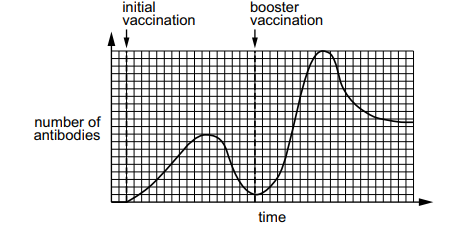
(i) Describe two differences between the response to the initial vaccination and the response to the booster vaccination shown in Fig. 1.2.
(2 marks)
(ii) Place a tick (✓) in the box that describes the response shown in Fig. 1.2.
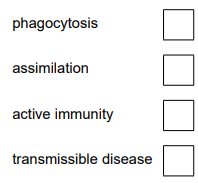
(1 mark)
Explain how platelets in the blood help defend the body against disease.
A doctor tells a patient that they are suffering from a viral infection.
Why would the doctor not prescribe antibiotics to the patient?
Choose your answer
Antibiotics do not affect viruses.
Antibiotics are drugs.
Long-term use of antibiotics may reduce their effectiveness against viruses.
Some bacteria are resistant to antibiotics.
Fig. 2.4 shows a drawing of the carpel from an insect-pollinated flower.
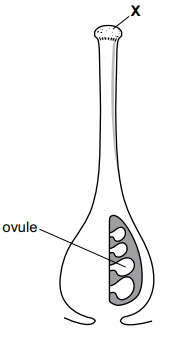
Fig. 2.4
(i) Identify the part labelled X on Fig. 2.4.
(1 mark)
(ii) Describe fertilisation in an ovule.
(1 mark)
Which reasons explain why deforestation contributes to climate change?
| species become extinct | increased risk of flooding | increase in atmospheric carbon dioxide | |
|---|---|---|---|
| A | ✗ | ✗ | ✓ |
| B | ✓ | ✓ | ✗ |
| C | ✗ | ✓ | ✗ |
| D | ✓ | ✗ | ✗ |
Choose your answer
Biodiversity is the number of different …R… in an area.
Which word replaces R in the sentence?
Choose your answer
food chains
food webs
organisms
species
Which label represents a plasmid in this diagram of a bacterium?
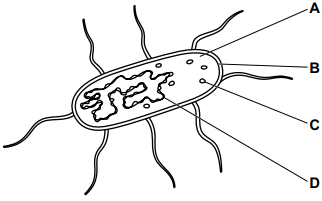
Choose your answer
Which factor would decrease the rate of diffusion from a plant cell?
Choose your answer
high temperature
large surface area
small concentration gradient
small diffusion distance
You are going to investigate vitamin C in apple juice.
You are provided with half an apple and some apple juice.
In the box, make a large drawing of the cut surface of the apple.
You will test the apple juice using DCPIP.
DCPIP is a dark blue solution that turns colourless when vitamin C is added.
The greater the amount of vitamin C in the apple juice, the fewer the drops of apple juice needed to turn the DCPIP colourless.
(i) Procedure
Table 1.1
| Experiment | Number of drops of apple juice added |
|---|---|
| 1 | |
| 2 | |
| 3 |
(ii) Calculate the average number of drops of apple juice added for the three experiments.
(1 mark)
(iii) Suggest one limitation of using a pipette in this procedure
(1 mark)
A student investigates photosynthesis using the set-up shown in Fig. 2.1.
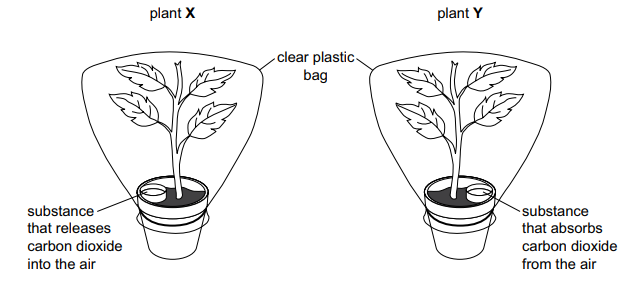
Fig. 2.1
The student puts the plants in the same warm room with plenty of light.
After three days, the student uses iodine solution to test a leaf from each plant.
Fig. 2.2 shows the results.
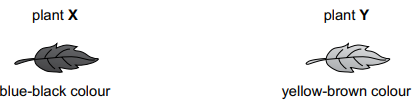
Fig. 2.2
(i) Complete the sentences to explain the results in Fig. 2.2.
The colour of the iodine solution shows that only the leaf from plant X contains .................................................. .
This investigation shows that photosynthesis requires the presence of .................................................. .
(2 marks)
(ii) State the name of the green pigment needed for photosynthesis.
(1 mark)
Photosynthesis is an enzyme-controlled reaction.
Fig. 2.3 shows the effect of temperature on the rate of photosynthesis for three different plants.
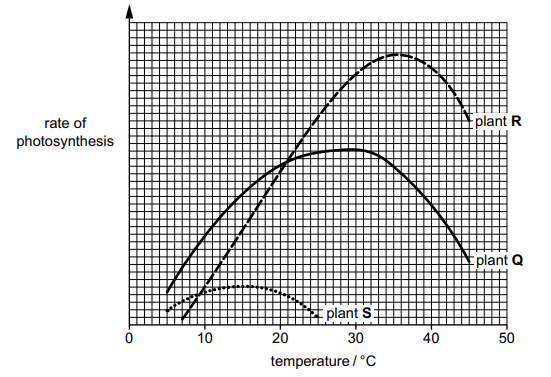
(i) Identify the temperature at which the rate of photosynthesis for plant Q is highest.
(1 mark)
(ii) In a desert, temperatures are often higher than 40 °C.
Explain why plant S would not survive in a desert.
Use the word enzyme in your answer.
(2 marks)
Fig. 2.1 shows a section of a plant stem.
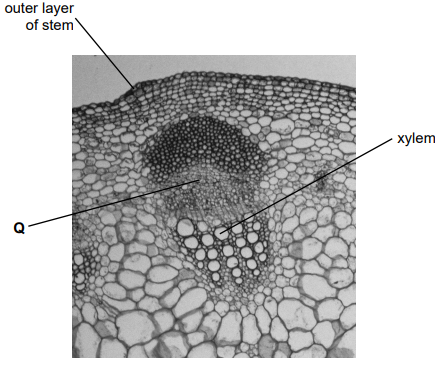
(i) Circle the substances transported by the cells labelled Q on Fig. 2.1.
amino acids fatty acids glycerol glucose nitrate ions starch sucrose
(1 mark)
(ii) One function of xylem is transport.
State one other function of xylem.
(1 mark)
Heart disease is caused by the blockage of arteries in the heart. Less oxygen is transported to the heart muscle, which causes damage to the heart.
(i) State the name of these blocked arteries.
(1 mark)
(ii) State the name of the component of blood that transports oxygen.
(1 mark)
What produces active immunity?
| infection by a pathogen | vaccination | |
|---|---|---|
| A | ✓ | ✓ |
| B | ✓ | ✗ |
| C | ✗ | ✓ |
| D | ✗ | ✗ |
Choose your answer
Which row contains the words that can replace X, Y and Z in the description of a food chain?
Energy from the Sun is transferred as …X… to be stored as …Y… energy in a …Z… .
| X | Y | Z | |
|---|---|---|---|
| A | chemical | light | consumer |
| B | chemical | kinetic | producer |
| C | light | chemical | producer |
| D | light | kinetic | consumer |
Choose your answer
Plants are an important part of the biodiversity of an ecosystem.
Explain the effect of deforestation on biodiversity.
Which label shows the site of aerobic respiration in this diagram of an animal cell?
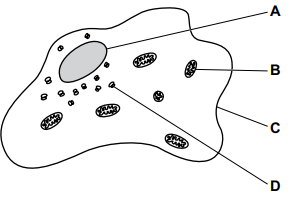
Choose your answer
The diagram shows a root hair cell.
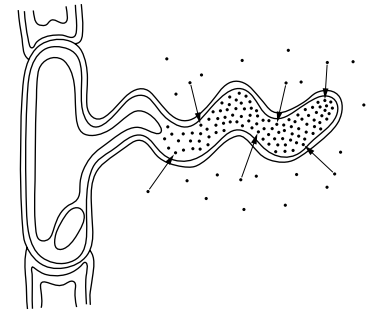
Which type of transport is shown by the arrows in this diagram?
Choose your answer
active transport
diffusion
osmosis
xylem transport