Electromagnetic Waves (Cambridge International IGCSE Science)
Exam board Cambridge International · IGCSEUpdated 2025-12-19
Electromagnetic waves
-
The electromagnetic spectrum is arranged in a specific order based on the wavelengths or frequencies of the radiation in each region
- Regions with a long wavelength have a low frequency and vice versa
-
The main regions of the continuous electromagnetic (EM) spectrum from longest to shortest wavelength are:
- Radio waves
- Microwaves
- Infrared
- Visible (red, orange, yellow, green, blue, indigo, violet)
- Ultraviolet
- X-rays
- Gamma rays
The electromagnetic spectrum in order of decreasing wavelength
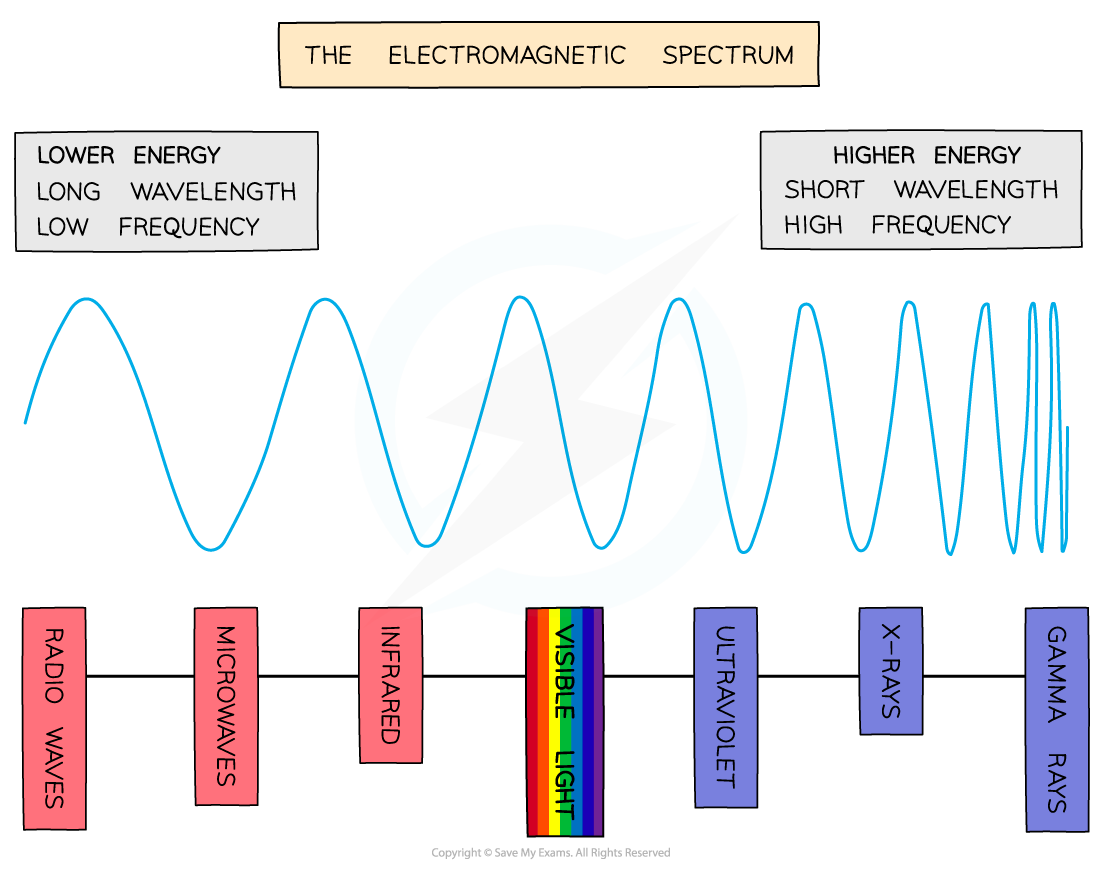
Visible light is just one small part of a much bigger spectrum: The electromagnetic spectrum
Exam Hint See if you can make up a mnemonic to help you remember the EM spectrum!
One possibility is:
Raging Martians Invaded Venus Using X-ray Guns
The electromagnetic spectrum is usually given in order of decreasing wavelength and increasing frequency i.e. from radio waves to gamma waves
Remember:
- Radios are big (long wavelength)
- Gamma rays are emitted from atoms which are very small (short wavelength)
Properties of electromagnetic waves
- All electromagnetic waves travel at the same high speed in a vacuum
- Electromagnetic waves are defined as: Transverse waves that transfer energy from the source of the waves to an absorber
The speed of electromagnetic waves
Spec point —
P3.3.5
Extended Tier Only
- The speed of electromagnetic waves in a vacuum is
3.0 × 10⁸m/s
- This is approximately the same speed as electromagnetic waves in air
Was this revision note helpful?
Build on this topic