Newton's First Law (Cambridge International IGCSE Science)
Spec point — Know that an object either remains at rest or continues in a straight line at constant speed unless acted on by a resultant force
Newton's first law
- Newton's 1st law of motion states:
An object either remains at rest or continues in a straight line at constant speed unless acted on by a resultant force
-
This means that:
- A stationary object will remain stationary
- An object moving with a constant velocity will continue to move at that constant velocity
- Unless the object is acted upon by a resultant force
-
Conversely, that means that if an object is at rest, or has a constant velocity, no resultant force can be acting on it
-
Remember that a constant velocity means:
- No change in speed
- No change in direction
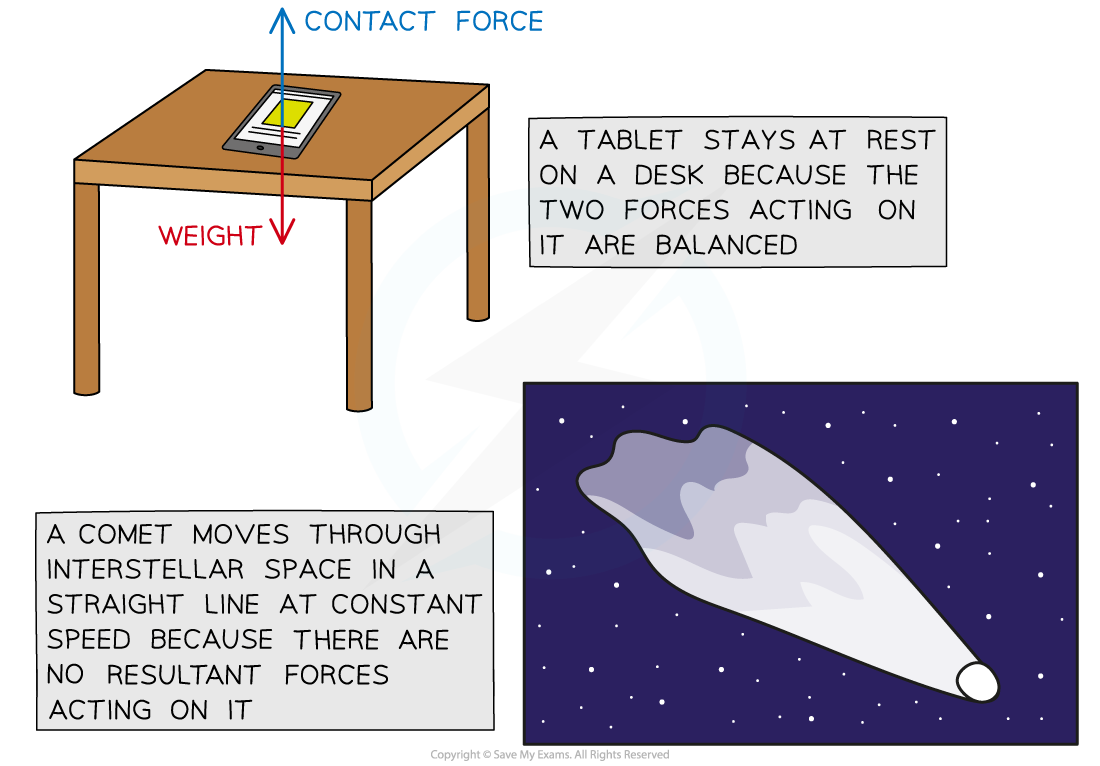
Constant velocity can only be achieved when the forces on an object are balanced, or in other words, when the resultant force is zero
Examples of Newton's first law
-
A mug on a table will remain stationary on the table unless acted upon by a resultant force
- For example, if someone picks up the mug, or knocks into the table
-
A piece of space debris will continue moving in a straight line at a constant speed unless acted upon by a resultant force
- For example, if it enters the gravitational field of a planet or collides with an asteroid
-
A car travelling in a straight line at a constant speed will continue to travel in a straight line at a constant speed unless acted upon by a resultant force
- For example, if the driver brakes or accelerates
Worked Example A student did some online research and found out that the Moon orbits the Earth at a constant speed of around 1000 m/s.
The student says that this is not an example of Newton's first law of motion. Is the student correct? Explain your answer.
[3]
Answer:
Step 1: Recall Newton's first law of motion
- Newton's first law of motion states that an object either remains at rest or continues in a straight line at constant speed unless acted on by a resultant force
Step 2: Determine if the object in the question is at rest, or if it is moving with a constant velocity
- The Moon, in this case, is not at rest
- It is moving at a constant speed
- But it is not moving in a constant direction - it continually orbits the Earth [1 mark]
- Hence, it is not moving with a constant velocity, because velocity is a vector quantity
Step 3: State and explain whether the student is correct
- The student is correct [1 mark]
- The Moon moves with a constant speed, but always changes direction
- So it is not moving with a constant velocity, and is not an example of Newton's first law of motion [1 mark]
Worked Example A car moves at a constant velocity. The driving force from the engine is 3 kN.
Determine the frictional force acting on the car.
[2]
Answer:
Step 1: Recall Newton's first law of motion
- Newton's first law of motion states that an object either remains at rest or continues in a straight line at constant speed unless acted on by a resultant force
Step 2: Relate Newton's first law to the scenario
- Since the car is moving at a constant velocity, there is no resultant force [1 mark]
- This means the driving and frictional forces are balanced
Step 3: State the value of the frictional force
- Frictional force, F = driving force = 3 kN [1 mark]

Exam Hint Students often struggle to understand how an object can move when there is no resultant force acting on it. You may even have this misconception without realising it.
A car can maintain a constant velocity when the force from the engine is balanced with the frictional forces opposing its motion (friction between the tyres and road, and air resistance). If nothing changes with these forces, it will continue travelling at a constant velocity. If you do want to change the motion of the car, to speed up or slow down, you need to provide a resultant force. By increasing the force from the engine, you can cause the car to speed up. By either decreasing the force from the engine, or increasing the frictional force (using the brakes) the car will slow down.
When the forces acting on an object are not balanced (a resultant force is exerted) this will cause a change in the object's motion.
Was this revision note helpful?
Build on this topic