14 markshard
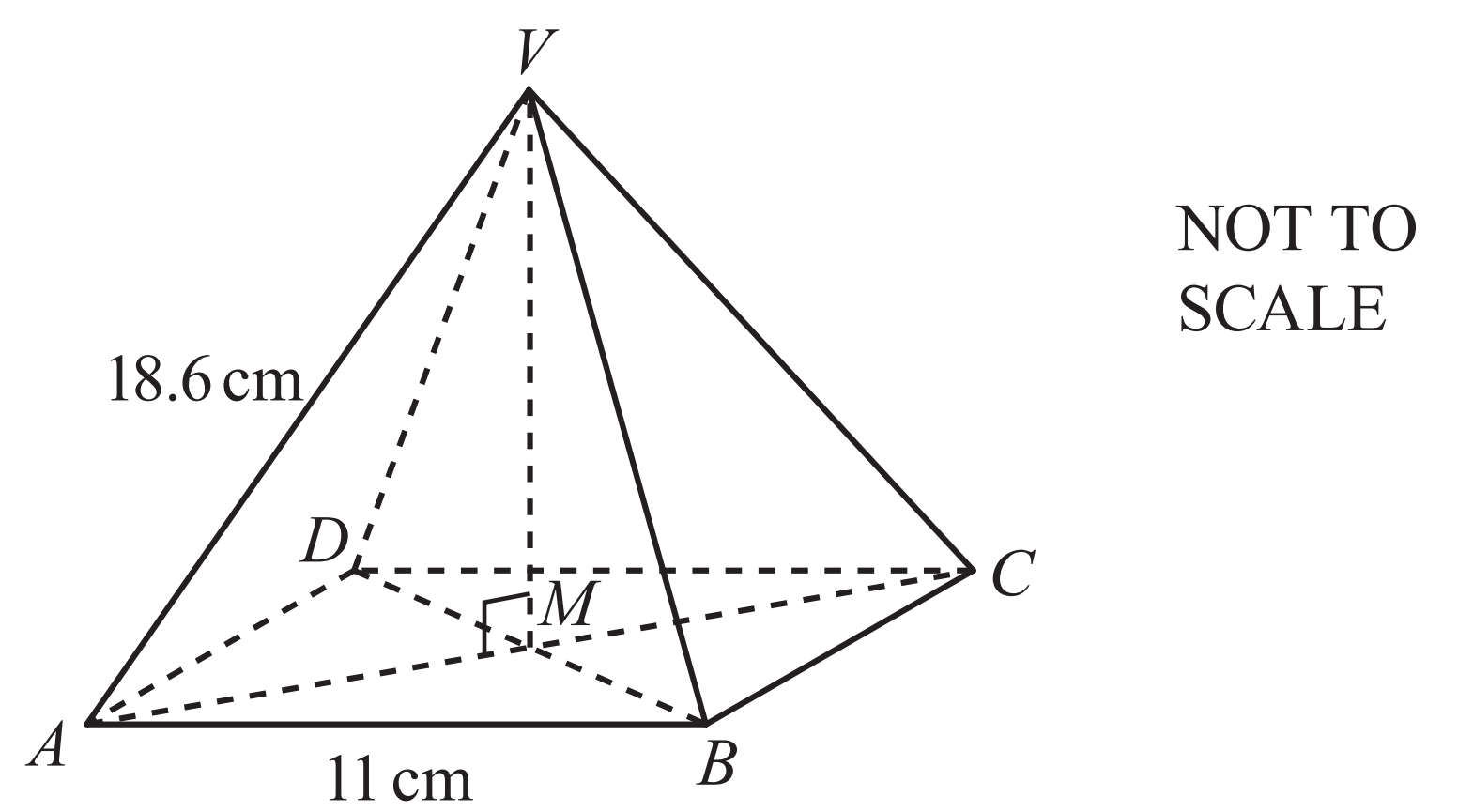
The diagram shows a pyramid with a square base ABCD.
The diagonals AC and BD intersect at *M. *
The vertex V is vertically above *M. *
AB = 11 cm and AV = 18.6 cm.
Calculate the angle that AV makes with the base.
20 questions · 83 marks · ≈ 1 hour · spans 20 of 55 topics
Assembled from the topic question banks — not an official Cambridge International paper
The diagram shows a pyramid with a square base ABCD.
The diagonals AC and BD intersect at *M. *
The vertex V is vertically above *M. *
AB = 11 cm and AV = 18.6 cm.
Calculate the angle that AV makes with the base.
Simplify.
Find the value of log _ 3 ( fourth sqrt of 1 / 9 ) )
i) Factorise .
(2 marks)
ii)
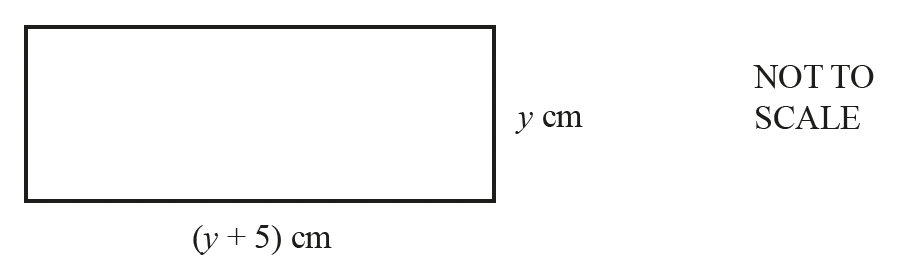
The area of the rectangle is 84 cm2.
Find the perimeter.
.......................................... cm [3]
i) Find .
(1 mark)
ii) Find .
(1 mark)
Extract:
f(x) = 3 - 2x
Find .
Work out the value of when
Solve the equation
................
is inversely proportional to the square root of . When .
Find when .
= ............................................
Solve the equation . Show all your working and give your answers correct to 2 decimal places.
= ........................... or = ...........................
Rearrange the formula to write in terms of and .
= ..............................................
The th term of a number sequence is
Write down the first three terms of the sequence.
Solve the simultaneous equations. You must show all your working.
.................... , ....................
.................... , ....................
A straight line goes through the points () and (), where
Find the gradient of the line.
Klaus buys silver balloons and gold balloons for a party.
He buys
Write down four inequalities, in terms of and/or , to show this information.
.................................................
.................................................
.................................................
.................................................
Extract:
Klaus buys x silver balloons and y gold balloons for a party.
He buys
Write down four inequalities, in terms of x and/or y, to show this information.
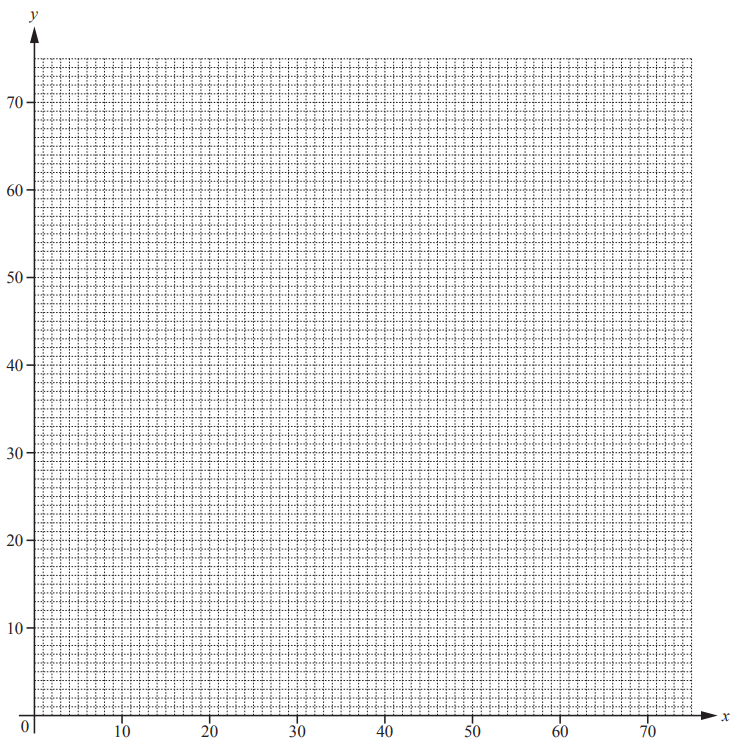
On the grid, show the information from part (a) by drawing four straight lines and shading the unwanted regions.
A is the point (7, 2) and B is the point (−5, 8).
Find the equation of the line that is perpendicular to AB and that passes through the point (−1, 3).
Give your answer in the form .
= ..............................................
The point lies on the curve with equation
On the graph of , where is a constant, the point is mapped to the point .
Determine the value of .
On the graph of , where is a constant, the point is mapped to the point .
Determine the value of .
A different function, , is a cubic function of the form .
The graph of is translated by the vector .
Write down the equation of the transformed graph in terms of , and .
The curve has equation
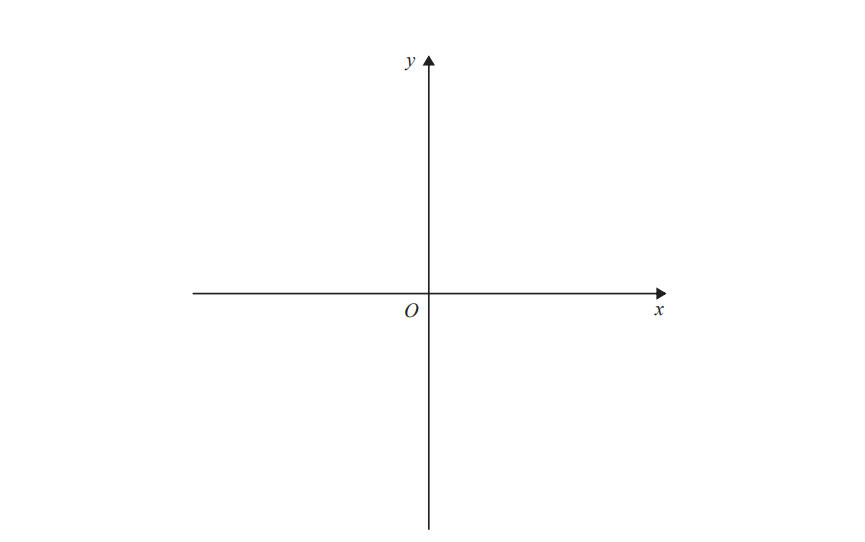
Using the axes below, sketch the curve . On your sketch show clearly
(i) the exact coordinates of any points of intersection of with the coordinate axes,
(ii) the coordinates of the turning point.
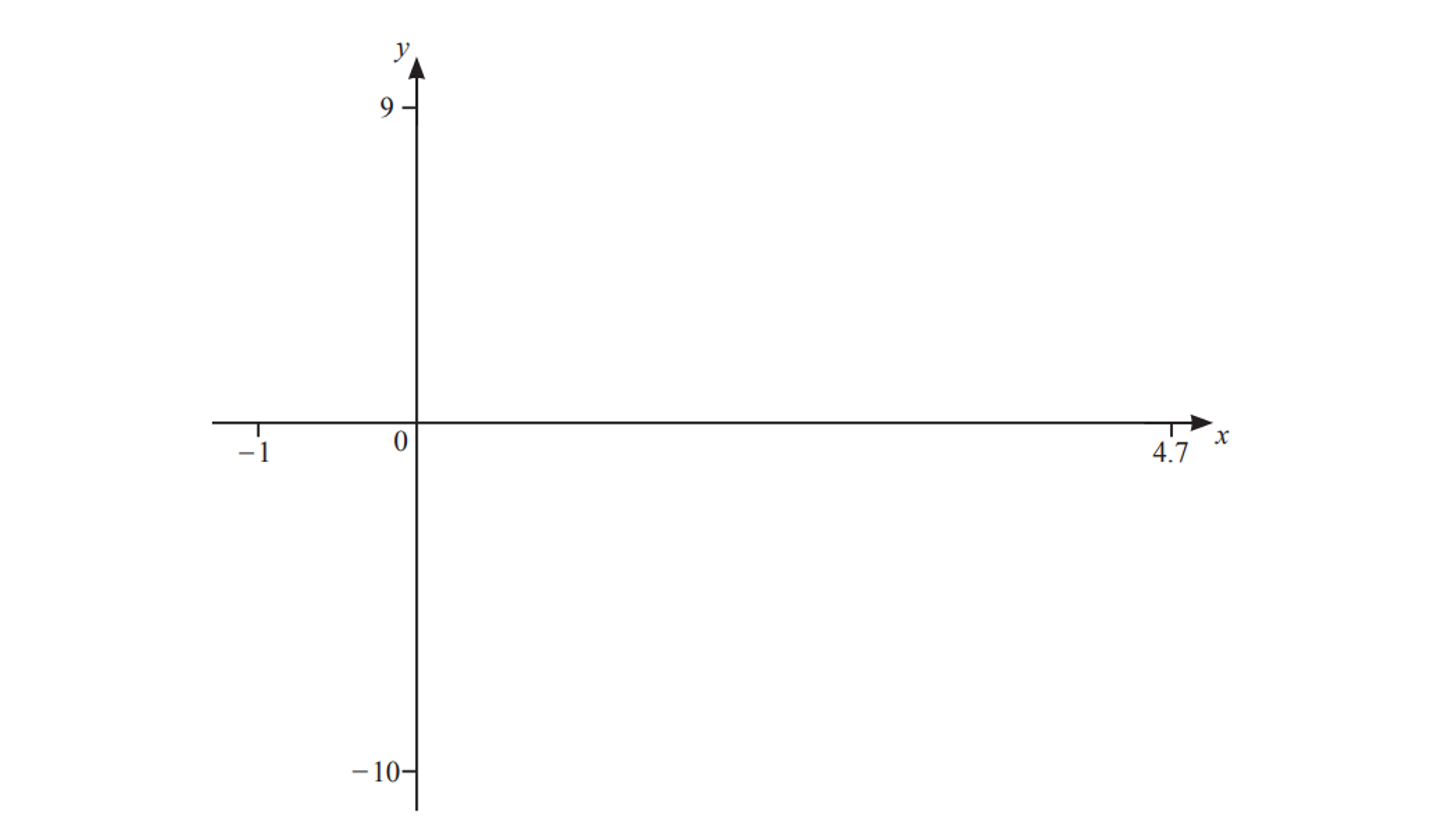
for
On the diagram, sketch the graph of .
Write down the coordinates of the local maximum.
Extract:
f(x) = (x - 2)^3 - 5x + 12
The equation has exactly 2 solutions.
Find the values of .
for
On the diagram, sketch the graph of .
Extract:
f(x) = (x - 2)^3 - 5x + 12 for -1 ≤ x ≤ 4.7 g(x) = -(x - 1)^2 for -1 ≤ x ≤ 4.7
Solve .
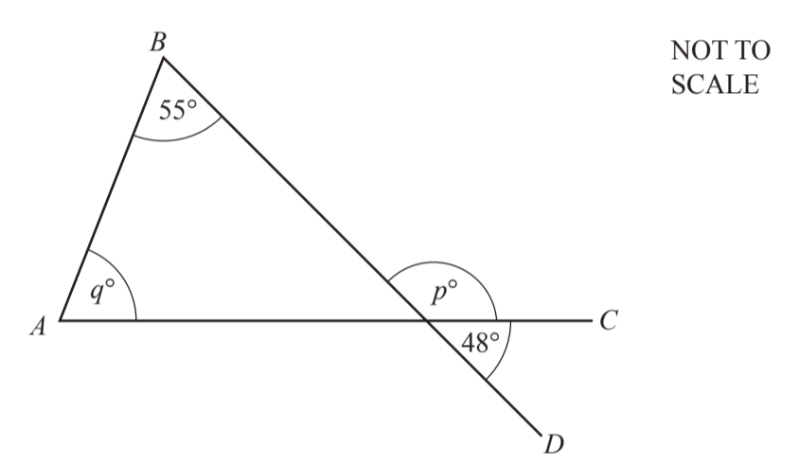
In the diagram, AC and BD are straight lines.
Find the value of and the value of .
= ...................................................
= ...................................................
The diagram shows the positions of three towns, Acton (), Barston () and Chorlton ().
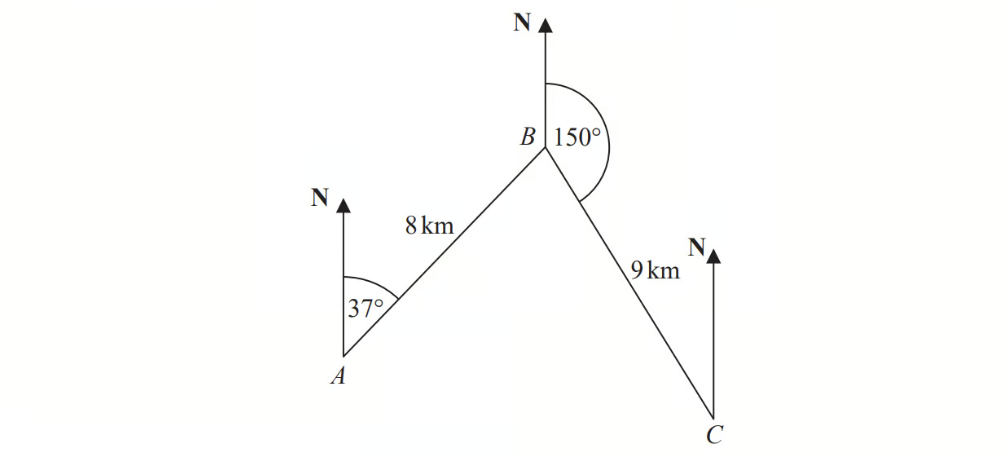
Barston is 8 km from Acton on a bearing of . Chorlton is 9km from Barston on a bearing of .
Find the bearing of Chorlton from Acton. Give your answer correct to 1 decimal place. You must show all your working.