Introduction to Lines & Angles (Cambridge International IGCSE Mathematics)
Properties of Lines & Angles
What properties do I need to know about lines?
-
A line is a straight, one dimensional path that extends forever
-
A line segment is a part of a line, it has a start and an end point
-
A line segment that starts at the point A and ends at the point B is usually labelled AB
-
Two lines with single marks are of equal length
- Two other lines with double marks are of (a different) equal length
-
-
Two lines are parallel if they continue in the same direction as each other forever
-
Parallel lines never intersect(meet)
-
Parallel lines should be marked with arrows
- If there is more than one pair (or set) of parallel lines in a diagram then multiple arrows will be used
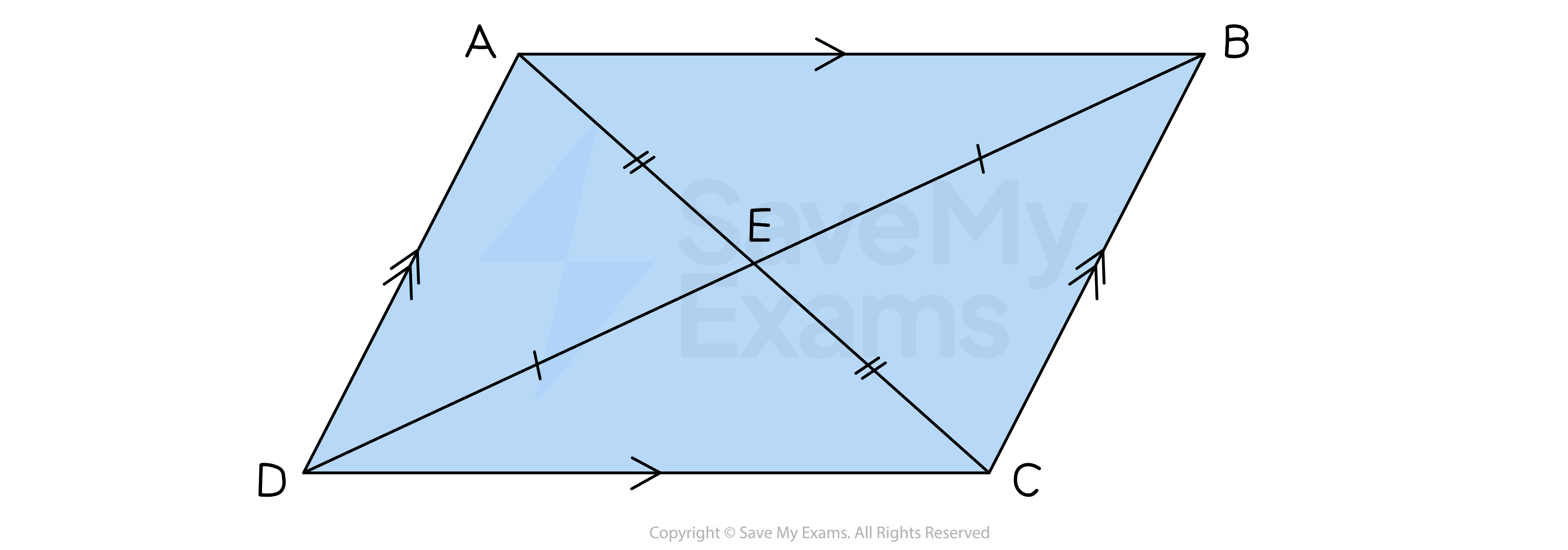
- If there is more than one pair (or set) of parallel lines in a diagram then multiple arrows will be used
-
-
Two lines are perpendicular if they intersect at right-angles (90°)
What properties do I need to know about angles?
-
When two lines intersect(meet) they will form an angle
-
There are different types of angles
- An angle that is less than 90° is called an acute angle
- An angle that is exactly 90° is called a right angle
- An angle that is greater than 90° and less than 180° is called an obtuse angle
- An angle that is exactly 180° is called a straight angle
- An angle that is greater than 180° but less than 360° is called a reflex angle
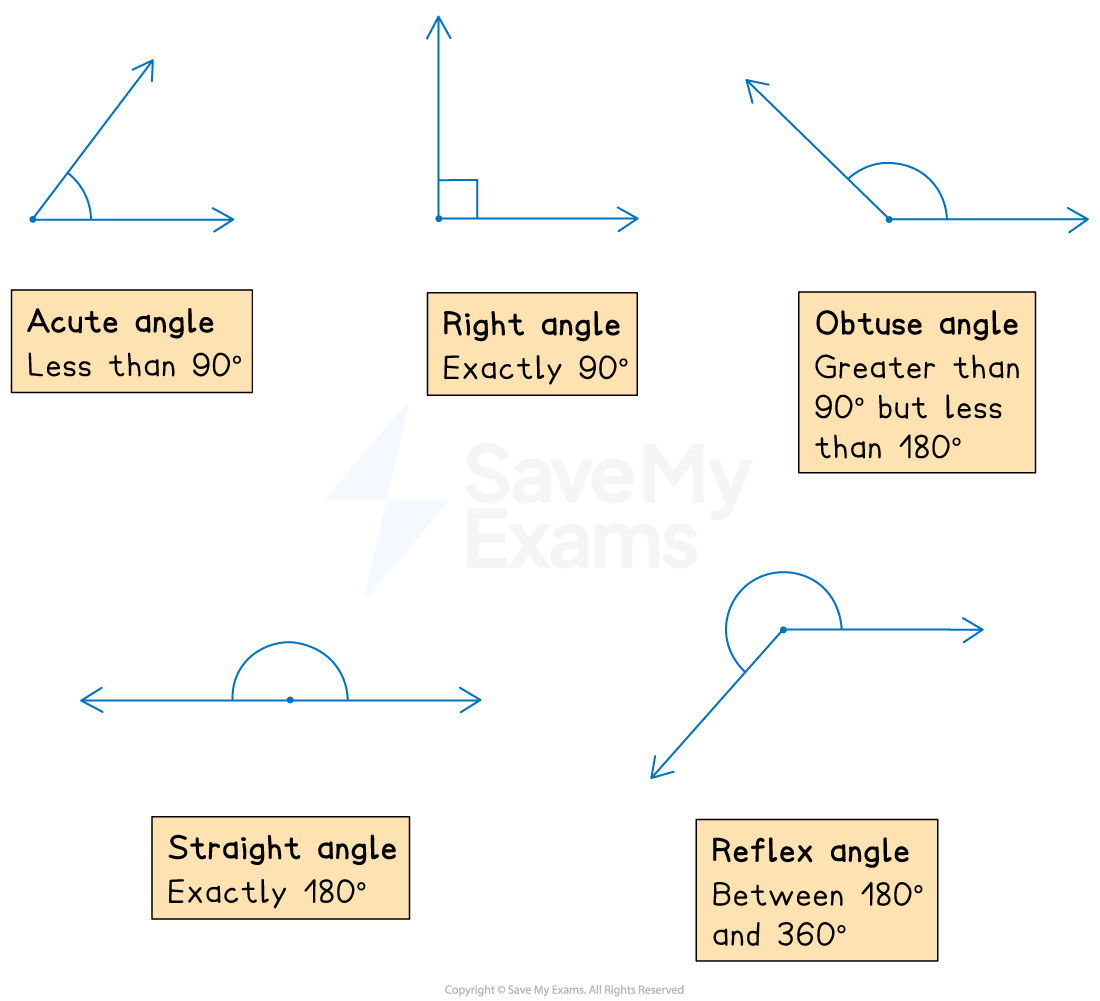
-
Angles at a point add up to 360°
-
Angles on a straight line add up to 180°
-
Angles that add up to 180° are called supplementary angles
- e.g. 30 and 150 degrees are supplementary angles
-
Exam Hint
- Do not assume two lines are parallel or perpendicular just because they look it, always look out for the arrows or right angle in a diagram, or read the question to look for clues
Worked Example Write down the mathematical name for an angle which is greater than 90° but less than 180°.
Answer:
Final answer: An obtuse angle
Was this revision note helpful?
Build on this topic