Types of Graphs (Cambridge International IGCSE Mathematics)
Types of Graphs
What graphs do I need to know?
-
You need to be able to recognise the following lines:
-
Straight lines
- y = mx + c
- Such as y = 3x * + 2, y = 5x * - 1, ...
- Two important ones are y = x and y = -x
-
Horizontal lines
- y = c
- Such as y = 4, y = -10, ...
-
Vertical lines
- x = k
- Such as x = 2, x = -1, ...
-
-
You need to be able to recognise quadratic graphs
- y = x2
- y = -x2
- y = ax2 + bx + c
-
You also need to be able to recognise reciprocal graphs
What does a quadratic graph look like?
-
The equation of a quadratic graph is y = ax2 + bx + c
-
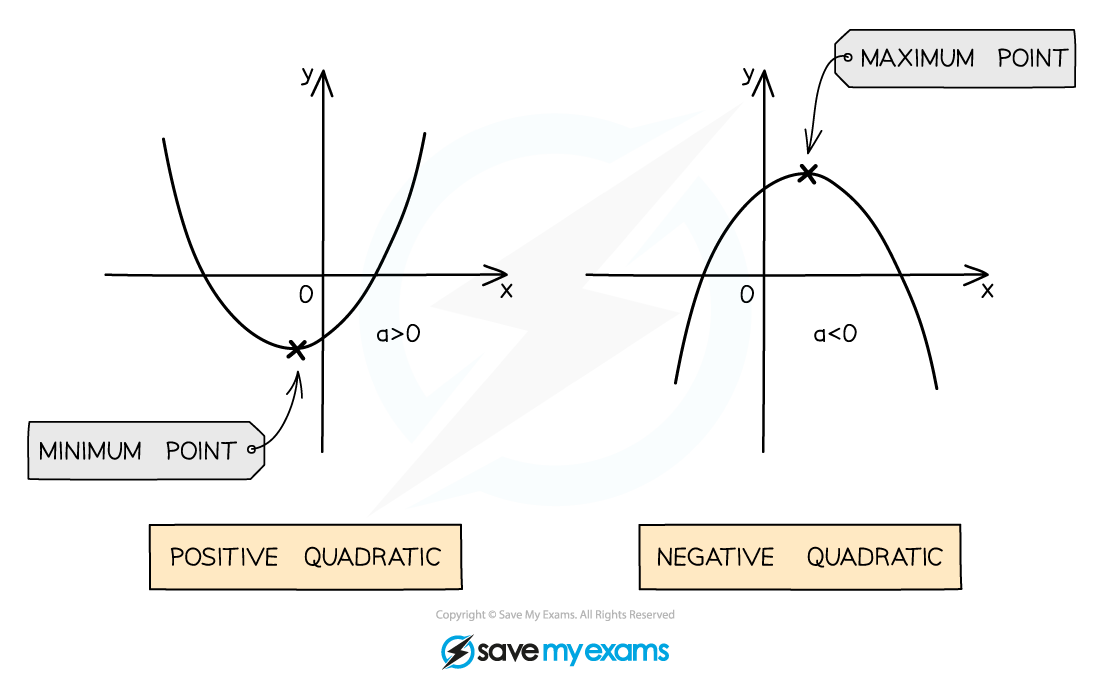
A quadratic graph has either a u-shape or an n-shape
- This type of shape is called a parabola
-
u-shapes are called positive quadratics
-
because the number in front of x2 is positive
- For example, y = 2x2 + 3x + 4
-
-
n-shapes are called negative quadratics
-
because the number in front of x2 is negative
- For example, y = -3x2 + 2x + 4
-
-
You can plot quadratic graphs using a table of values
What are the key features of a quadratic graph?
-
The point where the graph turns is called the vertex
-
Positive quadratics have a minimum point
- The bottom of the u-shape
-
Negative quadratics have a maximum point
- The top of the n-shape
-
-
Quadratic graphs always have a vertical line of symmetry down the middle
-
The equation of the vertical line of symmetry is x = k
- k is the x-coordinate of the minimum or maximum point
-
-
Quadratic graphs do not have to cross the x-axis
-
If they do, two x-intercepts are created, called roots
- If the curve just touches the x-axis, only 1 root is created
-
Roots are symmetric about the vertical line of symmetry
-
-
Quadratic graphs always have one y-intercept
What does a reciprocal graph look like?
-
The equation of a reciprocal graph is
-
You cannot substitute in x = 0 (division by zero is not allowed)
-
You should not include x = 0 in a table of values
-
-
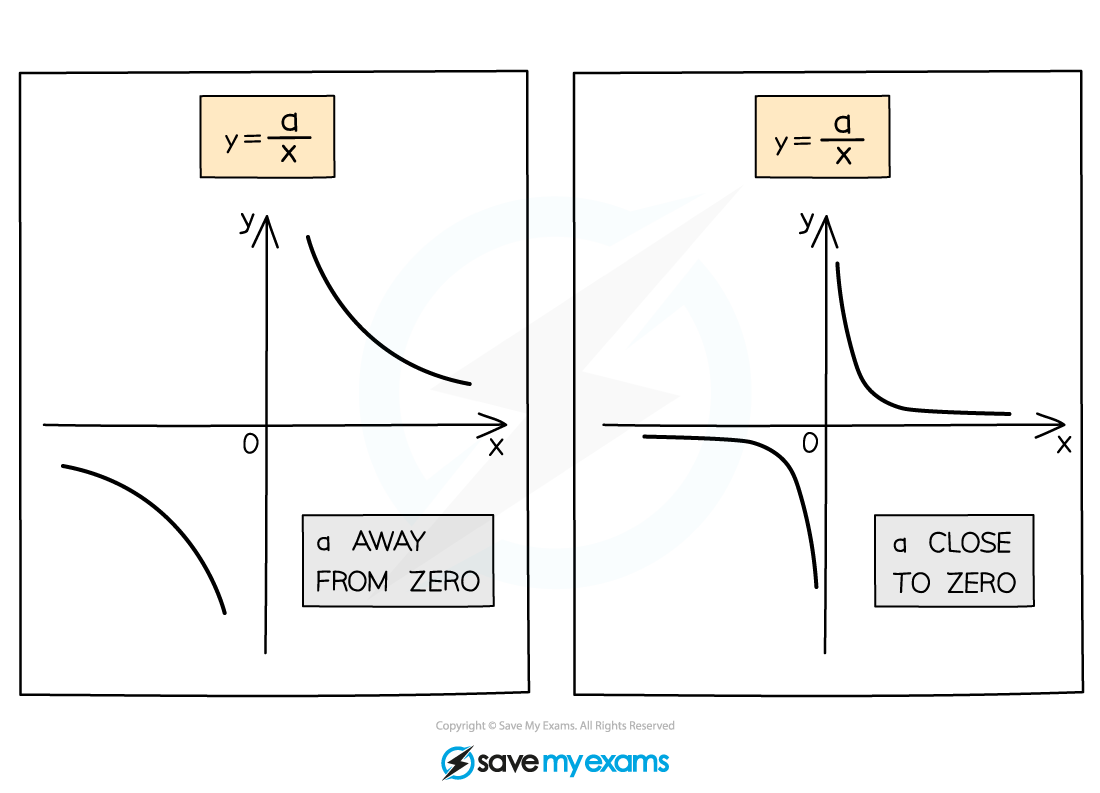
The shape of is shown below (for a positive value of a)
-
It has two two curved branches
- The branches are L-shaped
- The L is more rectangular when a is smaller
-
The branches never connect!
-
-
A negative value of a reflects the shape in the y-axis
Worked Example In each of the cases below, state the letter of the graph that corresponds to the equation given.
(a)
Answer:
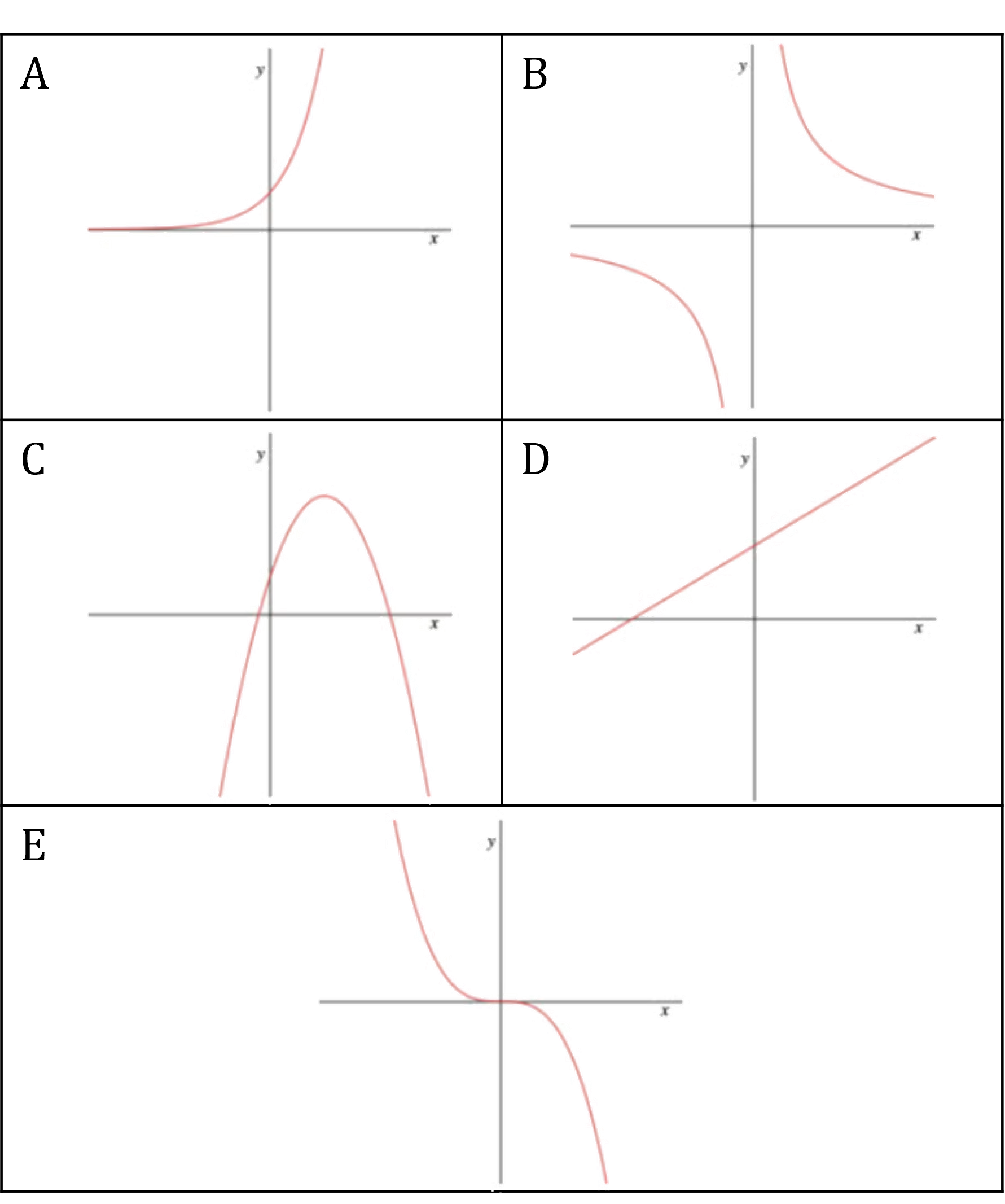
- This is a straight-line graph, y = mx + c*
Final answer: Graph D
(b)
Answer:
This is a quadratic graph, y = ax2 + bx +* c *(a = -1, b = 3, c = 2)
The number in front of* x*2 is negative so it has an n-shape
Final answer: Graph C
(c)
Answer:
This is a reciprocal graph, It has two L-shaped branches
Final answer: Graph B
Was this revision note helpful?
Build on this topic