Prime Factor Decomposition (Cambridge International IGCSE Mathematics)
Prime factor decomposition
What are prime factors?
-
A factor of a given number is a value that divides the given number exactly, with no remainder
- e.g. 6 is a factor of 18
-
A prime number is a number which has exactly two factors; itself and 1
-
e.g. 5 is a prime number, as its only factors are 5 and 1
-
You should remember the first few prime numbers:
- 2, 3, 5, 7, 11, 13, 17, 19, …
-
-
The prime factors of a number are therefore all the primes which multiply to give that number
-
e.g. The prime factors of 30 are 2, 3, and 5
- 2 × 3 × 5 = 30
-
How do I find prime factors?
-
Use a factor tree to find prime factors
-
Split the number up into a pair of factors
-
Then split each of those factors up into another pair
-
Continue splitting up factors along each "branch" until you get to a prime number
- These can not be split into anything other than 1 and themselves
- It helps to circle the prime numbers at the end of the branches
-
-
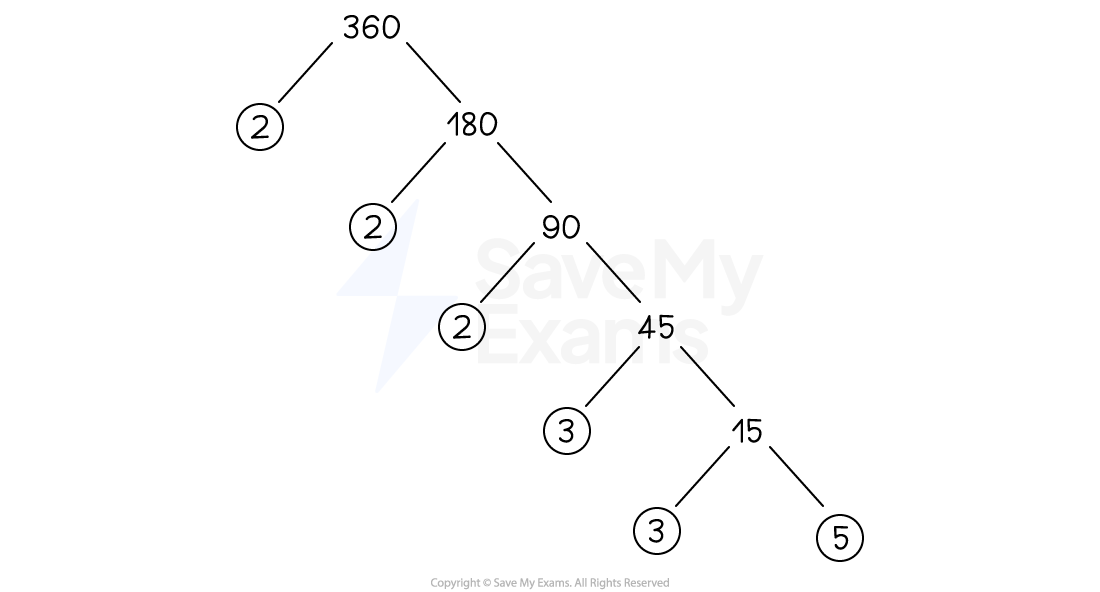
One way to split each number up is by dividing it by the smallest possible prime number
- This gives a prime factor at each stage
-
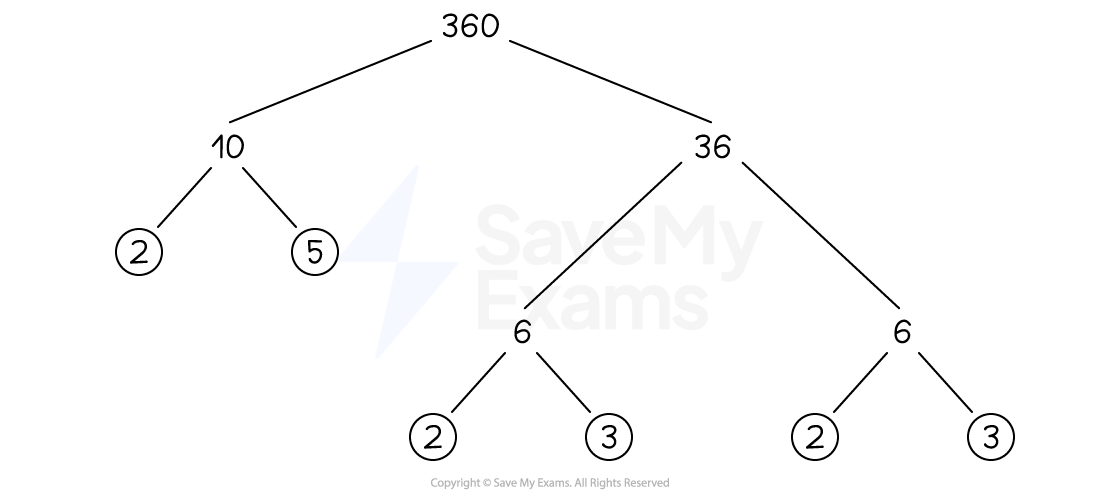
Another way to split each number up by dividing by easy numbers such as 10
- These do not need to be prime numbers
- You will need to split any non-prime numbers into pairs of factors
- These trees can get messy
-
The number will always end up with the same numbers circled no matter which pairs of numbers you choose
-
A number can be uniquely written as a product of prime factors
-
Write the prime factors as a multiplication, in ascending order
- 360 = 2 × 2 × 2 × 3 × 3 × 5
-
This can then be written more concisely using powers
- 360 = 23 × 32 × 5
-
Exam Hint Exam questions on this topic will ask you to express a number as a product of its prime factors. You should simplify your final answer by using indices. You need to show your working clearly to gain full marks.
Worked Example Express 432 as a product of powers of its prime factors. Show your working clearly.
Answer:
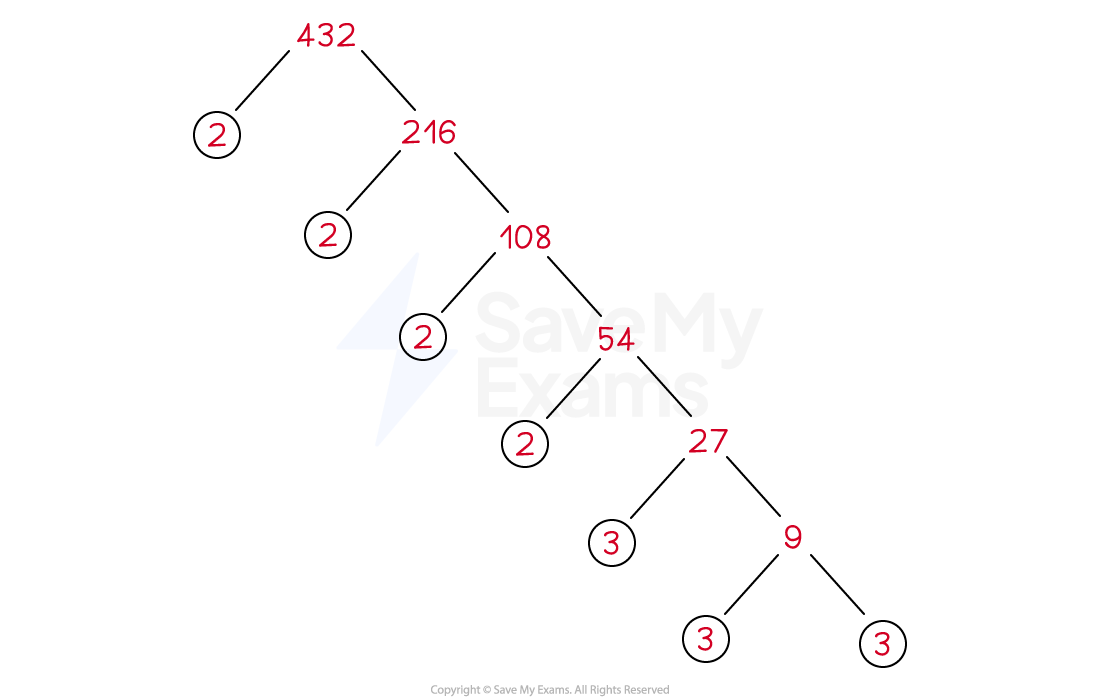
Create a factor tree Start with 432 and choose any two numbers that multiply together to make 432
2 and 216 is an obvious pair
Continue to split non-prime numbers into pairs of factors
The answer will be the same regardless of the factors chosen in the first step
Write the prime numbers out as a product
Any repeated prime factors can be written as a power
Final answer:
Was this revision note helpful?
Build on this topic