Angle in a Semicircle (Cambridge International IGCSE Mathematics)
Angle in a Semicircle
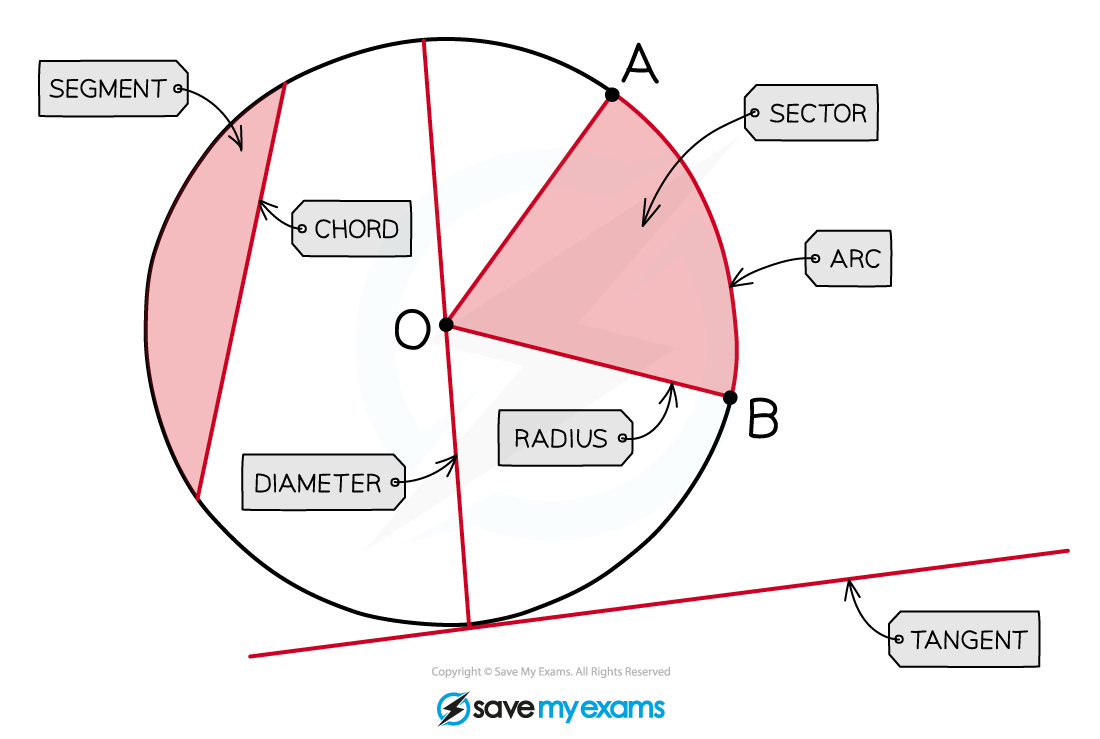
What are circle theorems?
-
Circle Theorems deal with angles that occur when lines are drawn within (and connected to) a circle
-
You may need to use other facts and rules such as:
- basic properties of lines and angles
- properties of triangles and quadrilaterals
- angles in parallel lines or polygons
Circle Theorem: The angle in a semicircle is 90°
-
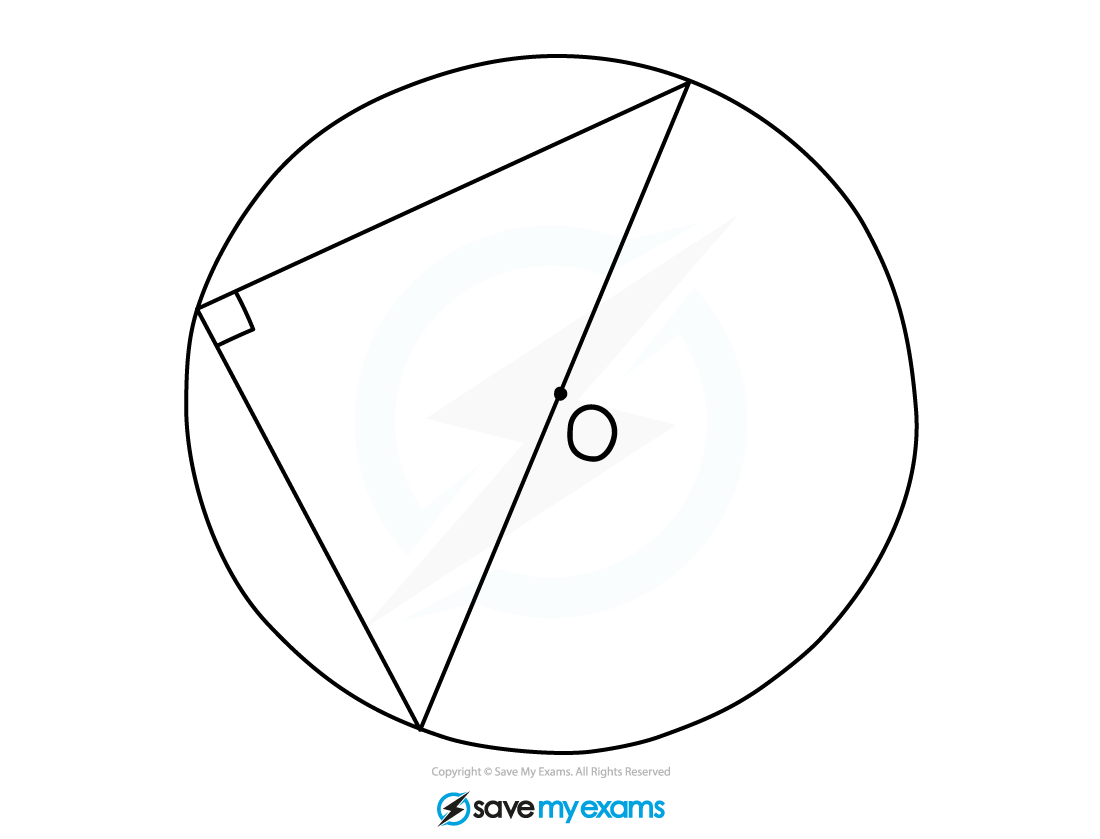
The lines drawn from a point on the circumference to either end of a diameter are perpendicular
-
The angle at that point on the circumference is 90°
-
This circle theorem only uses half of the circle
- The right-angle is called the angle in a semicircle
-
-
To spot this circle theorem on a diagram look for a triangle where
-
one side is the diameter
- Remember that a diameter always goes through the centre
-
all three vertices are on the circumference
-
-
The 90º angle will always be the angle opposite the diameter
-
When explaining this theorem in an exam you must use the keywords:
- The angle in a semicircle is 90°
-
Questions that use this theorem may
- appear in whole circles or in semicircles
- require the use of Pythagoras' Theorem to find a missing length
Exam Hint
As soon as you spot this arrangement in a question, mark the angle as 90° degrees on the diagram
- Sometimes just doing this will earn you a mark!
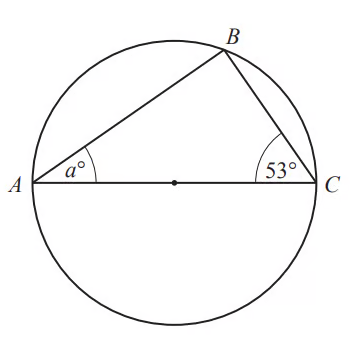
Worked Example A, B, and C are points on a circle. AC is a diameter of the circle. Find the value of a.
Answer:
As the line AC is the diameter of the circle, use the circle theorem "the angle in a semicircle is 90°" to state that angle B must be 90°
We can now use the fact that the internal angles of a triangle sum to 180°, to find the unknown angle
a + 53 + 90 = 180*
a + 143 = 180*
Final answer: a = 37
Was this revision note helpful?
Build on this topic