Impacts of Climate Change (Cambridge International IGCSE Geography)
Specification link
This page covers section 5.2.1, 5.3.1 and 5.3.2 of the CIE IGCSE specification .
- 5.2.1- The present day and predicted future impacts of climate change. For example, rising sea levels, and changes to global temperature, weather patterns, and food production.
- 5.3.1 - The strategies (including national and international agreements) and techniques used to manage the impacts of climate change.
- 5.3.2 - An evaluation of mitigation (including international agreements) and adaptation strategies and techniques used to manage the impacts of climate change.
Impacts of climate change
Health
-
Increased temperatures and lack of precipitation may lead to the spread of diseases:
- Italy has experienced cases of malaria since 2017, when it was previously a malaria-free area
- An additional 280 million people may be affected by malaria
- Waterborne diseases are more likely to spread
-
Heat waves may become more frequent
-
Heat stroke, dehydration and sunburn increase during heat waves
-
Stagnant air during heat waves increases air pollution levels:
- Respiratory diseases increase and those suffering from respiratory illnesses such as asthma may be more affected
-
Increased temperatures negatively affect people with cardiopulmonary diseases
-
Diets may be restricted by food shortages leading to malnutrition and famine
Homes and settlements
-
Increased flooding due to sea level rise and increased frequency and severity of storms will lead to the displacement of large numbers of people
-
Settlements in low-lying areas may have to be abandoned or need additional defences against sea level rise
- Moving settlements or improving flood defences will be costly
Agriculture
- Farmers may need to change the crop they grow if climate conditions become unsuitable
- Coastal flooding may lead to salt intrusion
- Reduced availability of water will mean that irrigation is limited or impossible
- Food shortages will lead to malnutrition and famine
- Food prices may rise
Employment
-
Job opportunities may change or decrease for the following reasons:
- Tourism may decline in some areas; for example, ski resorts may close due to the lack of reliable snow
- Coastal resorts may be at risk of flooding leading to the closure
- Farmers may have to change the crop they grow or livestock they raise or leave farming
- In some areas, agriculture may decline due to rising temperatures or changing rainfall patterns
Sea level rise
-
Warmer temperatures cause the water in seas and oceans to expand, increasing the sea level
-
Melting ice is adding to the increasing volume of water:
- Average sea levels have risen 23 cm since 1880
- Sea levels are forecast to increase a further 30 cm by 2050
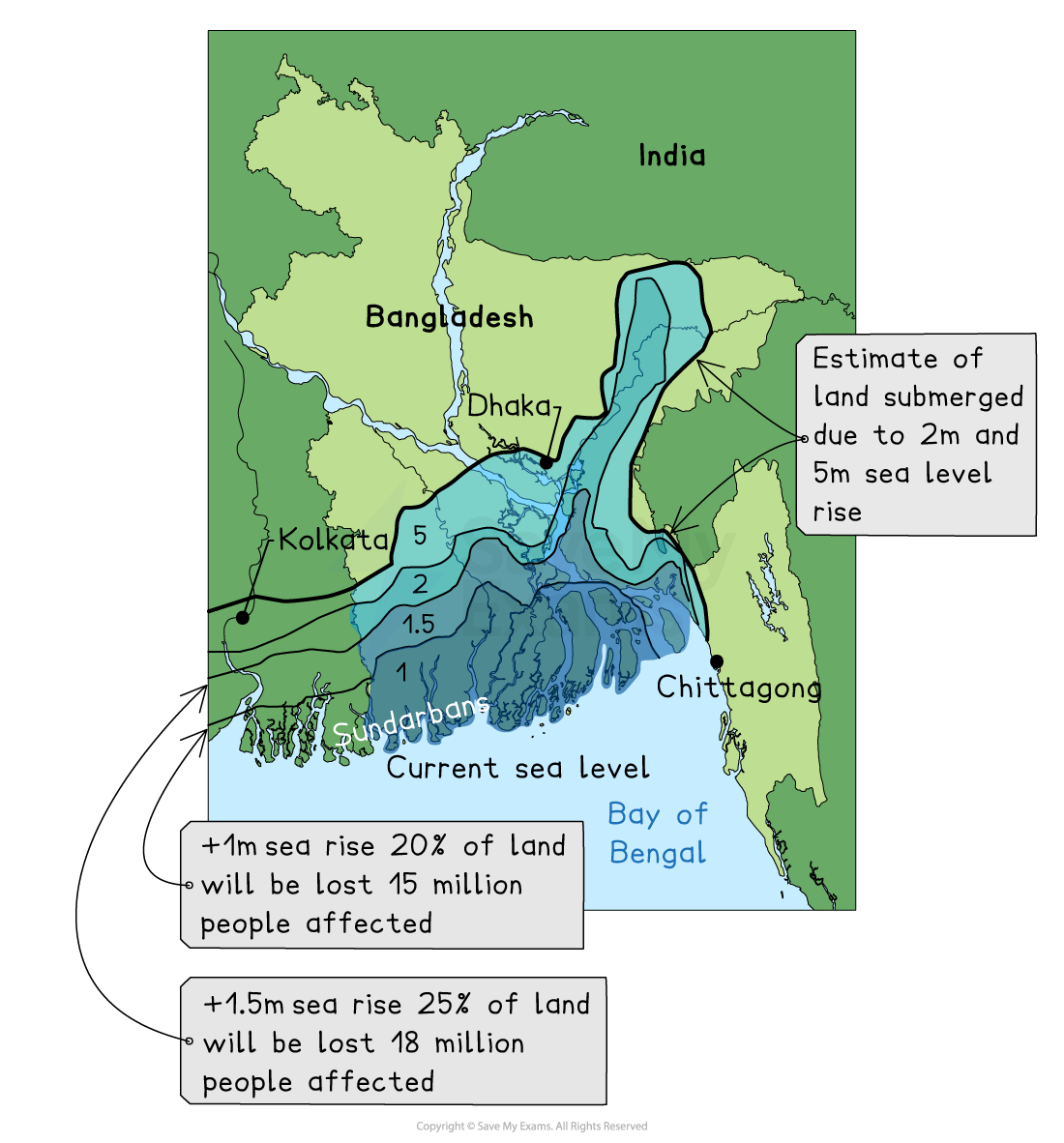
Bangladesh sea level rise predictions
-
Low-lying coastal areas such as southern Bangladesh and islands are at higher risk of flooding:
- The Maldives may be uninhabitable by 2050
-
Beach erosion will increase, leading to greater coastal erosion
-
Coastal ecosystems, including coral reefs and mangrove swamps, will be affected
-
Saltwater is contaminating freshwater supplies and affecting coastal agriculture
Ecosystem change
-
The location of biomes may shift to the north (Northern Hemisphere) and south (Southern Hemisphere) as they rely on specific climate conditions:
- Polar and tundra biomes are at risk of becoming extinct as they cannot shift any further north/south
-
Increasing sea temperatures and ocean acidification have resulted in coral bleaching
-
Migration and behavioural patterns of animals affected by changing temperatures:
- Fish species are moving north and south of their usual habitats to seek cooler water
- Reduced hibernation due to warmer winters
-
Melting of ice caps/glaciers leading to changing ocean currents
-
Mangrove swamps and coral reefs are threatened by rising sea levels
-
Loss of habitats through flooding, drought and wildfires
-
Food webs breaking as species numbers are reduced and food sources are decreased
-
Loss of plants and vegetation
Natural hazards
-
Changes in climate patterns are likely to increase the frequency and severity of storms:
- The 2020 Atlantic hurricane season was the first most active on record and 2021 was the third most active
-
The frequency and length of droughts are increasing
-
Dry conditions lead to the increased risk of wildfires:
- In 2021, Australia, Greece, South Africa, Brazil and the USA were just some of the places to experience severe wildfires
- In September 2021, the USA National Fire Centre reported 44,647 wildfires that had burnt 5.6 million acres
-
Rising sea levels together with increased storms lead to increased flooding risk
Worked Example State one reason for each of the following impacts of climate change.
- rising sea levels
- prices of food may rise
- shortage of water
[3]
The command word for this question is 'state' this means that no explanation is needed in the answer.
Answer
- Rising sea levels - due to melting of the ice caps/increased sea temperatures [1]
- Prices of food may rise - drought/lower crop yields [1]
- Shortage of fresh water - drought/more evaporation of rivers/lakes [1]
Responses to climate change
Spec point — The present day and predicted future impacts of climate change. For example, rising sea levels, and changes to global temperature, weather patterns, and food production.
-
Global warming and climate change require an international response because they affect the entire globe
-
Responses can involve either adaptation or mitigation
- Mitigation includes ways that people try to reduce or eliminate greenhouse emissions
- The aim is to halt global warming and therefore climate change
- Mitigations can include international agreements as well as national and individual actions
International agreements
- In 1988 the Intergovernmental Panel on Climate Change (IPCC) was set up to assess the 'risks of human-induced climate change'
- This was followed by several international agreements
Earth Summit, Rio 1992
-
In May 1992 the United Nations Framework Convention on Climate Change (UNFCCC) was established
-
It was then signed by 166 countries at the Earth Summit in Rio or at the UN headquarters
-
The Earth Summit also set out:
- Twenty seven principles aimed at guiding countries towards more environmentally sustainable development
- Aims to stabilise greenhouse gas levels
- Principles for the management, conservation and sustainable development of all forests
Kyoto Protocol 1997
- Delegates from 150 countries agreed to reduce greenhouse gas emissions
- It stated that industrialised countries would reduce emissions to below the levels in 1990
- Developing countries, including China and India, were exempt from the agreement
- The USA did not sign up for the treaty
- Canada withdrew in 2011, stating that without China and the USA, the treaty would not work
- The Kyoto Protocol was the first legally binding international treaty to set emissions targets
Marrakech Agreement, 2007
- It was agreed that funding would be provided to less developed countries to support them in adapting to the effects of climate change
Paris Agreement 2015
-
Global agreement to limit global warming to 2°C (preferably 1.5°C) above pre-industrial levels
-
The agreement also includes **reducing CO₂ emissions by at least 60% **by 2050
-
Signed by 196 countries, including the USA and China (the USA withdrew in 2020 and rejoined in 2021)
-
Introduced** Nationally Determined Contributions (NDCs)**
- These are climate action plans submitted by each country outlining their commitments
- Currently these are not sufficient to meet the 2oC target (projections show 2.6-2.7oC warming by 2100)
Conference of the Parties (COP)
-
The United Nations (UN) holds an annual (every year) meeting to discuss climate change.
-
COP29 was held in Baku, Azerbaijan
-
All nations agreed to:
- Continue to take action to further reduce greenhouse gas emissions
- Triple financial aid to developing countries
Reducing emissions
-
Emissions can be reduced in several ways, including:
- Reducing deforestation
- Increasing afforestation
- Improving energy efficiency in industry and domestic appliances
- Reducing emissions from industry
- Improving public transport
- Electric vehicles
- Use of renewable energy and nuclear power
- Carbon capture and storage
- Reducing meat consumption
- Alternative feed for cattle to reduce methane emissions
Exam Hint Remember, reducing emissions of greenhouse gases is achieved by either:
- reducing the sources of emissions, for example by reducing the use of fossil fuels
OR
- Increasing the stores of greenhouse gases, for example, by planting more trees
Adaptations
-
Climate change is already impacting many countries
-
Mitigation strategies will take time to have an impact
-
Adaptations are needed to help populations cope with the impacts which are already being felt
-
Examples of adaptations include:
- Improved building design to withstand flooding and increased storm intensity
- More efficient use of freshwater resources and desalination
- Coastal and river defences to reduce the impact of flooding
- Changing the types of crop grown
- Relocation of vulnerable communities
- Extreme weather plans
Effectiveness of mitigation and adaptation strategies
Spec point — An evaluation of mitigation (including international agreements) and adaptation strategies and techniques used to manage the impacts of climate change.
-
Climate change is a global issue
-
It requires international cooperation and collaboration
-
The effectiveness of both strategies depends on various factors, including:
- Political willingness to implement the strategies
- Availability of finance and economic resources
- Technological advancements
Mitigation strategies
- Mitigation strategies are important in the long term to reduce the rate or even halt global warming
- Their effects can be gradual and may take time to have an impact
Challenges of mitigation strategies
-
Implementing mitigation strategies changes can be expensive
-
They rely on international cooperation and may be politically challenging to implement
- Even if countries sign up to agreements, they may not be able to achieve the changes outlined
-
There may be resistance from industries reliant on fossil fuels
-
Not all mitigation strategies are equally effective
Adaptation strategies
- Adaptation strategies can help reduce the short-term negative impacts of climate change
Challenges of adaptation strategies
- Adaptation measures can be expensive and require significant infrastructure changes
- Some adaptation strategies may not be effective when there are extreme climate events
- Adaptation efforts may be more effective if combined with mitigation efforts
Was this revision note helpful?
Build on this topic