Managing Threats to the Antarctic (Cambridge International IGCSE Geography)
Specification link
This page covers section 3.2.3 of the CIE IGCSE specification.
- 3.2.3- An evaluation of the strategies and techniques used to manage the Antarctic ecosystem, including sustainability. For example, international agreements and environmental impact surveys.
- For the Antarctic ecosystem, a detailed specific example is not listed; this is because the topic content is only based upon Antarctica.
Managing threats to the Antarctic
Spec point — An evaluation of the strategies and techniques used to manage the Antarctic ecosystem; including sustainable. For example, international agreements and environmental impact surveys
- Fishing and whaling in the Southern Oceans have been continuous since the 1700s
- As pressure on Antarctica grew, it was decided that strategies and techniques needed to be put in place to manage the area sustainably
- One of the most significant challenges is the sheer size of the area that needs to be managed and protected
- This makes it difficult to monitor any strategy or technique to guarantee that international agreements are being kept
Antarctic Treaty System (ATS)
-
One strategy was the Antarctic Treaty
-
The ATS is a set of international agreements that protect Antarctica for peace and science
-
Signed in 1959 by 12 countries, it now has over 50 signatories
-
The treaty:
- Bans military activity, nuclear testing, and mineral extraction
- Promotes scientific research and international cooperation
-
The treaty designates Antarctica as a global commons—no one owns it
- However, several nations have made territorial claims to particular parts of the continent – Australia, Chile, Argentina, Norway, France, New Zealand and the UK
- Some of the claims overlap but none of them are universally recognised by the international community
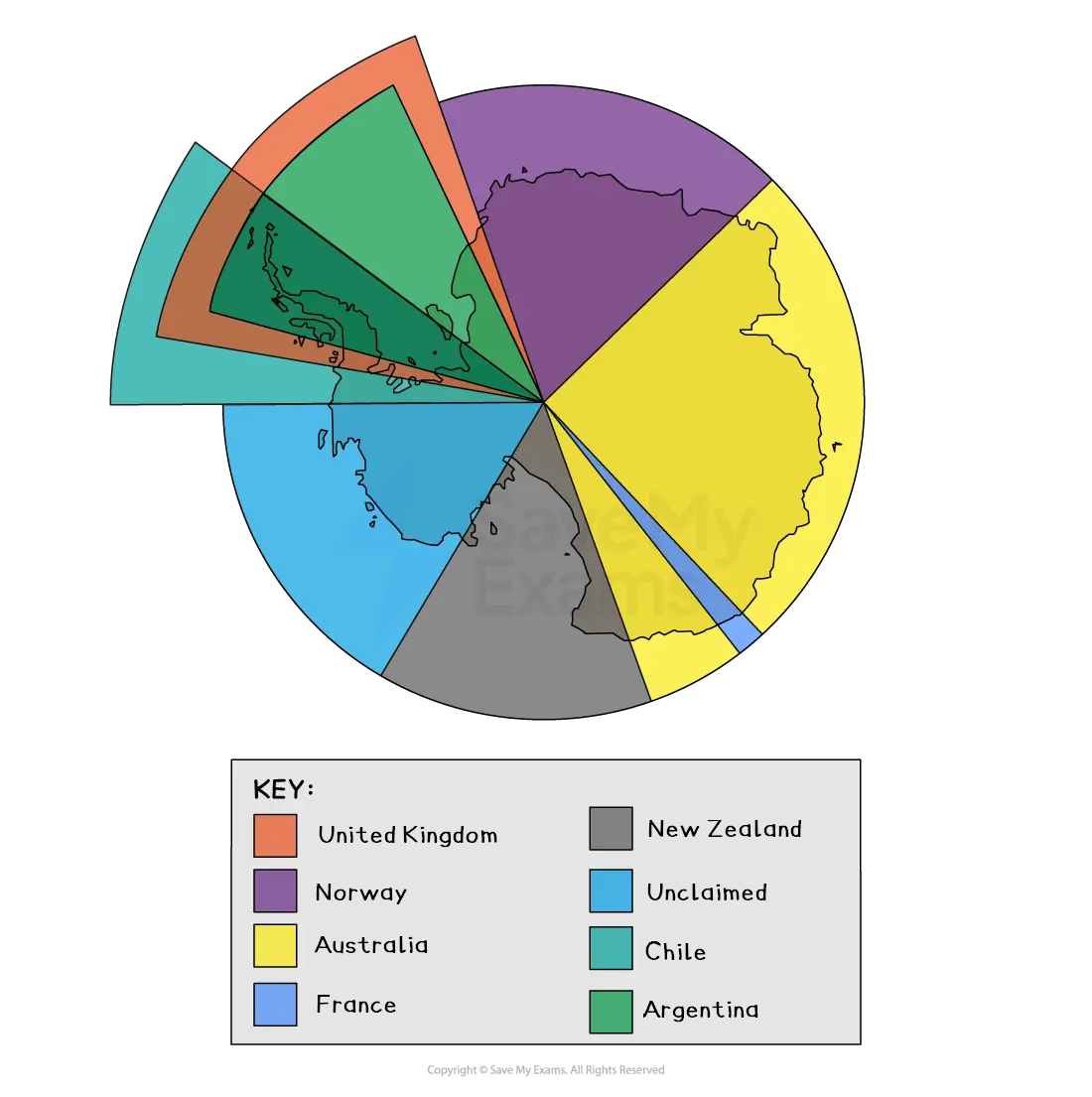
Map of territorial claims in Antarctica
Evaluation of the ATS
- The treaty is highly successful at preventing conflict and resource exploitation but has limited enforcement powers
Madrid Protocol (1991)
-
Full name: Protocol on Environmental Protection to the Antarctic Treaty
-
Its purpose is to protect Antarctica’s environment and regulate human activities (like science and tourism)
-
Key features:
- Bans mining and resource extraction
- Requires Environmental Impact Assessments (EIAs)
- Promotes waste reduction, biodiversity protection, and conservation of ecosystems
- Declares Antarctica a 'natural reserve, devoted to peace and science'
Environmental Impact Assessments (EIAs)
-
These are mandatory under the Madrid Protocol for any activity in the Antarctic ecosystem
-
An Environmental Impact Assessment (EIA) is a process for evaluating the potential environmental, social and economic impacts and sustainability of a proposed development project
-
The purpose of an EIA is to:
- Identify and evaluate the potential impacts of the project on the environment
- Develop strategies to mitigate or avoid those impacts
Evaluation of the Madrid Protocol
- The protocol sets out strict environmental rules, but will be reviewed in 2048, which may bring political challenges in the future
Exam Hint Do not confuse the Madrid Protocol with the Montreal Protocol.
The Madrid Protocol refers to the environmental protection of Antarctica and is part of the Antarctic Treaty.
The Montreal Protocol refers to substances that deplete the ozone layer and applies globally, not just in Antarctica.
Remember:
For managing human activity in Antarctica → Madrid Protocol
For reducing ozone damage globally → Montreal Protocol
CCAMLR – sustainable fishing
- CCAMLR is the Commission for the Conservation of Antarctic Marine Living Resources
- Its purpose is to manage fishing quotas to prevent overfishing, especially of krill and toothfish
- Uses scientific data to decide sustainable levels
- Protects marine food webs by limiting damage to non-target species
- Evaluation: Good science-based management, but illegal fishing is still a serious problem due to remote monitoring difficulties
Marine Protected Areas (MPAs)
- These are ocean zones where human activity is restricted to protect ecosystems
- Some areas around Antarctica are closed to fishing or have strict rules Protect breeding grounds of species like penguins, seals, and whales
- Evaluation: Good for biodiversity, but only a small percentage of the Southern Ocean is protected—more MPAs are needed
Ban on mineral and resource extraction
- It aims to stop mining, drilling or the extraction of minerals and oil
- Prevents large-scale environmental damage and pollution
- Supports the idea of sustainable use and preservation for future generations
- Evaluation: Effective now, but some countries (e.g. Russia, China) show interest in future exploitation if the rules change
Scientific research regulations
- These are guidelines and permits for scientists working in Antarctica
- All research must include environmental planning and waste management strategies
- Scientific stations are encouraged to use renewable energy (e.g. solar panels) and recycle waste
- Evaluation: Research is well-managed, but infrastructure development still creates localised environmental impacts
IAATO – tourism guidelines
-
IAATO is the International Association of Antarctica Tour Operators
-
It sets voluntary rules for tourist behaviour (e.g. keeping distance from wildlife, not leaving waste)
- Such as limiting ship sizes, landing sites, and group numbers
-
It aims to reduce the risk of environmental damage and invasive species. Evaluation: Largely successful due to cooperation, but not legally binding—compliance depends on the operator
Was this revision note helpful?