Coastal Processes (Cambridge International IGCSE Geography)
Specification link
This page covers sections 2.1.1 and 2.1.2 of the CIE IGCSE Geography specification.
- 2.1.1- Coastal erosion: hydraulic action, corrosion, corrasion, attrition, transportation, deposition, and longshore drift.
- 2.1.2- Types of waves: constructive and destructive and wave refraction.
Coastal processes
Spec point — Coastal erosion: hydraulic action, corrosion, corrasion, attrition; transportation; deposition; longshore drift.
-
The coast is the area where land and sea meet
-
Coastal processes are divided into two parts:
- Marine processes: offshore (water-based)
- Terrestrial processes: onshore (land-based)
-
These processes are further divided into:
- Erosion
- Transportation
- Deposition by wave action
-
Together with the local geology, these processes produce distinctive landforms around the coastline
- A coastline made up of softer rocks such as sands and clays will be easily eroded by destructive waves to form low, flat landscapes such as bays and beaches
- Coastlines of more resistant, harder rock will take longer to erode and produce rugged landscapes such as headlands
Marine erosion
-
Destructive waves are responsible for the majority of erosion that happens along a coast
-
They cut into the coastline in four ways:
-
Hydraulic action is the sheer force of the waves hitting the coast
-
Attrition occurs when material carried in the waves bumps against each other and becomes smaller and smoother
- This does not erode the coast but forms the sand and shingle
-
Corrosion, also known as solution, occurs because seawater is slightly acidic and gradually dissolves material. Some types of coastal rock such as limestone and chalk, are particularly prone to corrosion
-
Abrasion, also known as corrasion, occurs when waves pick up material and hurl it at the cliffs
-
Exam Hint Please ensure you understand the distinction between the four types of erosion, especially between abrasion (corrosion) and attrition. Many students confuse these two terms.
A tip for you is to think of abrasion as rubbing with sandpaper; maybe you have grazed your knees or elbows when you fell off your bike or skateboard. Those grazes were abrasions on your knees/elbows, etc.
Marine transportation
-
The sea transports sediment that it gets from erosion in the same way rivers do
-
Material in the sea arrives from many sources:
- eroded from cliffs
- transported by longshore drift along the coastline
- brought inland from offshore by constructive waves
- carried to the coastline by a river
-
In the water, material is moved through:
- Traction when large, heavy material is dragged along the sea floor
- Saltation occurs when smaller material bounces along the sea floor
- Suspension is the fine material held in the seawater
- Solution is dissolved material carried in the seawater
Longshore drift (LSD)
- Longshore drift (LSD) is the main process of transportation along the coast
- Waves approach the beach at an angle due to the prevailing wind
- As the waves break, the swash carries material up the beach at the same angle
- As the swash dies away, the backwash carries the material down the beach at right angles (90°)
- The process repeats, transporting material along the beach in a zig-zag movement
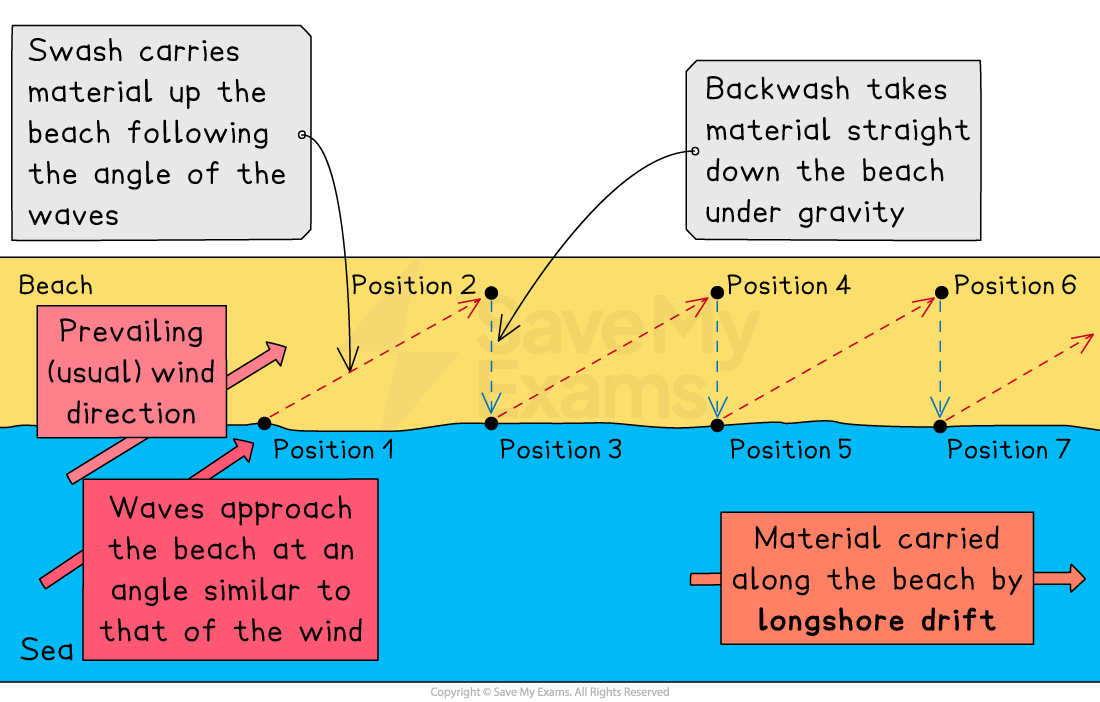
Illustration showing the process of longshore drift
-
Beach sediment is carried farther down the coast on coasts where longshore drift is one way; if it is blocked, sediment cannot move, and the area farther down the coast is deprived of sediment. This results in two problems:
- Smaller beaches are less attractive to tourists, causing a loss of income
- Removes natural coastal protection
Worked Example Describe and explain the process of longshore drift
[4 Marks]
Solution
- Longshore drift is the process where the waves transport material, such as sand, along the beach in the direction of the prevailing wind [1 mark]. The swash moves material up the beach at an angle [1 mark] as the waves approach in a similar direction to the wind. The backwash moves material back down the beach perpendicular (90°) to the shoreline due to gravity [1 mark]. This movement continues along the beach in a zigzag motion in the direction of the prevailing wind [1 mark].
Marking guidance
- The answer above is just one example of a response to this question
- The commands are to describe and explain and answers should detail the steps and reasons for longshore drift
- The focus must be on the process of 'longshore drift' and what it does
Exam Hint
- You can gain full marks using well-annotated diagrams to support your answer. Just as you like having a visual prompt, it helps the examiner to see that you do know the answer. Occasionally a diagram is easier than actually writing it all out.
- Longshore drift does not produce landforms; it is the process of transportation that supplies the sediment for the process of deposition (which does form features).
Marine Deposition
-
The waves carry sand or shingle as they travel
- Swash carries sediment onto the shore
- Backwash carries sediment away
-
The largest material is deposited along the upper reach of the swash when a constructive wave carries sediment up the beach
-
The backwash loses water and energy as it travels because of the sand's porosity, resulting in smaller and smaller deposits.
-
When a constructive wave carries sediment up the beach, the largest material is deposited along the upper reach of the swash
-
During a storm, large shingle is thrown above the usual high tide level to form a ridge at the top of the beach called a berm
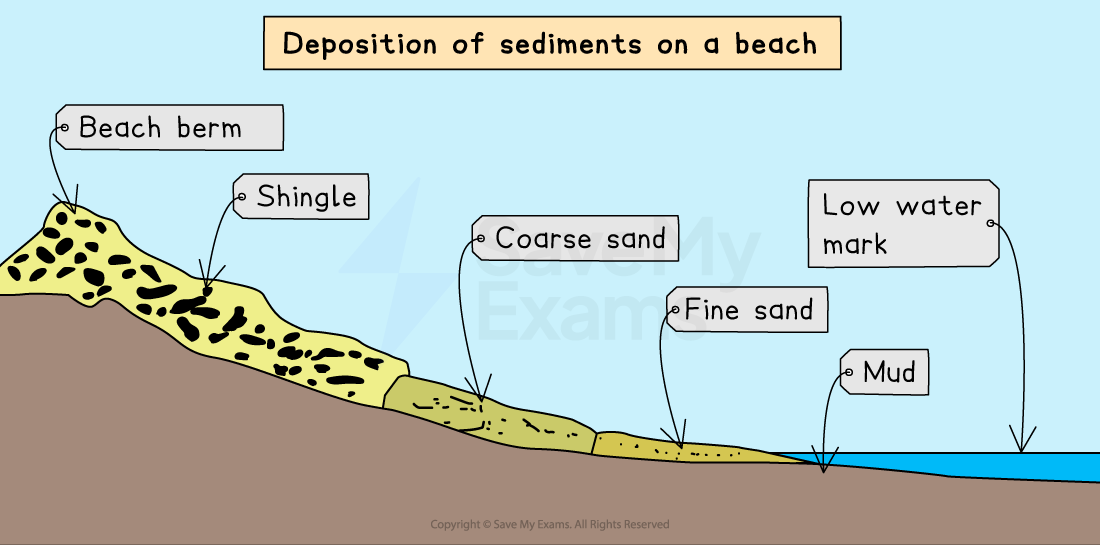
The action of the waves deposits sediment onto a beach
Wave types
Spec point — Types of waves: constructive and destructive and wave refraction.
-
Waves are marine processes
- They erode, transport and deposit material
-
Waves are formed by winds blowing over the surface of the sea
-
The height and strength of a wave are dependent on three factors:
- the fetch
- the amount of time the wind blows
- the strength of the wind
-
The greater the strength, time and fetch of the wind, the larger the wave
-
As a wave approaches the coast, it enters shallower water; friction from the seabed causes the wave to lean forward and eventually crest and break onto the beach
-
The movement of water up the beach is called the swash, and the return movement is the backwash
Types of waves
-
There are two types of waves:
- Destructive waves erode the beach
- Constructive waves are beach builders
Constructive waves
-
Constructive waves, also known as beach builders, have the following characteristics:
- a long wavelength with low height
- a low-frequency wave rate of 6-8 per minute
- a shallow wave gradient
- low energy
- a stronger swash that carries material up onto the beach and deposits a gently sloping, sandy beach
Destructive waves
-
Destructive waves erode the beach and have:
- a steep wave gradient
- a short wavelength with high height
- a high-frequency wave rate of 10-12 per minute
- high energy
- a strong, abrasive backwash that drags material out to sea and forms steep, shingle beaches
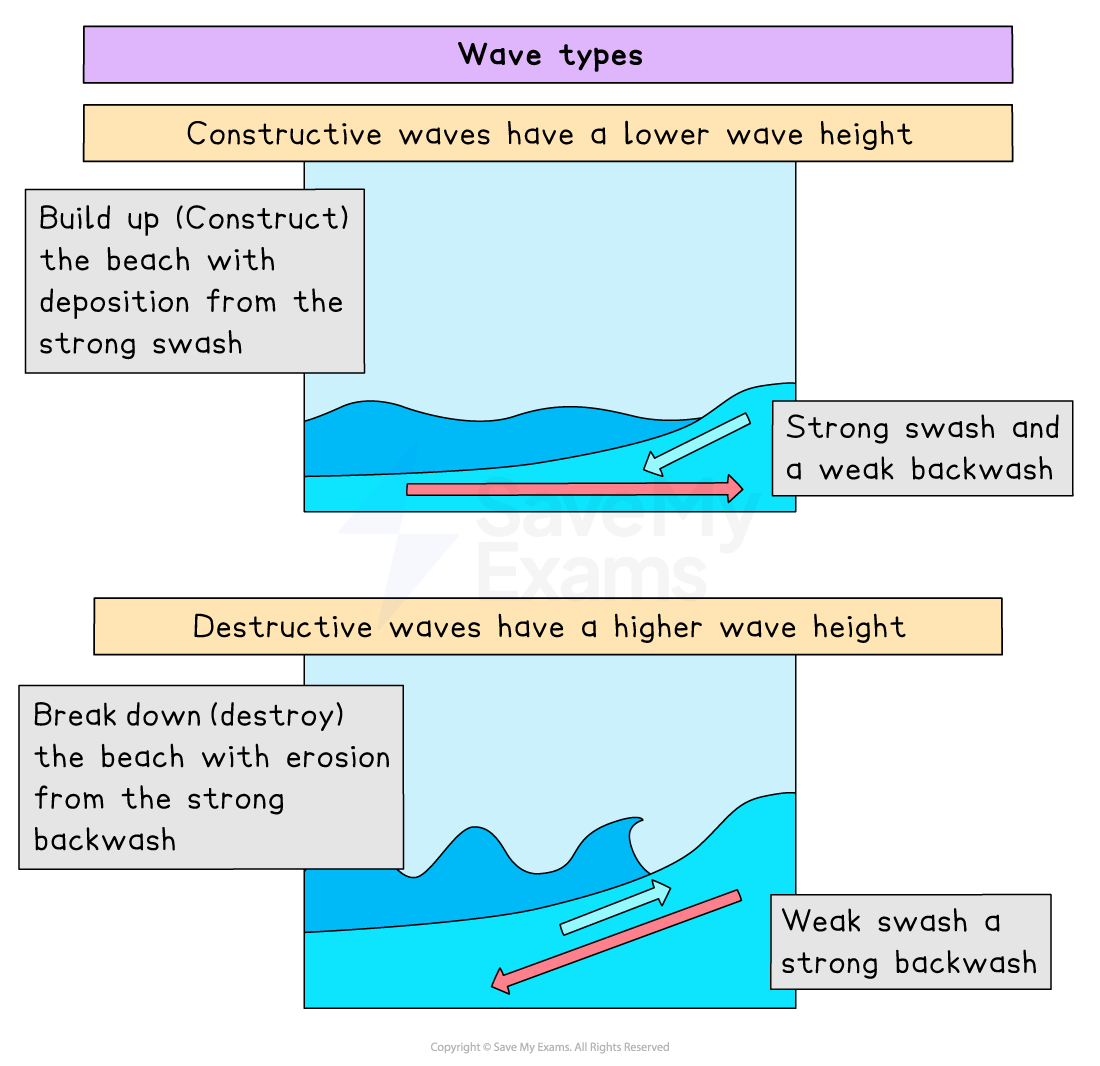
Diagram showing constructive and destructive waves
Wave refraction
- Coastlines have different-depths of water and reflect waves
- The depths vary because headlands and bays have formed over time
- As waves travel into shallower water near the beach, they slow down
- This makes the wave bend or refract to fit the shape of the shoreline
- When waves are refracted, the energy is focused on the headland
- This cause more erosion to the headland than bays, where sediment is deposited
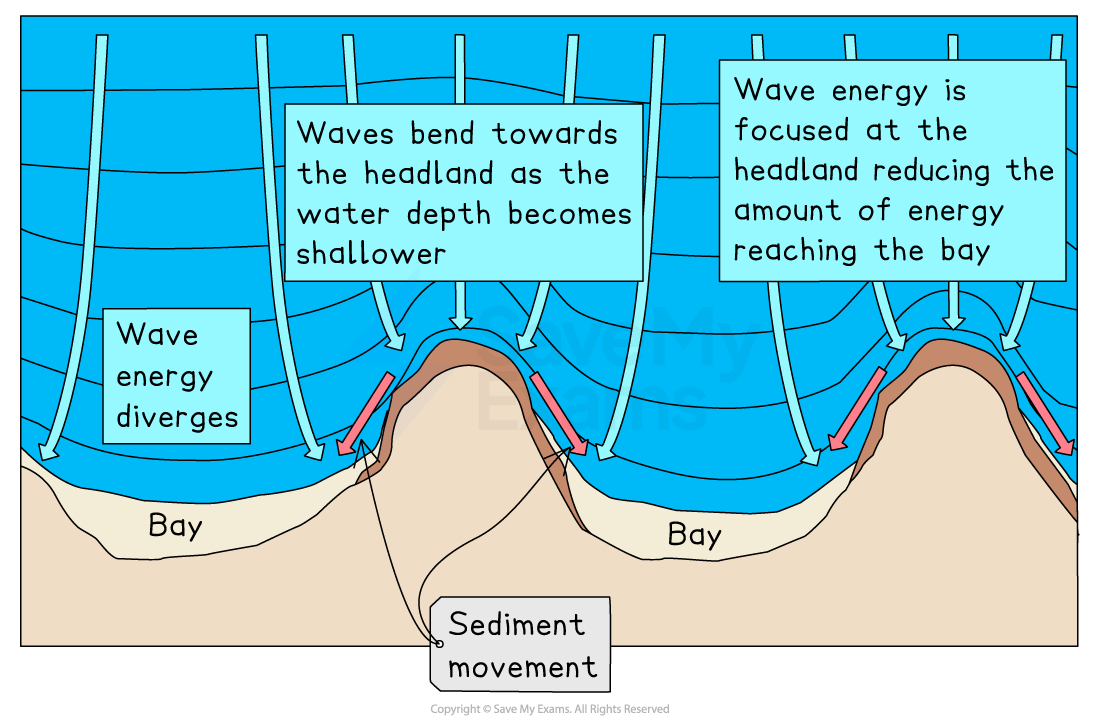
Wave refraction at a headland
Exam Hint Make sure you are familiar with how waves form and their different characteristics. You may have to identify the type of wave from a list of characteristics, such as wavelength, height, and the strength of swash and backwash.
Worked Example **Which statement below best describes the characteristics of a destructive wave? [1]
** A. **Long wavelength and weak backwash
** B. **Short wavelength and weak backwash
C. Short wavelength and strong backwash
** D. long wavelength and strong backwash
Final answer: Answer
The correct answer is C
- A destructive wave has a short wavelength, high-frequency rate, steep wave gradient and a strong backwash
The alternative answers are incorrect because:
- A is a constructive wave
- B and D are neither constructive nor destructive
Was this revision note helpful?
Build on this topic