What's the locus of if the length of this tangent equals ?
Question
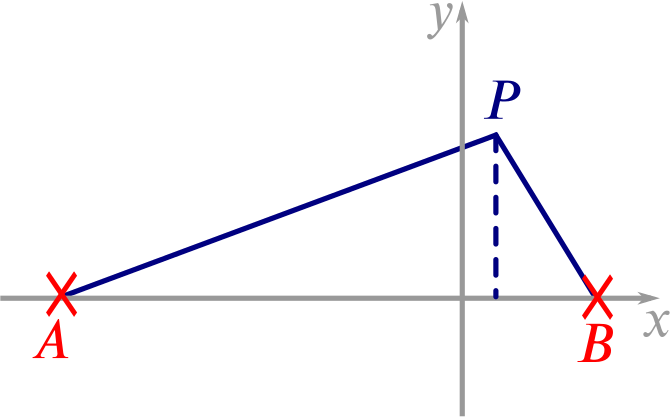
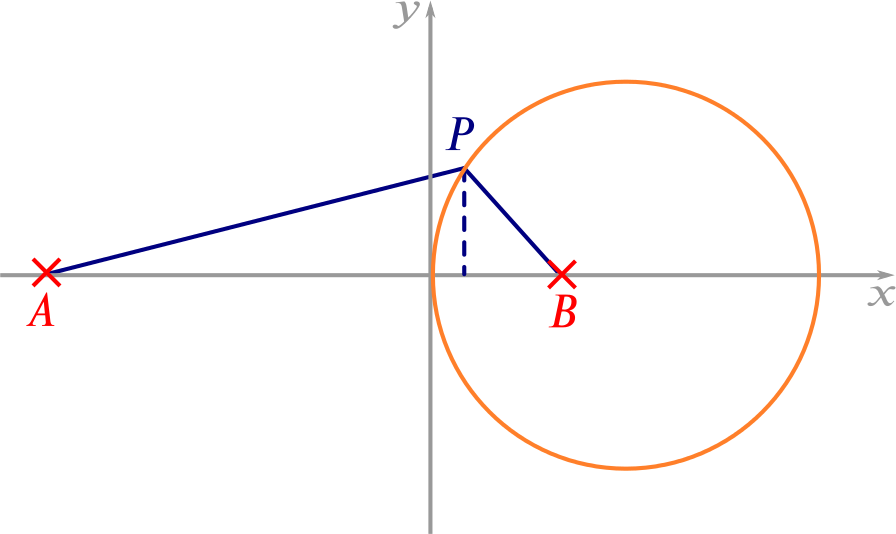
The fixed points and have coordinates and respectively. Find the equation of the locus of a point which moves in the coordinate plane so that . Show that the locus is a circle, , which touches the axis of and has its centre at the point .
A point moves in such a way that the perpendicular distance of from the axis of is equal to the length of a tangent from to the circle . Find the equation of the locus of .
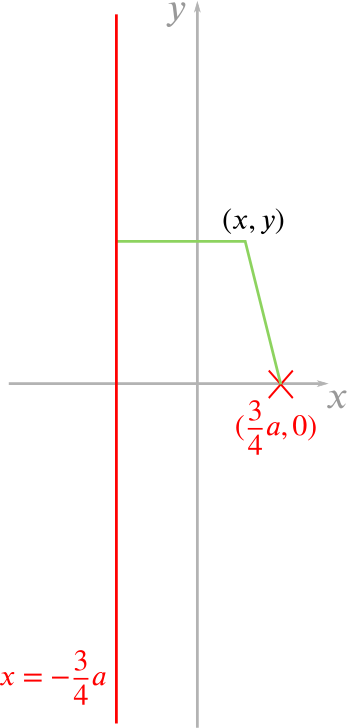
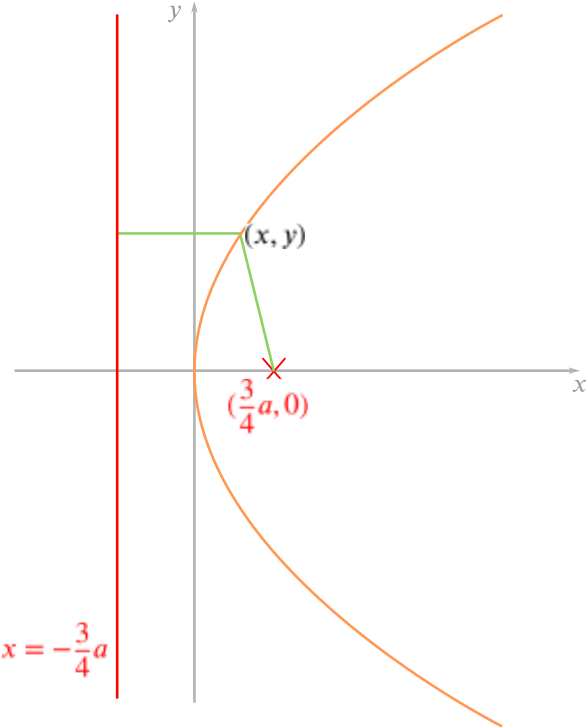
Show that this locus is also the locus of points which are equidistant from the line and the point .
Suggestion
If we call , can we write down expressions for the distances and ?
We could get bogged down in some very heavy algebra here if we pick the wrong method. Could we look at this problem geometrically?
Can we see a pentagon containing three right angles? What are the sides?
Solution
Let . Then and . We want to satisfy so the equation for the locus of is given by Squaring both sides, we find that which simplifies to and so the locus of is Writing this in the form of an equation of a circle which is a circle centred at of radius , which touches the axis (since putting gives a single value for ).
You might have noticed that there are two possible tangents we could have drawn from to the circle . How do we know that we would get the same answer if we used the other tangent?
We’ll consider the shape formed by the sides whose lengths we already know (in red above).
Let the length of the hypotenuse of the right-angled triangle with side-lengths and be , and so
We now add an additional vertical line.
Using Pythagoras’ Theorem and , we have that
and so the equation of the locus of is .
If we drew with a negative -coordinate on our original diagram, would we have the same answer?
What if the -coordinate was greater than ?
Do we need to consider either of these cases separately, or can they be deduced from the case we have already done?
We have that the distance of a point from the line is , and the distance from the same point to is .
Setting these equal to each other and squaring both sides, we have that Cancelling, we find that the locus of points equidistant from the line and the point is which is the same locus that we found previously.