Language of Functions (Cambridge International IGCSE Further Maths)
Introduction to Functions
What is a mapping?
- A mapping takes an 'input' from one set of values to an 'output' in another
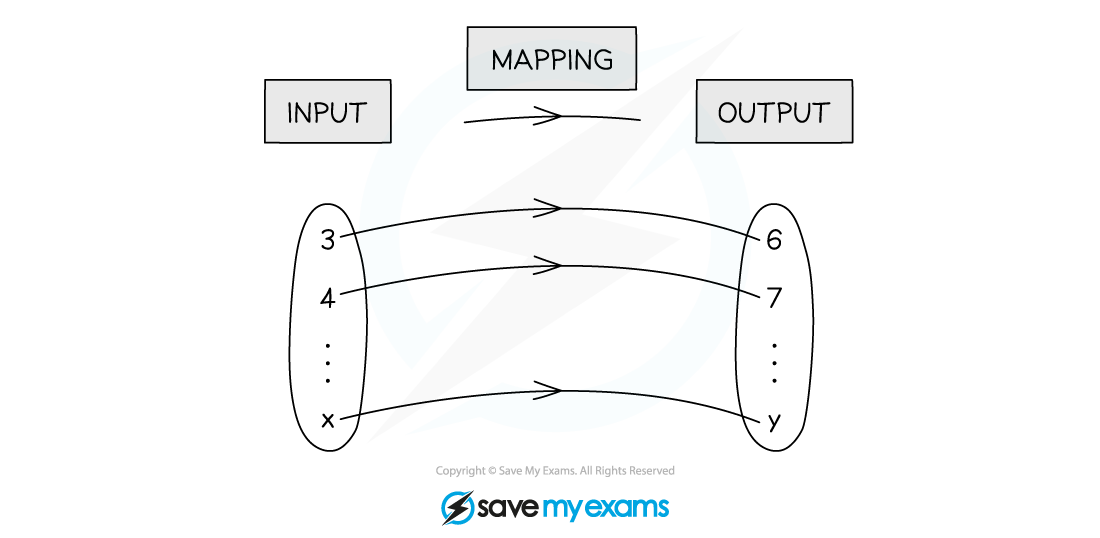
-
Mappings can be
-
'many-one' (many 'input' values map to one 'output' value)
-
'one-one' (one 'input' value maps to one 'output' value)
- You may also come across 'many-many' and 'one-many' functions
-
What is a function?
- A function is a mapping where every 'input' value maps to a single 'output'
- Therefore only many-one and one-one mappings are functions
What notation is used for functions?
-
Functions are denoted by , etc
- e.g.
- These would be pronounced as 'f of x', 'g of x', etc
-
There is an alternative notation
- e.g.
- Which may be pronounced 'the function f maps x to x-squared minus three x plus two'
How does a function work?
-
A function has an input and output
-
Whatever goes in the bracket (instead of ) with f, replaces the on the other side
- This is the input
-
If the input is known, the output can be calculated
-
For example, given the function
-
-
If the output is known, an equation can be formed and solved to find the input
-
For example, given the function
- If , the equation can be formed
- Solving this equation gives an input of 7
-
Worked Example A function is defined as .
a) Find .
The input is , so substitute 7 into the expression everywhere you see an .
Calculate.
b) Find .
The input is so substitute into the expression everywhere you see an .
* *
Expand the brackets and simplify.
* *
A second function is defined .
c) Find the value of for which .
Form an equation by setting the function equal to -16.
Solve the equation by first adding 4 to both sides, then dividing by 3.
Domain & Range
What is the domain of a function?
-
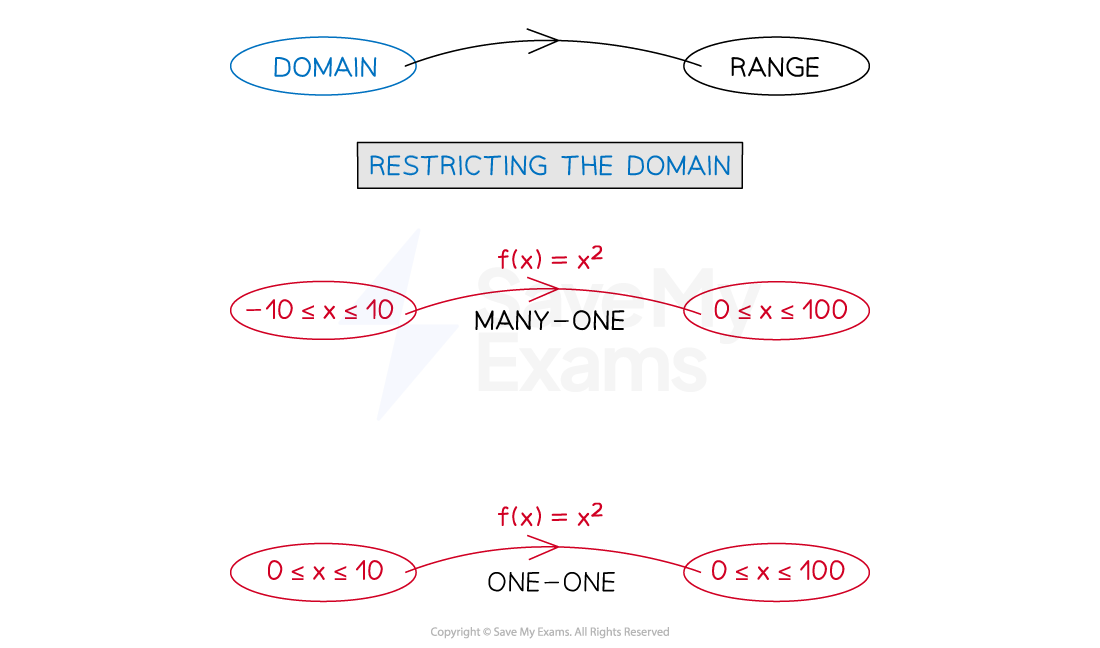
The domain of a function is the set of values that are allowed to be the ‘input’
-
A function is only fully defined once its domain has been stated
-
If a domain is not stated then it is assumed that the domain is the largest set of possible values
- e.g. the largest set of possible values for the function would be
-
-
Restrictions on a domain can turn many-one functions into one-one functions
What is the range of a function?
- The range of a function is the set of values of all possible ‘outputs’
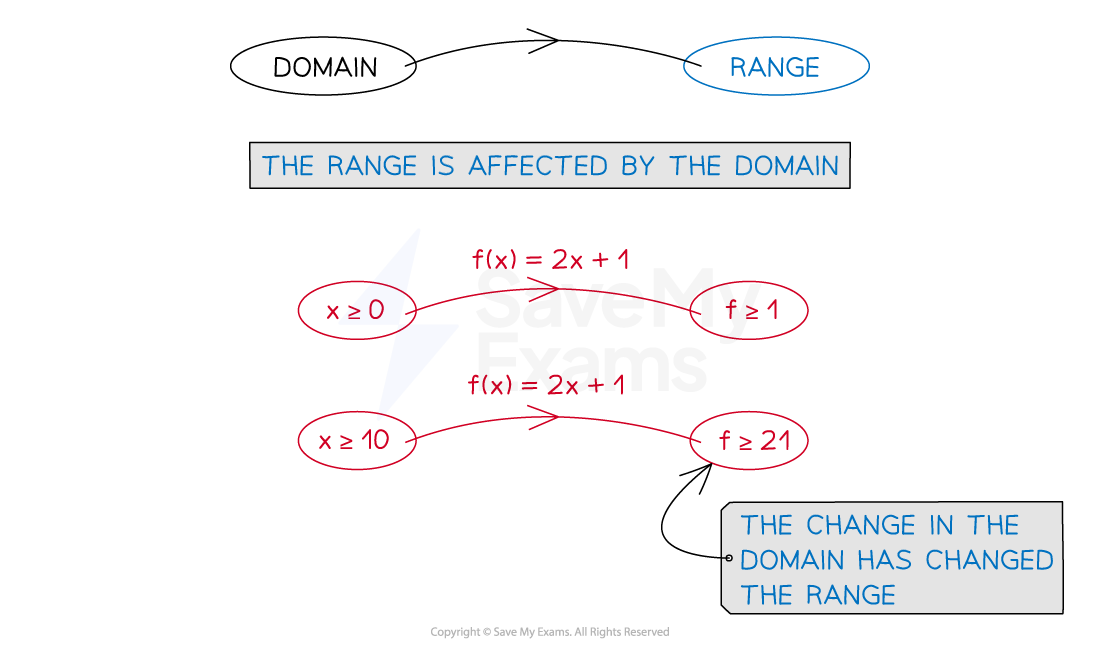
- The type of values in the range depend on the domain
How do I find a range from a given domain?
-
The domain of a function is the set of values that are used as inputs
-
The range of a function is the set of values that are given as outputs
-
Finding the range of a function involves determining all possible output values from a given domain
- This may need to be done by calculating each output value individually by **applying the function **to each input value
- Or by considering the** shape** or pattern of the function
-
To graph a function we use the inputs as the x-coordinates and the outputs as the y-coordinates
- corresponds to the coordinates (2, 5)
-
Graphing the function can help you visualise the range
- For example the range of the function for a domain of all real values of will be as the *y-*coordinates on the graph are all greater than or equal to zero
Worked Example The many-one function, , is given by
for all values of .
a) State the range of .
The 'output' from the function is a squared value and so will be positive, or zero.
b) The domain of is changed to . Write down the changed range of .
As ,
The Modulus Function
What is the modulus function?
-
The modulus function makes any 'input' positive
-
This is sometimes called the absolute value (of the input)
-
The modulus function is indicated by a pair of vertical lines being written around the input
- Similar to how brackets are used
- e.g.
-
What is the relationship between a function and its modulus?
-
For an 'output' such that , then
- Both the function and its modulus are positive
-
For an 'output' such that , then
- The function value is negative, but its modulus is positive
Was this revision note helpful?
Build on this topic