Quotient Rule (Cambridge International IGCSE Further Maths)
Quotient rule
What is the quotient rule?
-
The quotient rule is a formula that allows you to differentiate a quotient of two functions
- i.e. one function divided by another
-
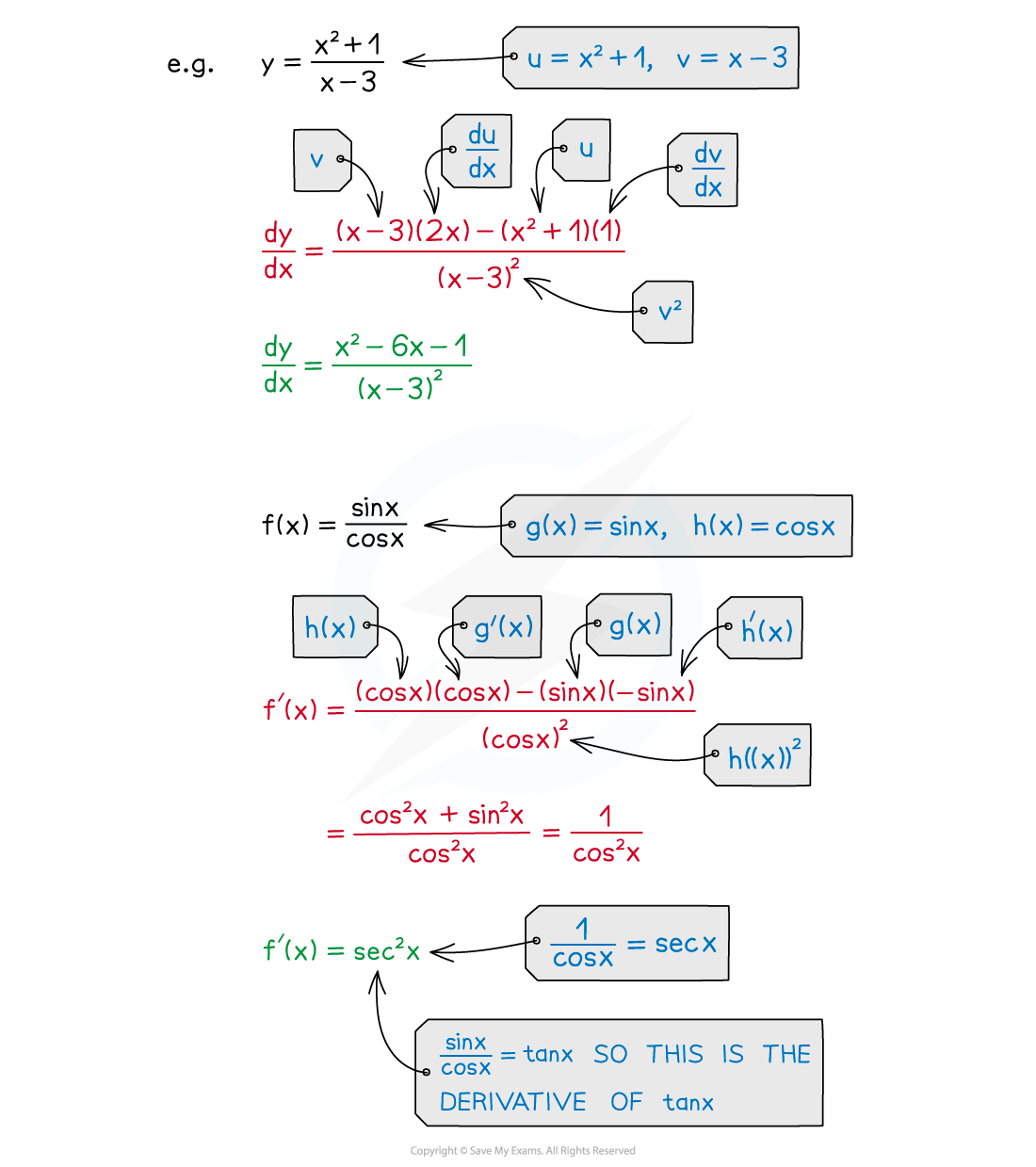
If where u and v are functions of x then the quotient rule is:
- In function notation, if then the quotient rule can be written as:
- As with the product rule, ‘dash notation’ may be used to make remembering it easier
- Final answers should match the notation used throughout the question
How do I know when to use the quotient rule?
-
The quotient rule is used when trying to differentiate a fraction where both the numerator and denominator are functions of
- if the numerator is a constant, negative powers can be used
- if the denominator is a constant, treat it as a factor of the expression\
How do I use the quotient rule?
-
Make it clear what and are
-
arranging them in a square can help
- opposite diagonals match up (like they do for product rule)
-
STEP 1
Identify the two functions, and
Differentiate both and with respect to to find and
STEP 2
Obtain by applying the quotient rule formula Be careful using the formula – because of the minus sign in the numerator, the order of the functions is important Simplify the answer if straightforward or if the question requires a particular form
Exam Hint
The quotient rule formula is not on the list of formulas page – you have to memorise it
- however if you do forget it in an exam, you could rewrite as and then use the product rule
- (the quotient rule is really doing exactly this)
Be careful using the formula – because of the minus sign in the numerator the order of the functions is important!
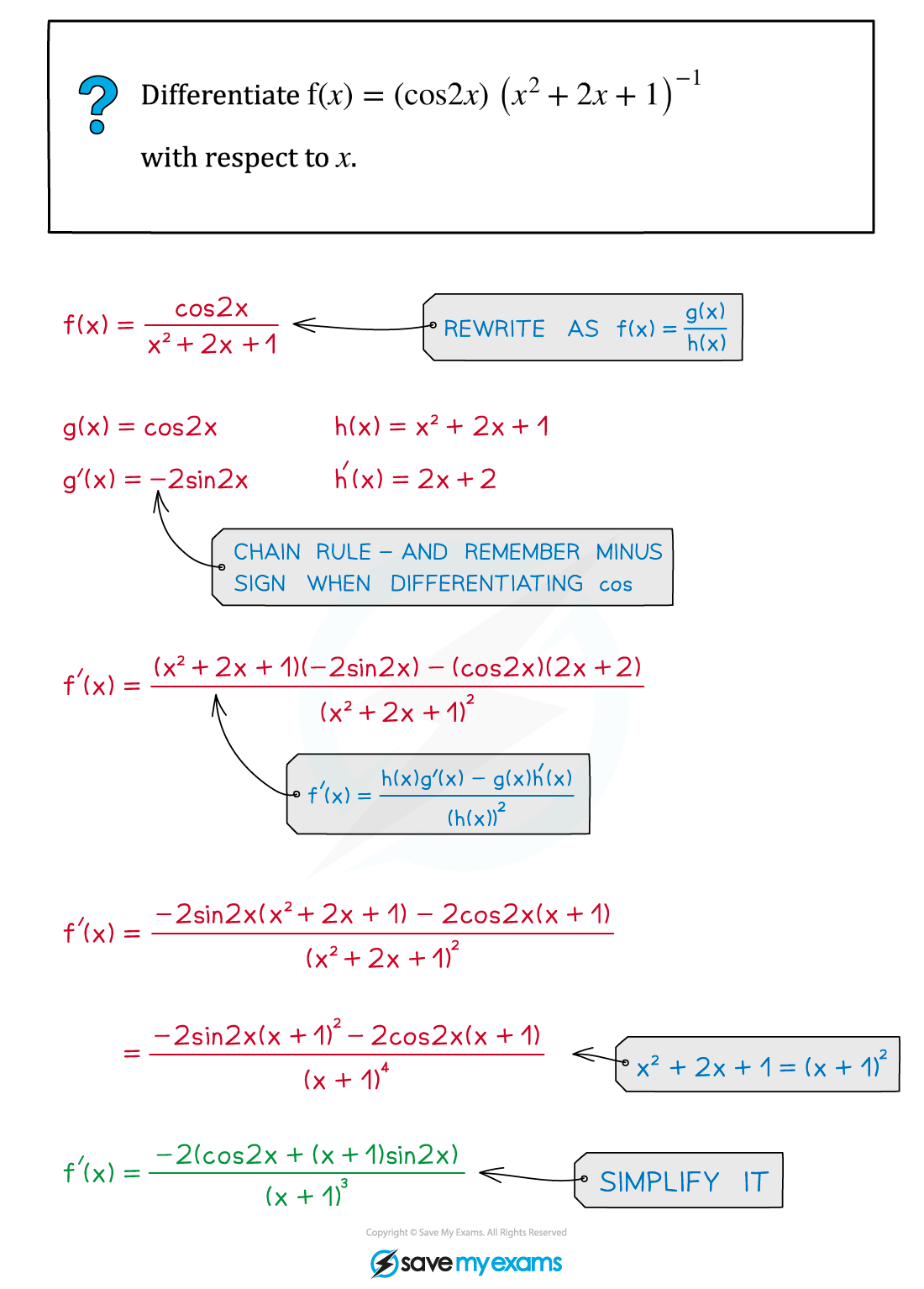
Worked Example
Was this revision note helpful?
Build on this topic