Completing the Square (Cambridge International IGCSE Further Maths)
Completing the square
What is completing the square?
-
Completing the square is another way of writing a quadratic function
-
It means rewriting in the form
- The key point is that now only occurs once in the equation
-
It can be used to solve quadratic equations, sketch their graphs and to find the coordinates of the turning point
How do I complete the square?
The method used will depend on the value of the coefficient of the term in
-
When
- is half of
- is
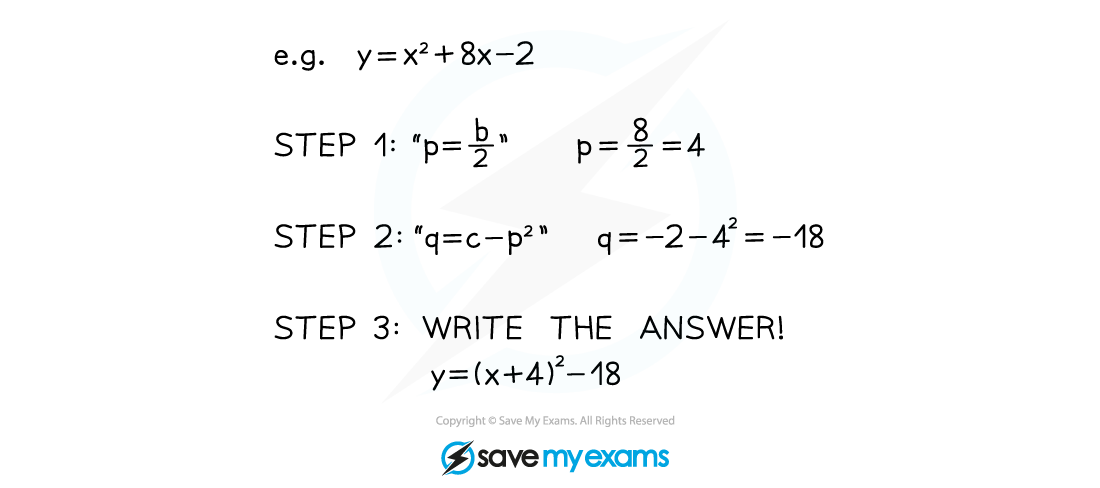
-
When a ≠ 1
- First take a factor of out of the and terms
- Then continue as above
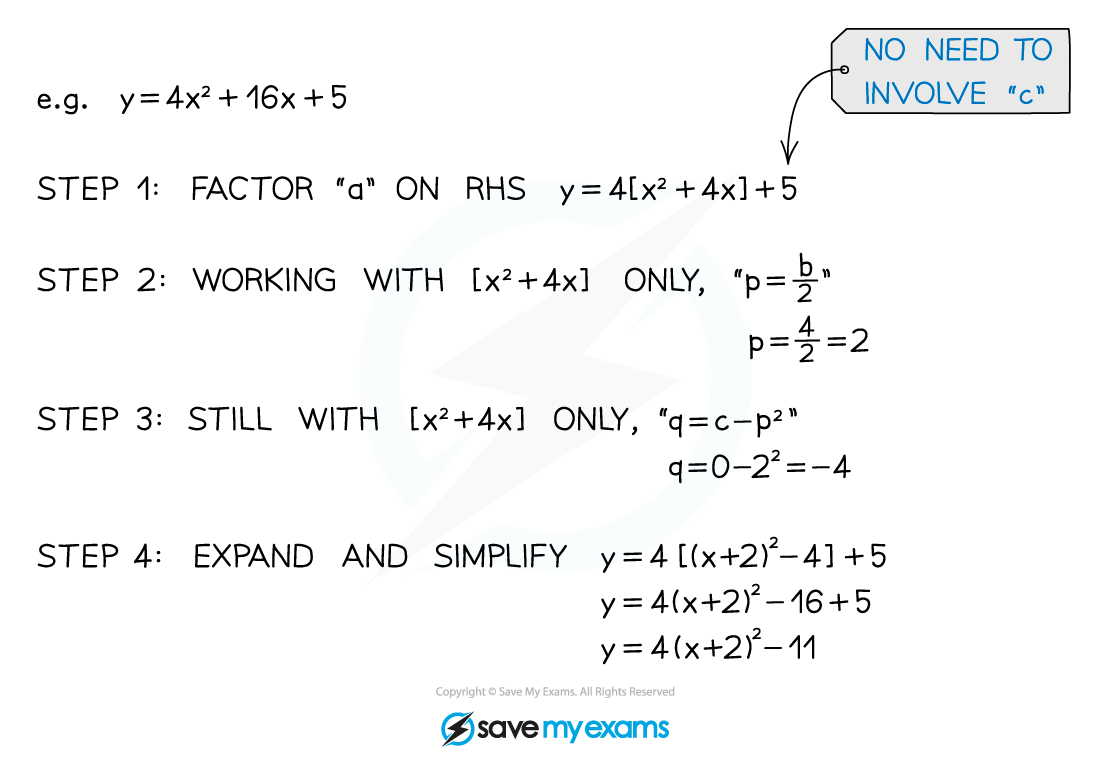
Exam Hint
- Sometimes a question will explicitly use the phrase complete the square
- Sometimes a question will use the form without using the phrase completing the square
Worked Example Write in the form , where and are constants to be found, and is an unknown constant.
The form required is 'completing the square' (do not be put off by the , it is just a constant!).
STEP 1 - Take a factor of 3 out of the and terms - leaving avoids awkward fractions.
STEPS 2 and 3 - Complete the square on the part only. "" and "".
STEP 4 - Expand and simplify.
i.e.
Solving by Completing the Square
How do I solve a quadratic equation by completing the square?
-
To solve x2 + bx + c = 0
-
replace the first two terms, x2+ bx, with (x + p)2 - p2 where p is half of b
-
this is called completing the square
-
x2 + bx + c = 0 becomes
- (x + p)2 - p2 + c = 0 where p is half of b
-
-
rearrange this equation to make x the subject (using ±√)
-
-
For example, solve x2 + 10x + 9 = 0 by completing the square
-
x2 + 10*x *becomes (x + 5)2 - 52
-
so x2 + 10x + 9 = 0 becomes (x + 5)2 - 52 + 9 = 0
-
make x the subject (using ±√)
- (x + 5)2 - 25 + 9 = 0
- (x + 5)2 = 16
- x + 5 = ±√16
- x = ±4 - 5
- x = -1 or x = -9
-
-
If the equation is ax2 + bx + c = 0 with a number in front of x2, then divide both sides by a first, before completing the square
Exam Hint
When making x the subject to find the solutions at the end, don't expand the squared brackets back out again!
- Remember to use ±√ to get two solutions
Worked Example Solve by completing the square.
*Divide both sides by 2 to make the quadratic start with x2 * * *
* *
Halve the middle number, -4, to get -2 Replace the first two terms, x2 - 4**x, with (x - 2)2- (-2)2 * *
* *
Simplify the numbers * *
* *
Add 16 to both sides * *
* *
Square root both sides Include the ± sign to get two solutions * *
* *
Add 2 to both sides * *
* *
Work out each solution separately
Final answer: x = 6 or x = -2
Was this revision note helpful?
Build on this topic