Definite Integrals (Cambridge International IGCSE Further Maths)
Definite integration
What is definite integration?
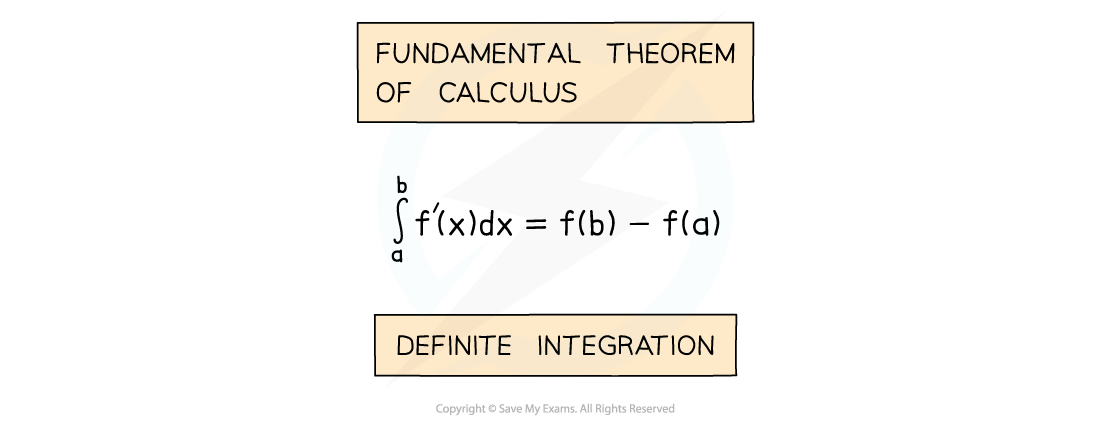
- Definite Integration occurs in an alternative version of the Fundamental Theorem of Calculus
- This version of the Theorem is the one referred to by most textbooks/websites
-
a and b are called limits
- a is the lower limit
- b is the upper limit
-
f’(x) is the derivative of f(x)
-
The value can be positive, zero or negative
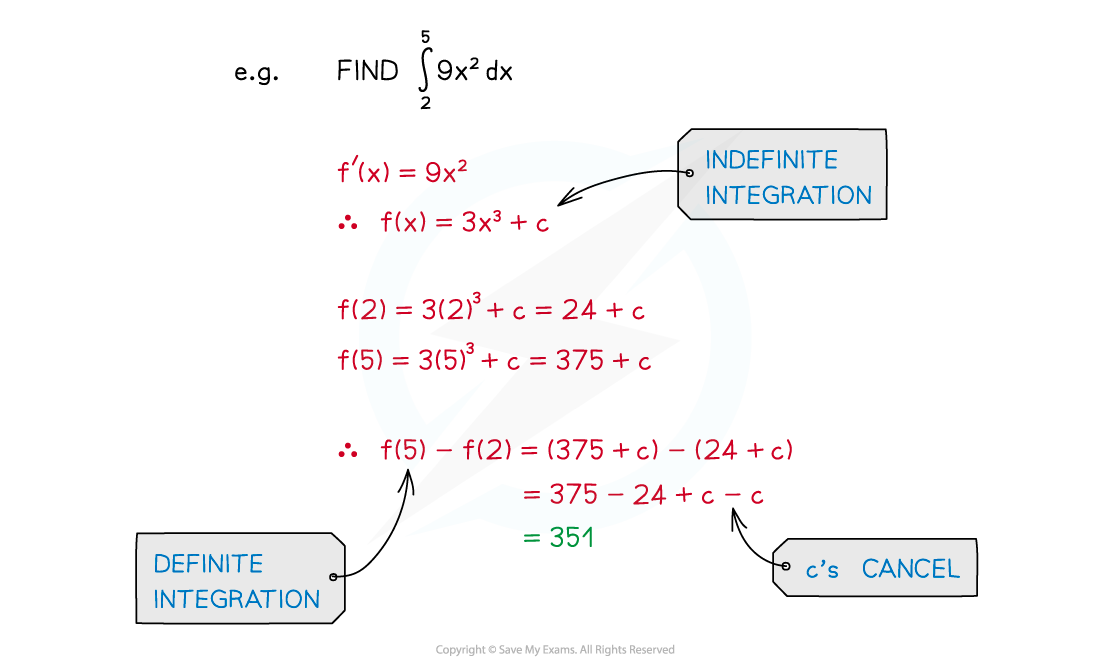
Why do I not need to include a constant of integration for definite integration?
-
“+c” would appear in both f(a) and f(b)
- Since we then calculate f(b) – f(a) they cancel each other out
- So “+c” is not included with definite integration
How do I find a definite integral?
-
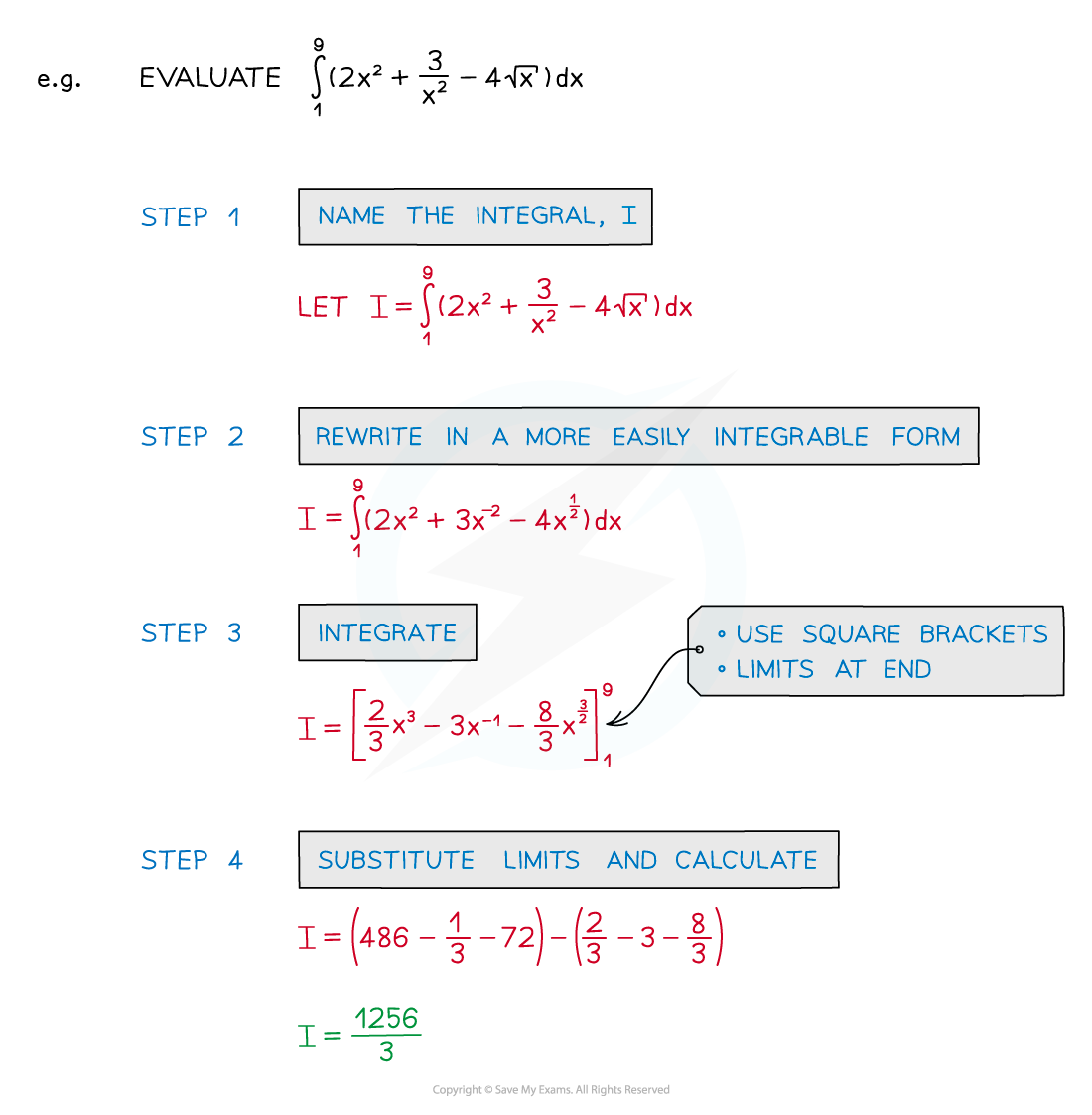
STEP 1
-
Give the integral a name (if it does not already have one)
- This saves you having to rewrite the whole integral every time!
-
-
STEP 2
-
If necessary rewrite the integral into a more easily integrable form
- Not all functions can be integrated directly
-
-
STEP 3
-
Integrate without applying the limits
- Notation: use square brackets [ ] with limits placed after the end bracket
-
-
STEP 4
-
Substitute the limits into the function and calculate the answer
- Substitute the top limit first
- Then substitute the bottom limit
- Subtract the second value from the first
-
What are the special properties of definite integrals?
-
Some of these have been encountered already and some may seem obvious …
-
taking constant factors outside the integral
- where is a constant
- useful when fractional and/or negative values involved
-
integrating term by term
- the above works for subtraction of terms/functions too
-
equal upper and lower limits
- on evaluating, this would be a value subtracted from itself!
-
swapping limits gives the same, but negative, result
- compare 8 subtract 5 say, with 5 subtract 8 …
-
splitting the interval
- where
- this is particularly useful for areas under multiple curves or areas under the-axis
-
Exam Hint
- Look out for questions that ask you to find an indefinite integral in one part (so “+c” needed), then in a later part use the same integral as a definite integral (where “+c” is not needed)
Worked Example Find the value of
Answer:
Start by expanding the brackets inside the integral
Integrate as usual (here it's a 'powers of ' integration)
Write the answer in square brackets with the integration limits outside
Now substitute 4 into that function And subtract from it the function with 2 substituted in
Error converting from MathML to accessible text.
Was this revision note helpful?
Build on this topic