Linear Simultaneous Equations (Cambridge International IGCSE Further Maths)
Elimination Method
What are simultaneous linear equations?
-
When there are two unknowns (say x and y) in a problem, we need two equations to be able to find them both: these are called simultaneous equations
-
you solve two equations to find two unknowns, x and y
- for example, 3x + 2y = 11 and 2x - y = 5
- the solutions are x = 3 and y = 1
-
-
If they just have x and y in them (no x2 or y2 or xy etc) then they are linear simultaneous equations
-
Solving a pair of simultaneous equations means finding pairs of values that make both equations true at the same time
-
A linear equation in two unknowns will produce a straight line if you graph it... linear = line
-
A pair of simultaneous equations will produce lines that will cross each other (if there is a solution!)
How do I use elimination to solve simultaneous linear equations?
-
"Elimination" completely removes one of the variables, x or y
-
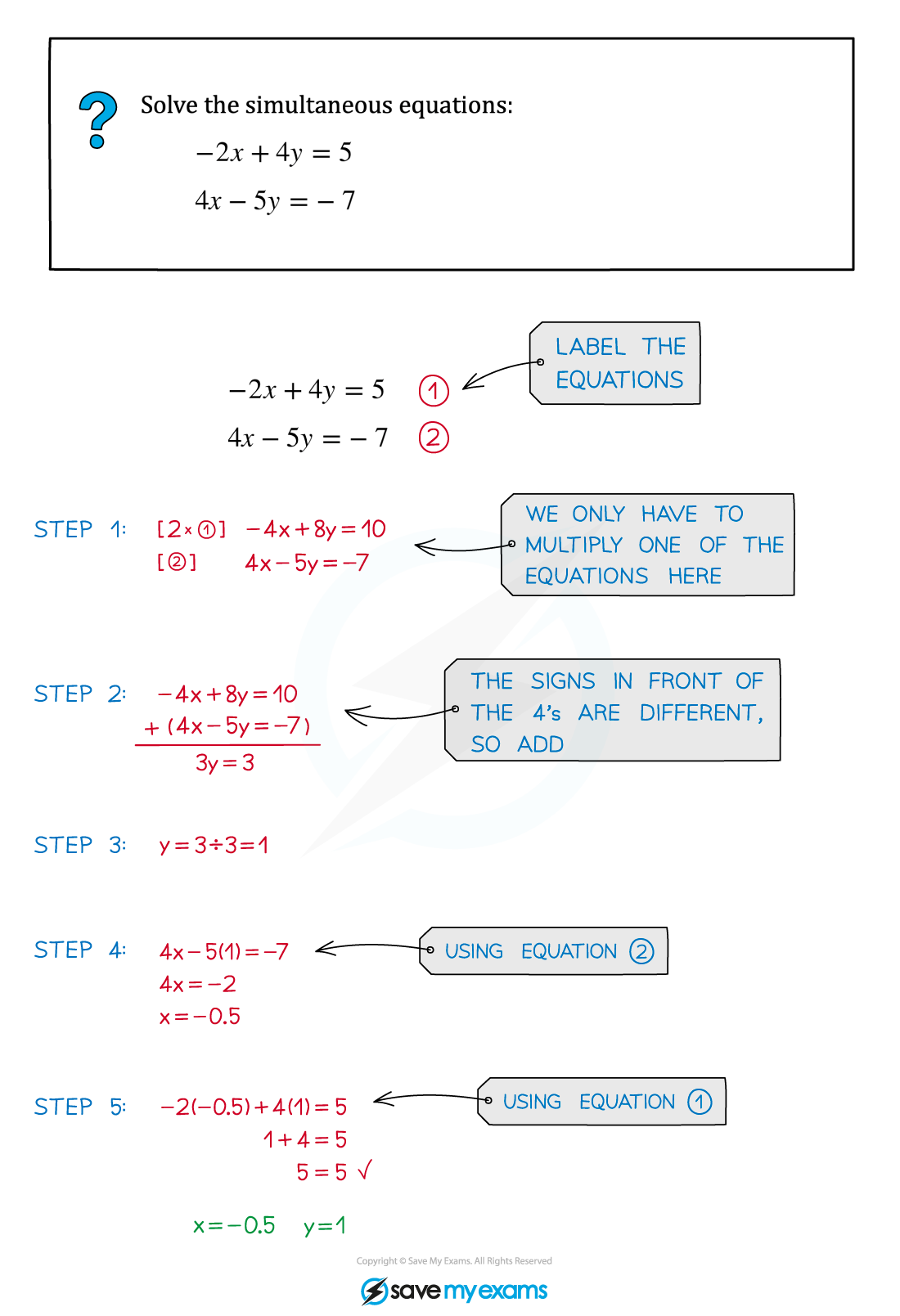
Begin by multiplying one (or both) of the equations by a constant (or constants)to get the numbers in front of one of the unknowns to match
-
For example to eliminate the x's from 3x + 2y = 11 and 2x - y = 5
- Multiply every term in the first equation by 2 6x + 4y = 22
- Multiply every term in the second equation by 3 6x - 3y = 15
-
-
If the matching numbers have the same sign, then subtract one equation from the other
-
If the matching numbers have different signs then add the equations together
-
Subtract the second result from the first to eliminate the 6x's
- 4y - (-3y) = 22 - 15
- 7y = 7
-
-
Solve the new equation to find the value of one of the unknowns
-
Solve to find y
- y = 1
-
-
Substitute the value into one of the original equations and solve to find the value of the other unknown
-
Substitute y = 1 back into either original equation
- 3*x *+ 2(1) = 11
- x = 3
-
Alternatively, to eliminate the y's from 3x + 2y = 11 and 2x - y = 5
- Multiply every term in the second equation by 2
- 4x - 2y = 10
- Add this result to the first equation to eliminate the 2y's (as 2y + (-2y) = 0)
- The process then continues as above
-
-
Check your final solutions satisfy both equations
- 3(3) + 2(1) = 11 and 2(3) - (1) = 5
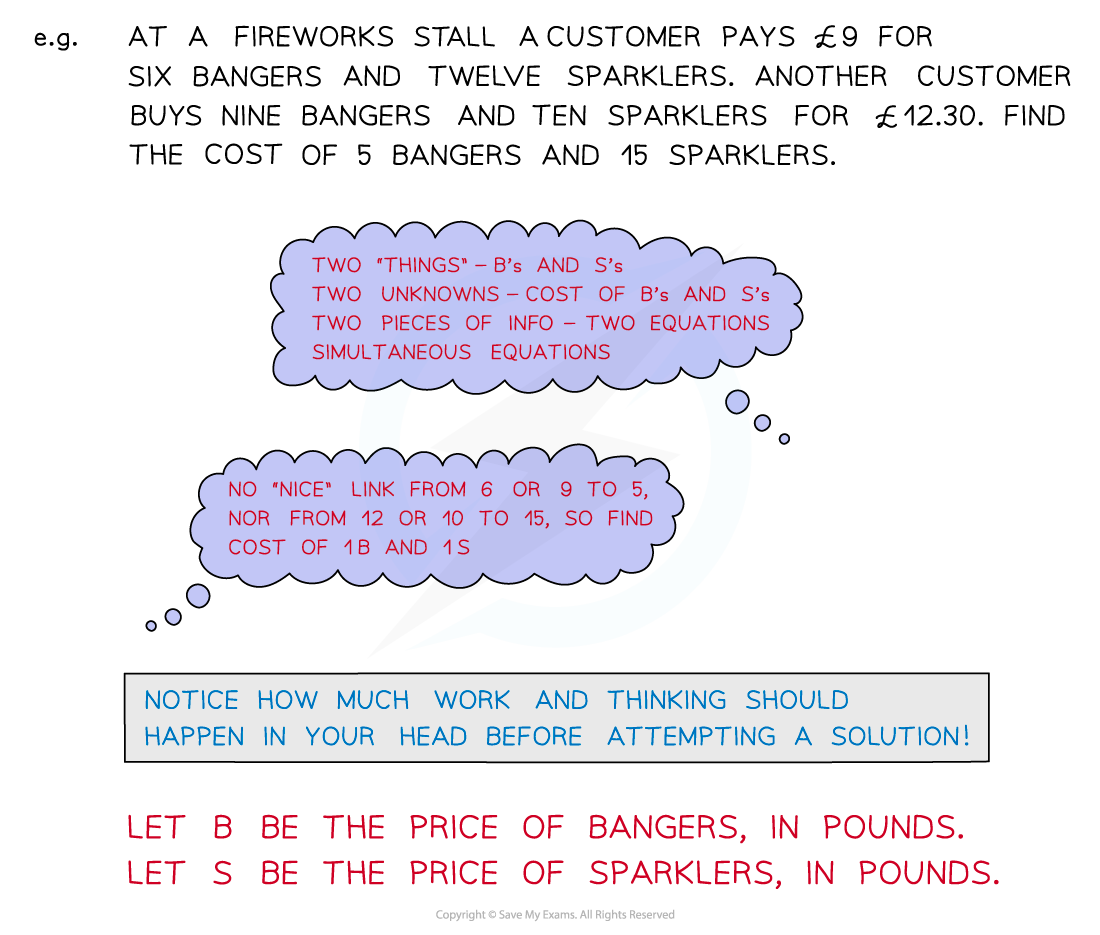
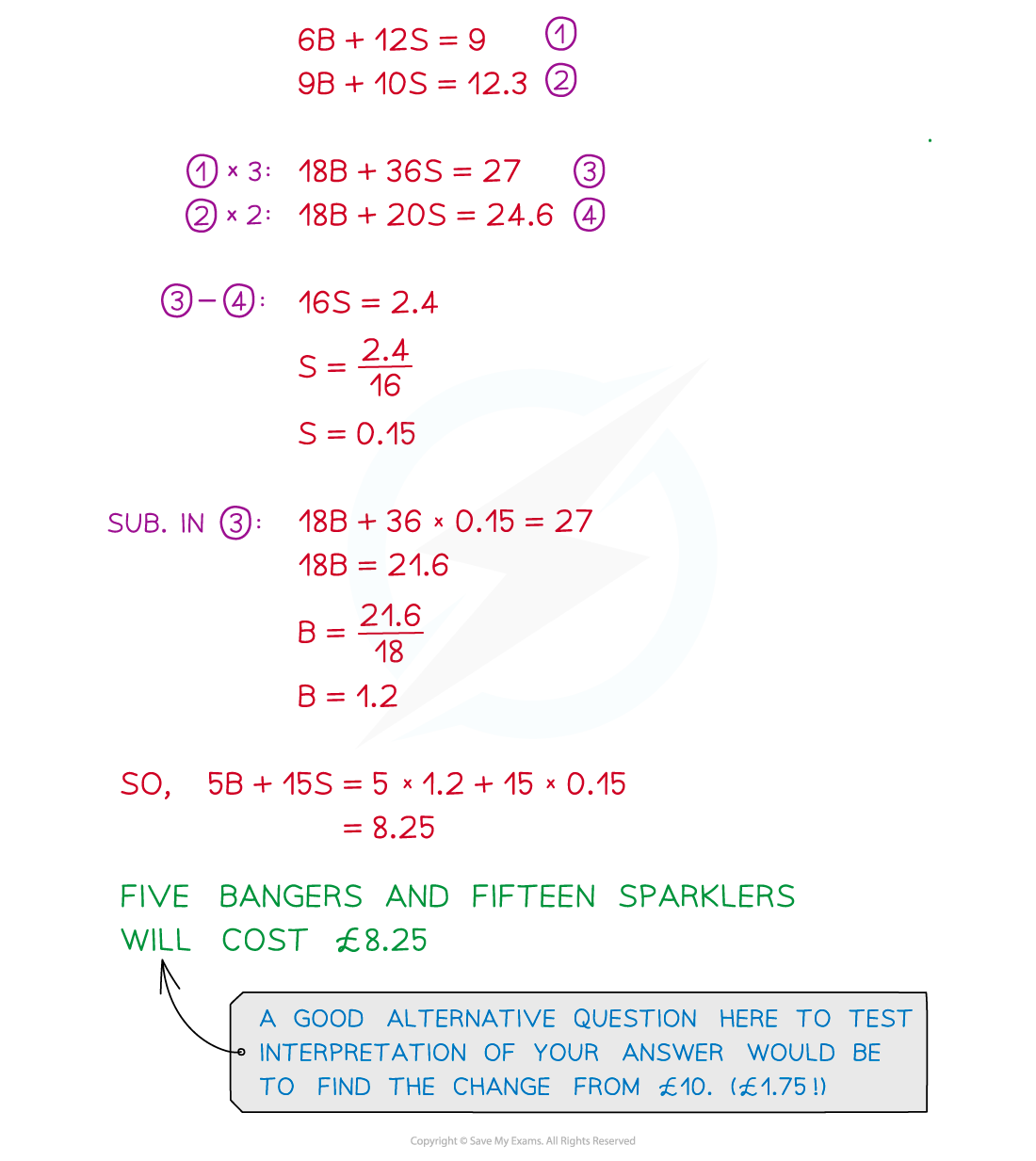
How do I solve linear simultaneous equations from worded contexts?
Exam Hint
- Don't skip the checking step (it only takes a few seconds) – there are many places to go wrong when solving simultaneous equations!
- Mishandling minus signs is probably the single biggest cause of student error in simultaneous equations questions
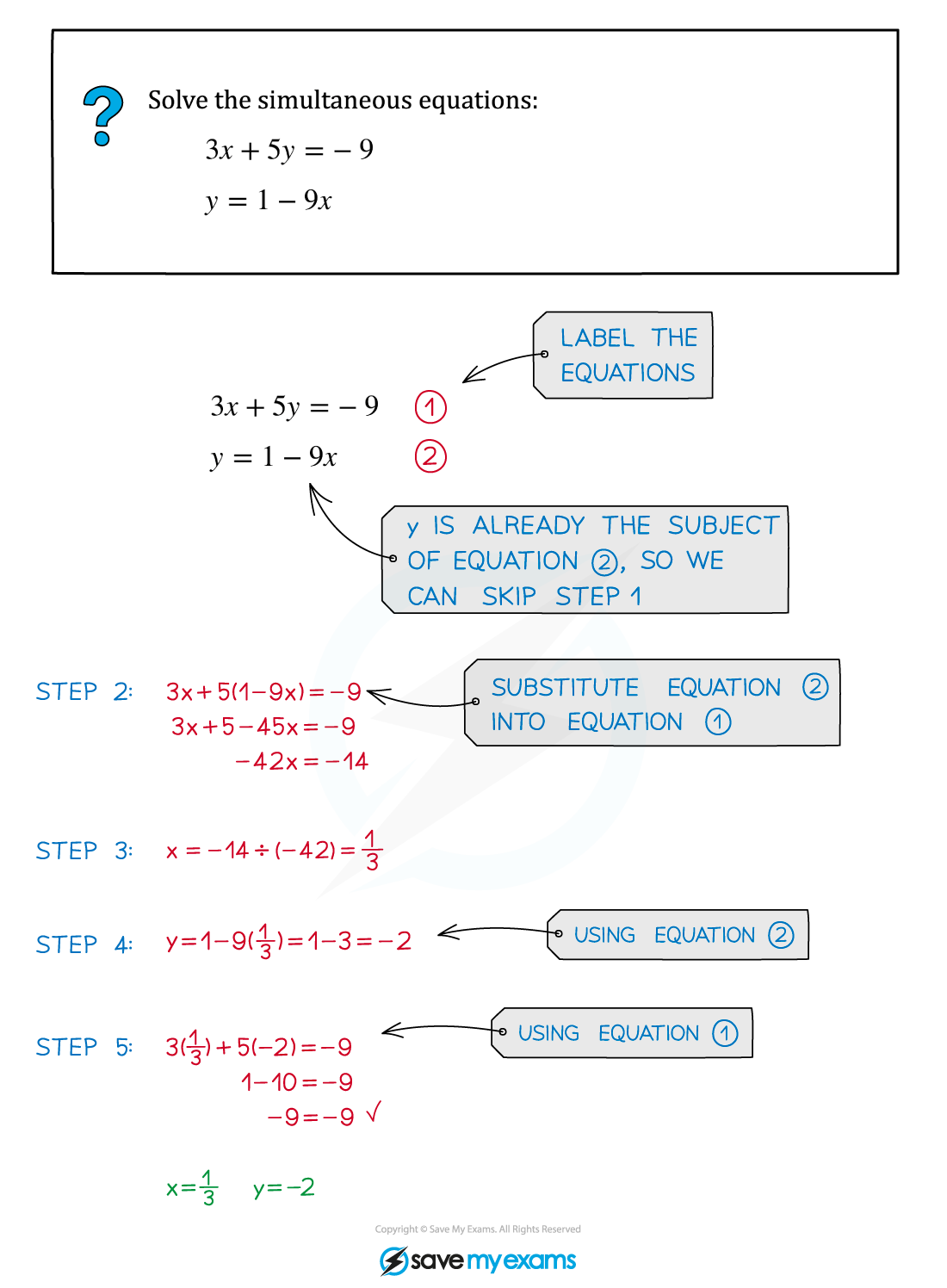
Worked Example
Substitution Method
How do I use substitution to solve simultaneous linear equations?
-
"Substitution" means substituting one equation into the other
-
Rearrange one of the equations to make one of the unknowns the subject
-
To solve 3x + 2y = 11 and 2x - y = 5 by substitution
-
Rearrange one of the equation into y = ... (or x = ...)
- For example, the second equation becomes y = 2x - 5
-
-
Substitute the expression found for x or y into the equation not used to rearrange
-
Replace all y's with 2x - 5 in brackets
- 3x + 2(2x - 5) = 11
-
-
Solve the new equation to find the value of one of the unknowns
-
Solve this equation to find x
- x = 3
-
-
Substitute the value found for x or y into the rearranged equation from to find the value of the other unknown
-
Substitute x = 3 into y = 2x - 5 to find y
- y = 2(3) - 5
- y = 1
-
-
Check your final solutions satisfy both equations
- 3(3) + 2(1) = 11 and 2(3) - (1) = 5
How do you use graphs to solve linear simultaneous equations?
-
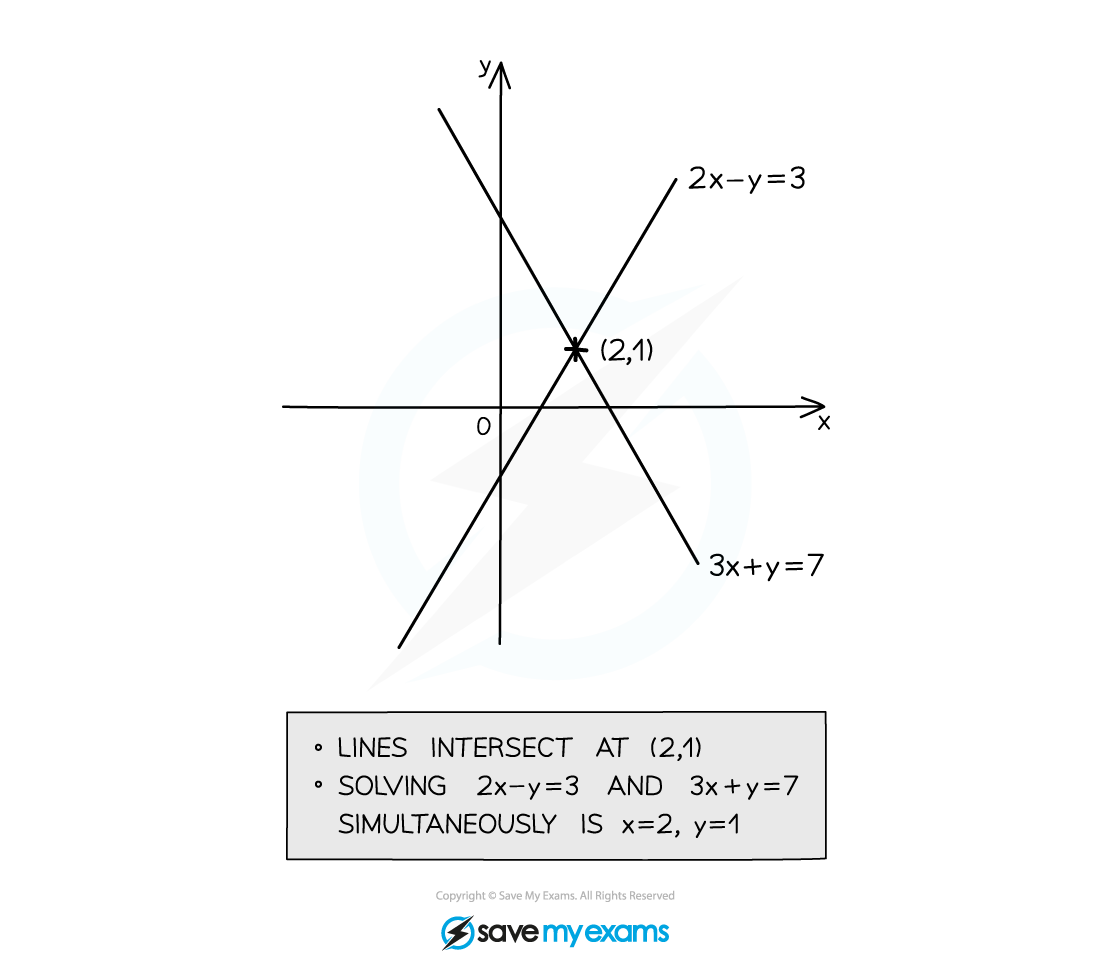
Plot both equations on the same set of axes
- to do this, you can use a table of values or rearrange into y = mx + c if that helps
-
Find where the lines intersect (cross over)
- The x and *y solutions to the simultaneous equations are the *x and y coordinates of the point of intersection
-
e.g. to solve 2x - y = 3 and 3x + y = 4 simultaneously, first plot them both (see graph)
- find the point of intersection, (2, 1)
- the solution is x = 2 and y = 1
Exam Hint
- Although elimination will always work to solve simultaneous linear equations, sometimes substitution can be easier and quicker
- Knowing both methods can help you a lot in the exam (plus you will need substitution to solve quadratic simultaneous equations)
Worked Example
Was this revision note helpful?
Build on this topic