13 marksmedium
Given that , use calculus to find the approximate change in as increases from to , where is small.
32 questions · 224 marks · ≈ 4 hours
Given that , use calculus to find the approximate change in as increases from to , where is small.
Find the -coordinate of the stationary point on the curve , giving your answer in the form ,where and are rational numbers.
The radius, , of a circle is increasing at the rate of . Find, in terms of , the rate at which the area of the circle is increasing when .
The volume, , of a sphere of radius is given by . The radius, , of a sphere is increasing at the rate of . Find, in terms of , the rate of change of the volume of the sphere when .
Given that , show that , where and are integers.
Extract:
Given that y = ( x ^2 - 1 ) sqrt( 5 x + 2 ), show that ( d y)/( d x) = (A x ^2 + B x + C)/(2 sqrt( 5 x + 2 )), where A , B and C are integers.
Find the coordinates of the stationary point of the curve . Give each coordinate correct to 2 significant figures.
Extract:
From part (b): The stationary point of the curve y = ( x ^2 - 1 ) sqrt( 5 x + 2 ) for x greater than 0 occurs at x = 0.315 and y = - 1.70 (coordinates to 2 significant figures).
Determine the nature of this stationary point.
Variables and are such that . Use differentiation to find the approximate change in as increases from , where h is small.
The equation of a curve is .
Find the exact coordinates of the stationary point of the curve.
Find and hence evaluate the area enclosed by the curve and the lines .
A curve has equation .
Show that , where and are constants.
Extract:
A curve has equation y = (2x-1)√(4x+3).
Show that dy/dx = 4(Ax+B)/√(4x+3), where A and B are constants.
From the mark scheme: dy/dx = 4(3x+1)/√(4x+3)
Hence write down the -coordinate of the stationary point of the curve.
Extract:
The x-coordinate of the stationary point of the curve is x equals negative 1 third.
Determine the nature of this stationary point.
Find the equation of the tangent to the curve at the point where .
Extract:
Find the equation of the tangent to the curve y = x³ - 6x² + 3x + 10 at the point where x = 1.
The equation of the tangent is y = -6x + 14
Find the coordinates of the point where this tangent meets the curve again.
It is given that for .
Find
Extract:
It is given that y = ln(1 + sin x) for 0 < x < π.
Find dy/dx
To differentiate y = ln(1 + sin x), we can use the fact that the differential of ln x is 1/x and chain rule.
dy/dx = 1/(1 + sin x) × cos x
dy/dx = (cos x)/(1 + sin x)
Find the value of when , giving your answer in the form , where is an integer.
Extract:
It is given that y = ln(1 + sin x) for 0 < x < π.
Find dy/dx
dy/dx = cos x / (1 + sin x)
Find the values of for which .
A curve has equation .
Find .
Extract:
A curve has equation y = x cos x.
dy/dx = -x sin x + cos x
Find the equation of the normal to the curve at the point where , giving your answer in the form .
Find the equation of the tangent to the curve at the point where . Give your answer in the form, where and are constants correct to 3 decimal places.
A curve has equation where . The normal to the curve at the point where , cuts the -axis, at the point . Find the equation of the normal and the -coordinate of .
Variables and are such that , where is in radians. Use differentiation to find the approximate change in as increases from 1 to , where is small.
The tangent to the curve , at the point where , meets the -axis at the point . Find the exact coordinates of .
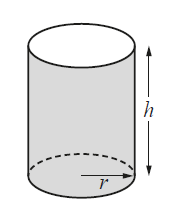
A container is a circular cylinder, open at one end, with a base radius of cm and a height of cm. The volume of the container is 1000 cm3. Given that and can vary and that the total outer surface area of the container has a minimum value, find this value.
Find the -coordinates of the stationary points of the curve .
A curve has equation and has exactly two stationary points. Given that , , use the second derivative test to determine the nature of each of the stationary points of this curve.
In this question all lengths are in centimetres.
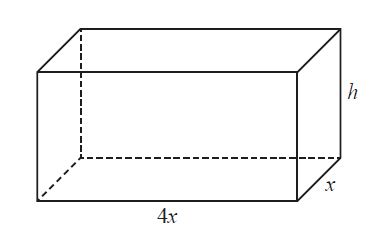
The diagram shows a solid cuboid with height and a rectangular base measuring by . The volume of the cuboid is . Given that and can vary and that the surface area of the cuboid has a minimum value, find this value.
Find the equation of the tangent to the curve at the point where . Give your answer in the form , where and are integers.
Extract:
Find the equation of the tangent to the curve 2y = tan 2x + 7 at the point where x = π/8.
The equation of the tangent is 2x - y = π/4 - 4
This tangent intersects the -axis at and the -axis at . Find the length of .
Given that , show that , where and are constants.
Extract:
y = x√(x+2)
From part (a): dy/dx = (3x+4)/(2√(x+2))
Find the exact coordinates of the stationary point of the curve .
Extract:
y = x√(x+2)
dy/dx = (3x + 4)/(2√(x+2))
Stationary point occurs at x = -4/3
Determine the nature of this stationary point.
Differentiate with respect to .
Variables and are such that . Use differentiation to find the approximate change in as increases from , where is small.
It is given that .
Find the exact value of when .
Extract:
Find the exact value of ( d y)/( d x) when x = pi / 3.
At x = π/3, dy/dx = 2√3
Hence find the approximate change in as increases from where is small.
Extract:
Find the exact value of ( d y)/( d x) when x = pi / 3.
Given that is increasing at the rate of 3 units per second, find the corresponding rate of change in when , giving your answer in its simplest surd form.
It is given that .
Find .
Extract:
y = ln(sin x + 3 cos x) for 0 < x < π/2
dy/dx = (cos x - 3 sin x)/(sin x + 3 cos x)
Find the value of for which .
Given that , find .
Extract:
Differentiate the equation using the quotient rule and chain rule.
Substitute into the quotient rule, ( d y)/( d x) = (( v ) ( ( d u)/( d x) ) - ( u ) ( ( d v)/( d x) ))/(v ^2).
Hence, given that is increasing at the rate of 2 units per second, find the exact rate of change of when .
A sphere of radius cm and volume cm3 is increasing in size with time seconds. The volume increases at a constant rate of 24 cm3 s-1.
Find the exact rate at which the radius is increasing when the sphere reaches a volume of cm3.
A sector from a circle of radius has an internal angle of radians, as shown below.

The perimeter of the sector is 4 units and the area of the sector is square units.
Show that .
Show that where and are constants to be found.
Find the maximum area of the sector. You must show that this area is a maximum.
A curve is given by .
Use calculus to find the approximate change in as increases from to where is small.
In this question, all lengths are in centimetres.
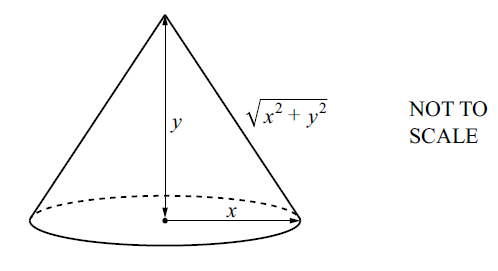
The diagram shows a cone of base radius , height and sloping edge . The volume of the cone is .
Show that the curved surface area, , of the cone is given by .
Extract:
In this question, all lengths are in centimetres.
The diagram shows a cone of base radius x, height y and sloping edge √(x² + y²). The volume of the cone is 10π cm³.
Show that the curved surface area, S, of the cone is given by S = (π√(x^6 + 900))/x.
Given that can vary and that has a minimum value, find the value of for which is a minimum.
Variables and are such that .Use differentiation to find the approximate change in as increases from , where is small.
In this question all lengths are in centimetres. The volume, , of a cone of height and base radius is given by
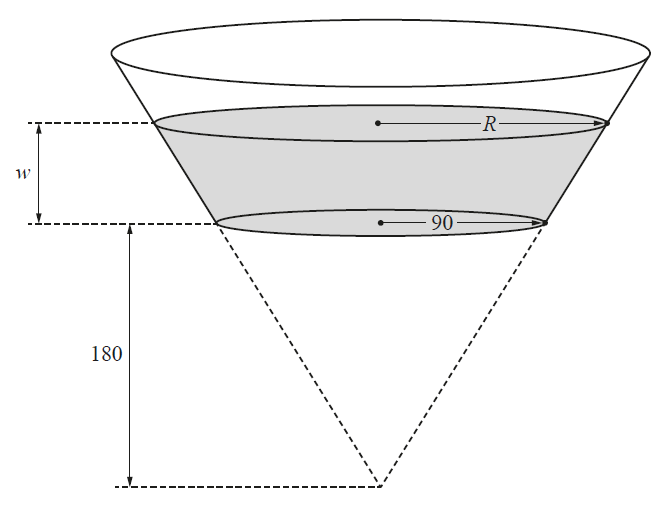
The diagram shows a large hollow cone from which a smaller cone of height 180 and base radius 90 has been removed. The remainder has been fitted with a circular base of radius 90 to form a container for water. The depth of water in the container is w and the surface of the water is a circle of radius .
Find an expression for in terms of and show that the volume of the water in the container is given by V = pi / 12 ( w + 180 ) ^3 - 486000 pi.
Extract:
The diagram shows a large hollow cone from which a smaller cone of height 180 and base radius 90 has been removed. The remainder has been fitted with a circular base of radius 90 to form a container for water. The depth of water in the container is w and the surface of the water is a circle of radius R.
Find an expression for R in terms of w and show that the volume V of the water in the container is given by V = (π/12)(w + 180)³ - 486000π.
Water is poured into the container at a rate of . Find the rate at which the depth of the water is increasing when .
A curve has equation
Find the equation of the normal to the curve at the point where .
Extract:
At the point where x space equals space square root of 2:
Find the approximate change in as increases from , where is small.
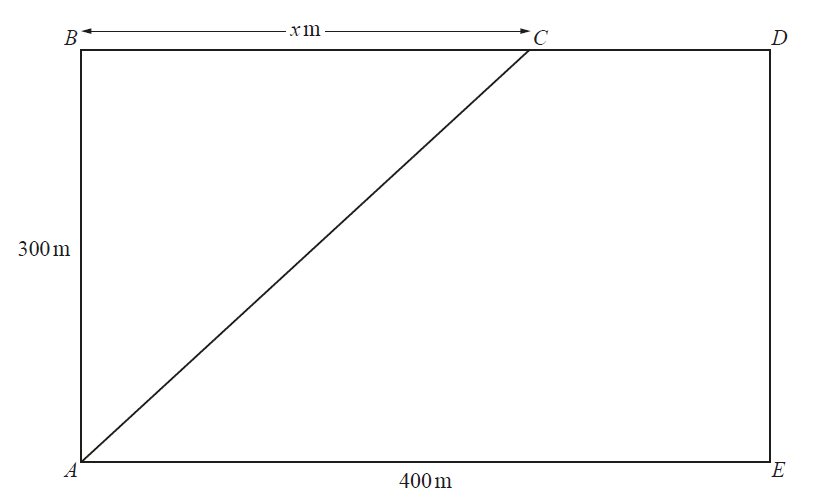
The rectangle represents a ploughed field where and . Joseph needs to walk from to in the least possible time. He can walk at on the ploughed field and at on any part of the path along the edge of the field. He walks from to and then from to . The distance .
Find, in terms of , the total time, , Joseph takes for the journey.
Extract:
The rectangle ABCDE represents a ploughed field where AB = 300 m and AE = 400 m. Joseph needs to walk from A to D in the least possible time. He can walk at 0.9 ms⁻¹ on the ploughed field and at 1.5 ms⁻¹ on any part of the path BCD along the edge of the field. He walks from A to C and then from C to D. The distance BC = x m.
Given that can vary, find the value of for which is a minimum and hence find the minimum value of .
A curve has the equation .
Find and factorise an expression for .
Hence find .
Show that the second derivative of the curve satisfies the relationship
where , and are constants to be found.