Narrative Writing: What the Question is Asking (Cambridge International IGCSE English Language)
Paper 2: Writing is divided into two sections:
- Section A: Directed Writing
- Section B: Composition
The following guide will provide you with the information you need to answer Section B narrative writing to a high standard. It includes:
- An overview of narrative writing
- Breaking down the questions
- Exam tips
Overview of narrative writing
You will have a choice of two narrative writing options: Question 4 or 5.
You are required to write about 350-450 words, which is approximately 2-3 sides of A4 in standard-sized handwriting, and you will have one hour in which to do this.
This task is worth 40 marks. You will be awarded up to 16 marks for content and structure, and up to 24 marks for style and accuracy. For narrative writing, this means:
| Content and structure (16 marks) | Style and accuracy (24 marks) |
|---|---|
| - The plot is well-defined and strongly developed with features of fiction writing such as description, characterisation, effective climax and convincing details | - The writing contains precise, well-chosen vocabulary and varied sentence structures chosen for effect - Language and tone are suitable for the context - Spelling, punctuation and grammar are almost always accurate |
Remember, in narrative writing, your aim is to craft a convincing story.
You should spend 15 minutes planning your writing, and 45 minutes writing your response (including 5 minutes at the end to re-read and check your work).
Breaking down the question
You should carefully consider the two question choices and plan your route through your composition, including how it will end, before you start writing. Consider how you can be convincing and original in your use of detail, and choose your vocabulary and sentence structures carefully to create specific effects.
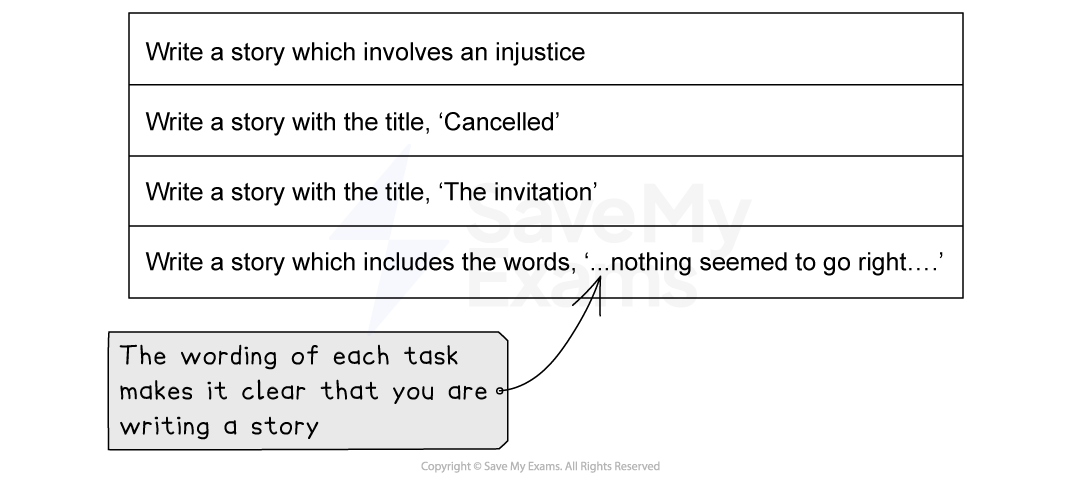
The examples below are a selection of past CIE narrative writing tasks:
Exam tips
-
Ensure that your response is a well organised and thoughtful interpretation of whichever title you choose
-
Demonstrate your ability to shape a narrative, including moments of tension and drama
-
Use characterisation to create believable protagonists and characters
-
Avoid cliches or over-used narratives, such as abandoned cabins in the woods
-
Do not just “tell” a series of events:
- Consider imaginative ways to tell your story, apart from just a chronological account
- Include your characters’ thoughts and feelings, not just what happens
-
Do not over-complicate your language unnecessarily:
- Do not underestimate the power of simple words and sentences to create powerful effects
-
Start at your story’s main setting, not in the journey or build up
-
Ensure that all of the words you choose contribute to the overall atmosphere and effect you want to create
-
Vary your sentence and paragraph lengths to keep the style and tone dynamic
-
Do not over-use dialogue:
- Only use dialogue if it drives forward the plot and you are able to punctuate it correctly
-
Consider the “message” of your story and how your characters represent this
-
Consider the narrative perspective which will work most effectively for your story
Was this revision note helpful?
Build on this topic