Indicators of Living Standards (Cambridge International IGCSE Economics)
Real GDP per head (capita)
Spec point — advantages and disadvantages of real GDP per head and HDI as indicators
-
Economic development is the sustainable increase in living standards for a country, typically characterised by increases in life span, education levels, and income
-
There are many measures of living standards
- Single indicators, e.g., real gross domestic product per capita, number of doctors/1000 people; infant mortality rate, and % of the population with access to clean drinking water
- Composite indicators such as the Human Development Index (HDI)
The distinction between real, nominal and per head GDP
Nominal GDP
-
In economics, the use of the word 'nominal' refers to the fact that the metric has not been adjusted for inflation
-
Nominal GDP is the actual value of all goods and services produced in an economy in a one-year period
- There has been no adjustment to the amount based on the increase in general price levels (inflation)
Real GDP
-
Real GDP is the value of all goods and services produced in an economy in a one-year period - and adjusted for inflation
- For example, if nominal GDP is $100bn and inflation is 10% then real GDP is $90bn
Real GDP per head (capita)
- This metric take the real GDP and divides it by the number of people in the population
-
It shows the mean wealth of each citizen in a country
-
This makes it easier to compare standards of living between countries
- For example, Switzerland has a much higher GDP per capita than Burundi
The advantages and disadvantages of real GDP per capita
| Advantages | Disadvantages |
|---|---|
| - Allows comparisons – helps compare living standards between countries or over time - Adjusts for population size – gives a better measure than total GDP alone - Useful indicator of economic growth – helps track whether an economy is growing or shrinking on a per-person basis - Inflation adjusted – when measured in real terms, it gives a clearer picture of changes in purchasing power | - Ignores income distribution – does not show how evenly income is shared among the population - Non-market activities excluded – ignores work like home care or informal sector jobs - Doesn’t show quality of life – doesn't measure health, education or environmental quality - Currency value differences – exchange rates can distort international comparisons |
Exam Hint When an exam question uses the phrase 'at constant prices', it is referring to real GDP. For example, a question may read, 'Explain what is meant by a rise in GDP at constant prices.' This requires you to define real GDP and then explain the rise.
The human development index (HDI)
Spec point — advantages and disadvantages of real GDP per head and HDI as indicators
-
The Human Development Index (HDI) is a measure used to compare the development levels of different countries, not just based on income, but also on health and education
-
Developed by the United Nations, the Human Development Index is a combination of 3 indicators
- Health – measured by life expectancy at birth
- Education – measured by average years of schooling and expected years of schooling
- Income, as measured by the real gross national income per capita at purchasing power parity (PPP)
-
Each indicator is given equal weighting in the index
-
The index ranks countries on a score between 0 and 1
- A score closer to 1 means a higher level of human development
- A score closer to 0 means a lower level of human development
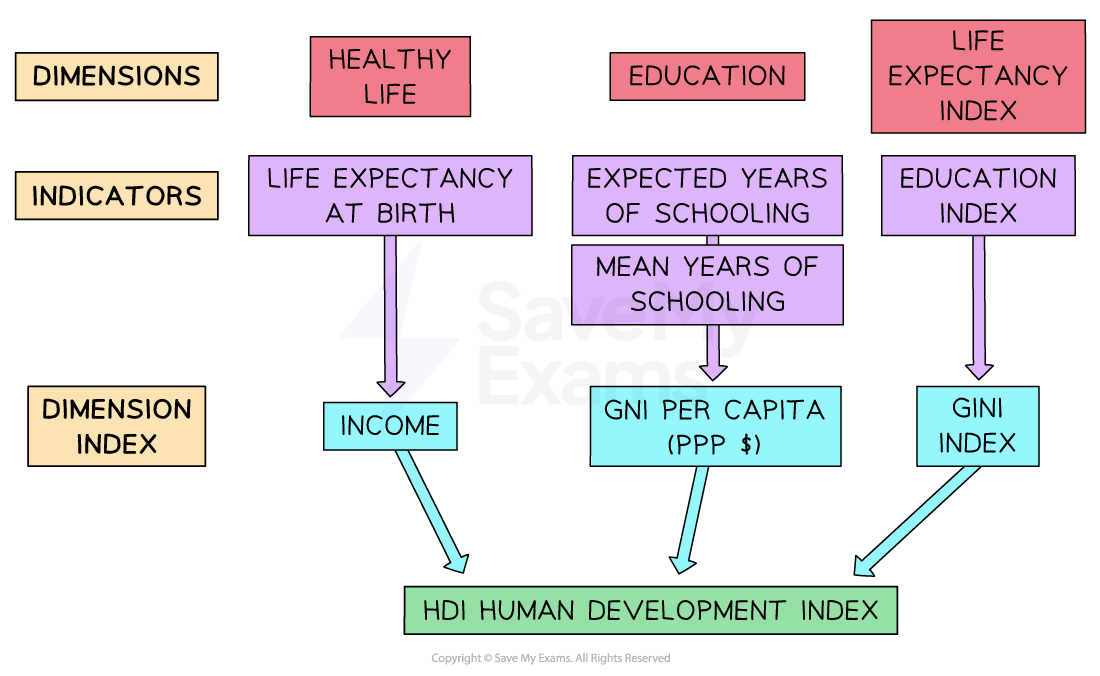
The components of the HDI
Examples of HDI values
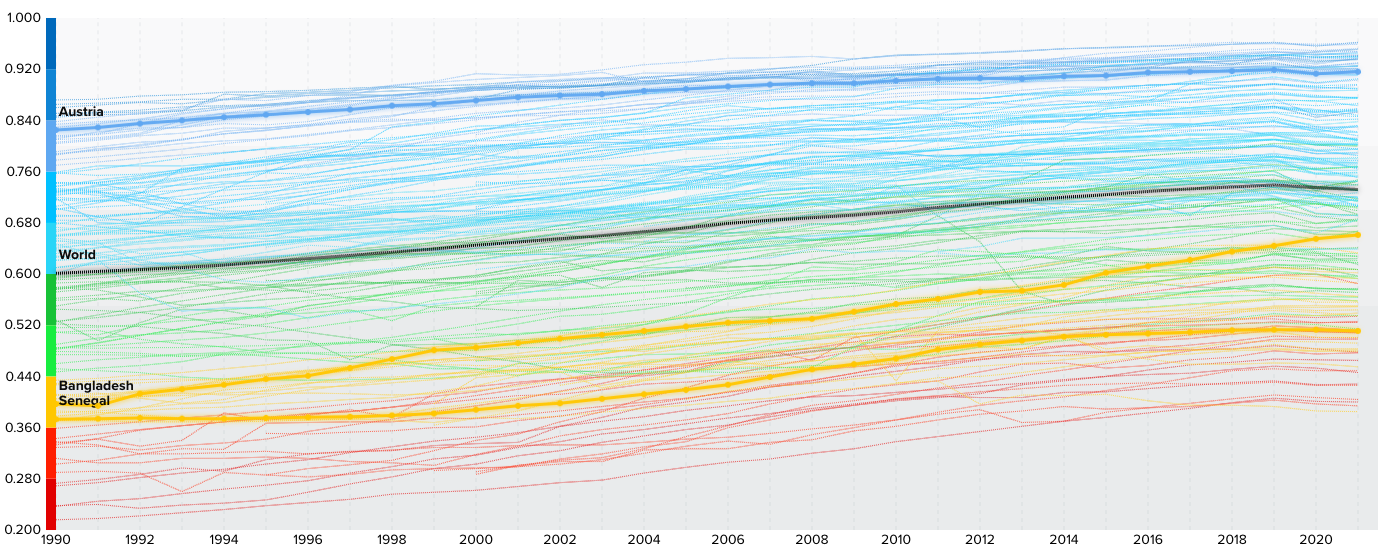
The Human Development Index scores from 1990 to 2021
Source: UNDP Data Centre
- A value of less than 0.550 is considered low development, e.g. Senegal was at 0.514 in 2021
- A value of 0.550-0.699 is considered medium development, e.g., Bangladesh was at 0.667 in 2021
- A value of 0.700-0.799 is considered high development; e.g., Thailand was at 0.777 in 2021
- A value ≥ 0.800 is considered very high development, e.g. Austria was at 0.918 in 2021
The advantages and disadvantages of using the HDI
- One of the main advantages is that the HDI is a composite indicator which provides a more useful comparison metric than single indicators do
| Advantages | Disadvantages |
|---|---|
| - It incorporates three of the most important metrics for households, i.e., health, education and income - It is widely used all over the world, which provides an opportunity for meaningful comparisons - It provides a goal for governments to use when developing their policies; e.g., it may help identify that the education levels are holding back improvements to the HDI, and government policy can target that - It provides citizens with an understanding of how their quality of life compares to other countries | - It does not measure the inequality that exists, as it uses the mean GNI per capita - It does not measure or compare the levels of absolute and relative poverty that exist - For many countries it does not provide useful short-term information, as gathering the data required for the calculation is difficult - This means the data often lags reality by several years |
Was this revision note helpful?
Build on this topic