National Minimum Wages (NMW) (Cambridge International IGCSE Economics)
Government policy: minimum wages
Spec point — "government policy, including national minimum wage (NMW) drawing and interpretation of diagrams that illustrate the effects of: – national minimum wages"
Government policy: minimum wages
-
Government's often intervene in the labour market by setting a minimum wage
- They do this in order to **improve equity *and avoid the exploitation of worker
-
A** minimum wage is a legally imposed wage level that employers must pay their workers
- It is set above the market rate
- The minimum wage/hour often varies based on age
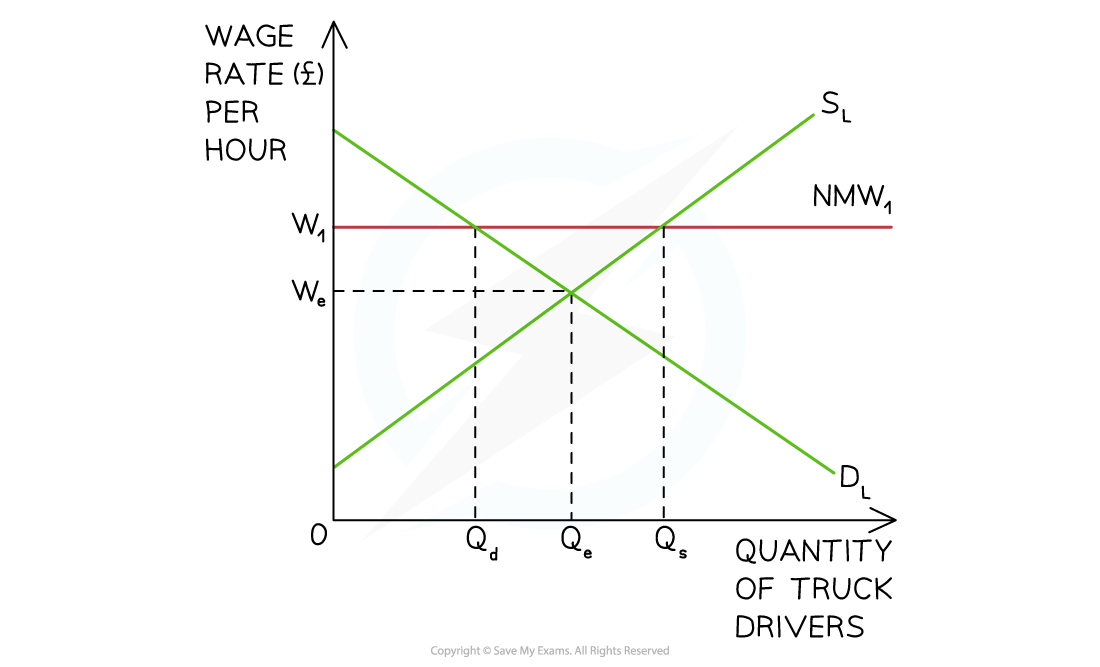
A national minimum wage (NMW1) is imposed above the market wage rate (We) at W1
Diagram analysis
- The market equilibrium wage and quantity for truck drivers in the UK is seen at WeQe
- The government imposes a national minimum wage (NMW) at W1
- Incentivised by higher wages, the supply of labour increases from Qe to Qs
- Facing higher production costs, the demand for labour by firms **decreases **from Qe to Qd
- This means that at a wage rate of W1 there is** excess supply of labour** and the potential for unemployment equal to QdQs
Case Study Switzerland’s National Minimum Wage
In 2020, voters in the canton of Geneva, Switzerland, approved the introduction of the world’s highest legal minimum wage at CHF 23 per hour (about USD $25). The measure was introduced to address concerns over the high cost of living in the region, particularly rent and food prices, which were making it difficult for low‑income workers to afford basic needs.
Impact on labour supply and demand
Supply of labour
- The higher legal wage encouraged more workers — including cross‑border commuters from France — to seek jobs in Geneva, increasing the supply of labour
Demand for labour
- Some small businesses, especially in hospitality and retail, reported reducing staff hours or delaying hiring to cope with higher wage bills, leading to a fall in labour demand
Potential unemployment
- In sectors heavily reliant on low‑paid labour, such as cleaning services, there were fears of an increase in unemployment if firms could not afford to retain all staff at the higher wage
Equity effects
- Supporters argued that the minimum wage improved fairness by ensuring workers earned a living income, reducing the risk of in‑work poverty
- Critics warned that it might harm job prospects for young and less‑skilled workers if firms cut roles to save costs
Lesson for policy
Switzerland’s example highlights the trade‑off governments face
- A national minimum wage can raise incomes for the lowest‑paid
- But if set significantly above the market equilibrium, it risks creating excess supply of labour and unemployment in vulnerable sectors
Exam Hint When evaluating national minimum wages, do not assume that they will automatically increase unemployment.
Many studies have shown that unemployment does not increase - and in some instances employment increases. This is likely due to the fact that workers are receiving higher wages and choose to consume more. This increases total demand in the economy, which in turn increases the demand for labour by firms - thus reducing or eliminating any potential unemployment.
Was this revision note helpful?
Build on this topic