Free Trade (Cambridge International IGCSE Economics)
Exam board Cambridge International · IGCSEUpdated 2025-08-19
The advantages of free trade
Spec point — The advantages of free trade
- Free trade is the exchange of goods and services between countries without any trade barriers, such as tariffs, quotas or import bans
- This means countries can buy and sell freely with each other, allowing for more open access to foreign markets
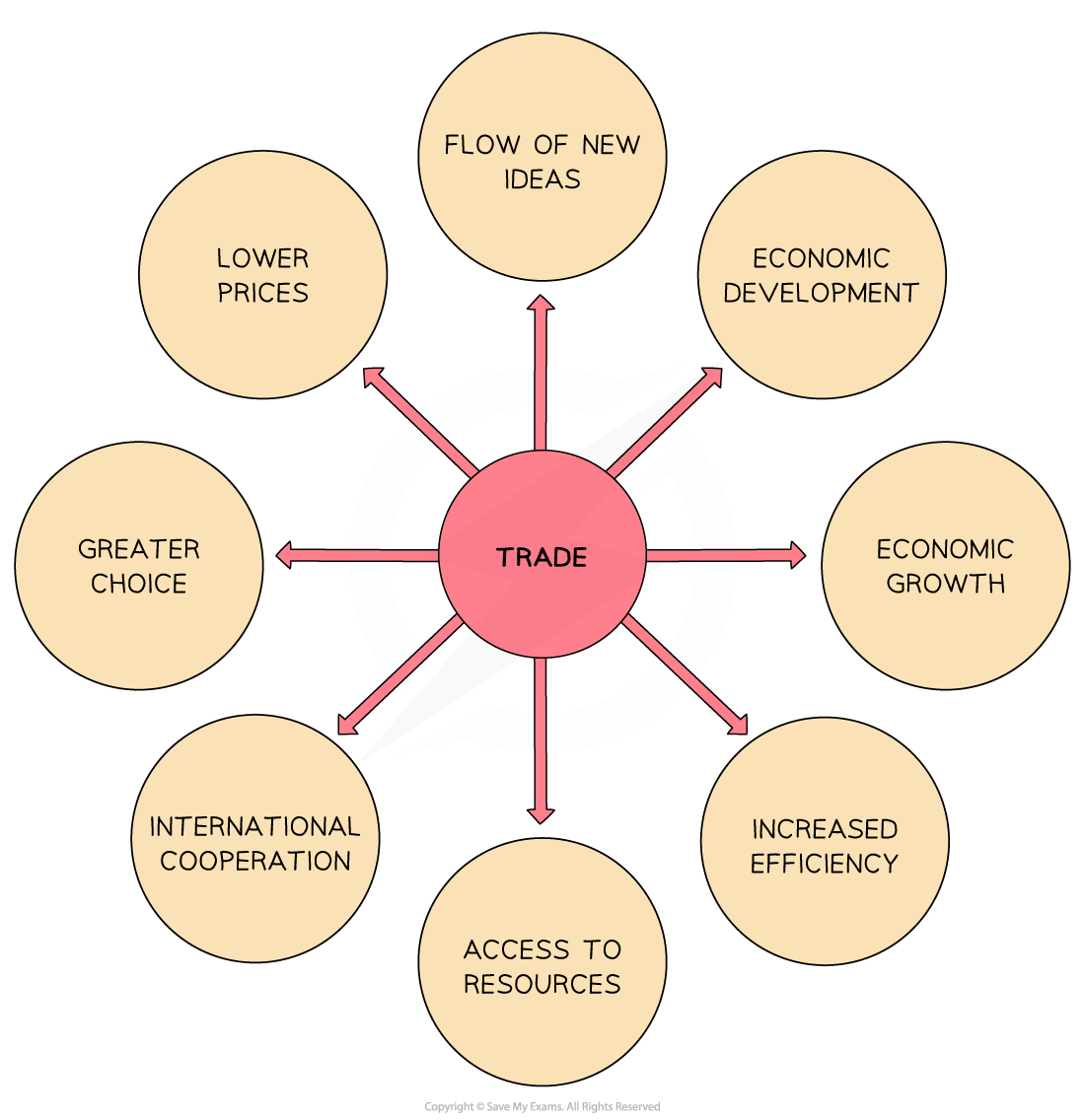
The benefits of free trade
-
Greater choice
- With access to a wider variety of goods/services, the standard of living improves
-
Lower prices
- With international competition prices fall, giving households the ability to buy more
-
International cooperation
- Required for trade, it helps countries to build better relationships, which leads to lower levels of hostilities
-
Flow of new ideas
- Innovative ideas and technology can be shared between countries
-
Access to resources
- Output can increase and costs of production can fall with increased access to raw materials
-
Increased efficiency
- International competition allows the most efficient firms to emerge and this improves the use of global resources
-
Economic growth
- Exports are a key component of the gross domestic product of many countries and an increase in exports can lead to economic growth
-
Economic development
- Increased output leads to lower levels of unemployment, which leads to higher incomes and a higher standard of living
The disadvantages of free trade
Spec point — The disadvantages of free trade
-
Harm to domestic industries
- Without protection from foreign competition, local firms may struggle to survive
- This can lead to business closures and job losses in certain sectors
-
Over-dependence on imports
- Countries may rely too heavily on other nations for essential goods, such as food, fuel or medicine
- This can be risky if global supply chains are disrupted
-
Job losses
- Free trade can lead to structural unemployment as less competitive industries shrink or shut down in the face of cheaper imports
-
Worsening trade balance
- Some countries may import more than they export, leading to trade deficits which can create long-term economic problems
-
Unequal gains
- While some countries and firms benefit, others may be left behind
- Smaller or less developed economies can find it hard to compete fairly
-
Environmental damage
- Transporting goods across the world increases carbon emissions
- Also, some countries may ignore environmental standards to stay competitive
-
Exploitation risks
- Firms may shift production to countries with lower wages and weaker labour laws, leading to poor working conditions and inequality
Was this revision note helpful?
Build on this topic