Effects of Changing Population Sizes (Cambridge International IGCSE Economics)
The optimum population
Spec point — The optimum population
-
Overpopulation occurs when there are more people in a country/region than can be supported by its resources and technology and leads to
- Higher levels of pollution
- Higher crime rates
- Higher unemployment or underemployment
- Higher levels of food and water shortages
- Higher pressure on services such as hospitals and schools
-
Underpopulation occurs when there are more resources available than the population can use effectively and may lead to
- Fewer people paying tax which can lead to higher taxes
- Underused resources, which can lead to wastage
- A shortage of workers
- Lower levels of exports and production, which affects the wealth of an area
- Fewer customers for goods and services
-
Optimum population occurs when there is a balance between the number of people and available resources/technology
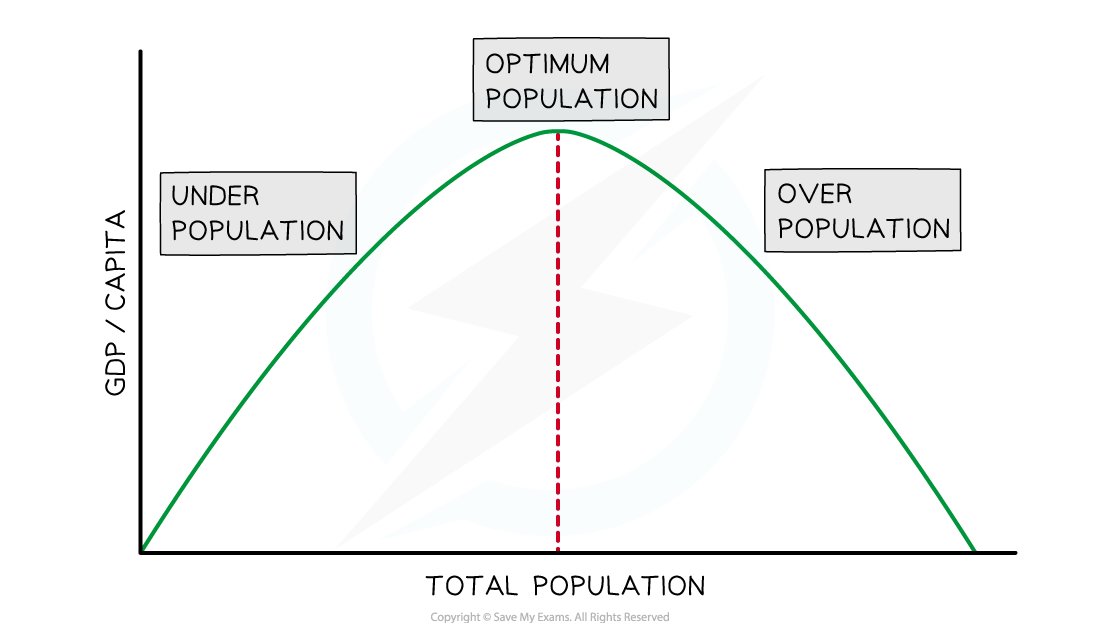
Optimum theory of population
-
The optimum population results in the highest standard of living
- There are not so many people or so few resources that the standard of living falls
- There are enough people to develop the resources of the country
Exam Hint It is important to remember that overpopulation does not just mean there are a lot of people, and underpopulation means there are few people. The terms refer to the balance between population and resources. There may be many people in a country, but it is only overpopulated when there are too few resources to support that population.
Population distribution
Spec point — Population distribution
-
The characteristics of a population ( the distribution of age, sex, ethnicity, religion etc), is known as the population structure
-
The population structure is the result of changes in:
- the birth rate
- the death rate
- net migration
-
The two main characteristics of age and sex can be shown on a population pyramid
Population pyramids
-
Population pyramids are used to display the gender and age structure of a given population
- They illustrate the distribution of population across age groups and between male/female
-
Population pyramids can be used to identify the following groups:
- Young dependents
- Old dependants, e.g. number of retired people
- Economically active (working population or labour force)
- Dependency ratio
Example 1: Niger as a less economically developed country (LEDC)
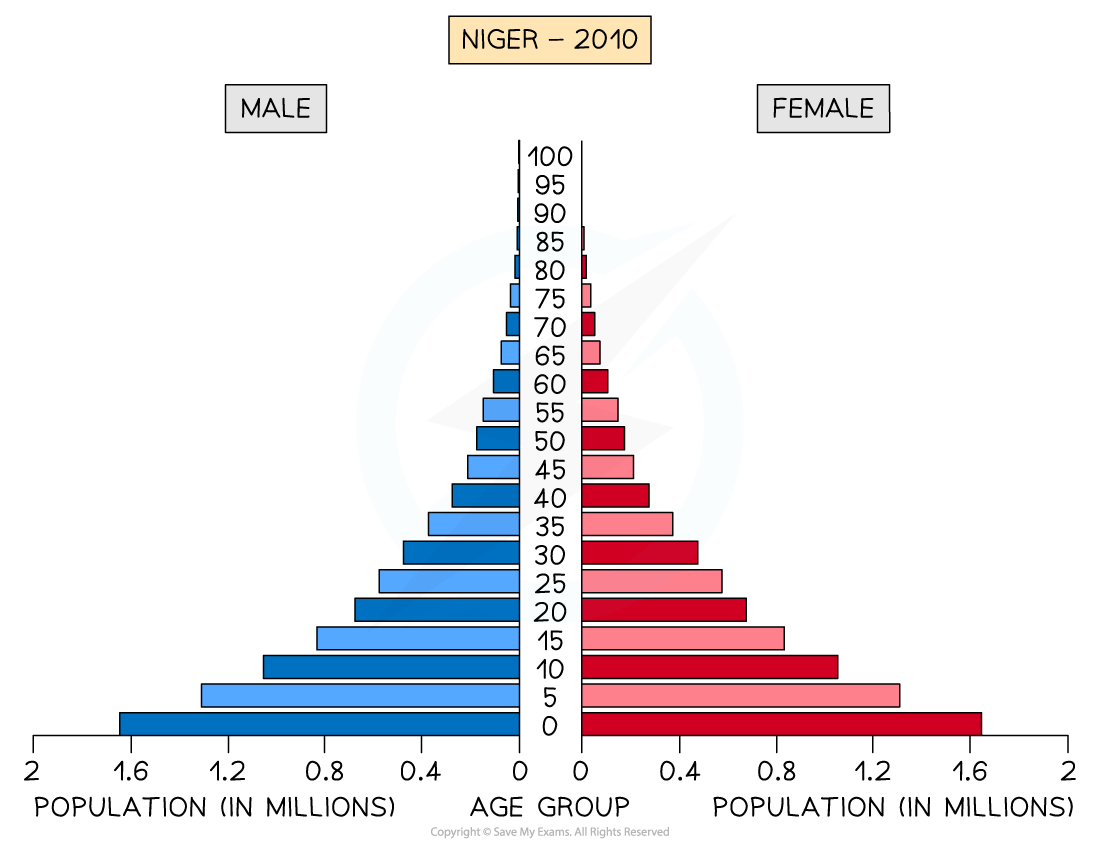
Population Pyramid - Niger
-
LEDCs like Niger have a concave pyramid shape which indicates
- High birth rate
- Low life expectancy
- High death rate but starting to decrease (people dying through every age group)
- High infant mortality rate (significant decrease between 0-5)
- Young dependent population dominates the distribution
Example 2: USA as a more economically developed country (MEDC)
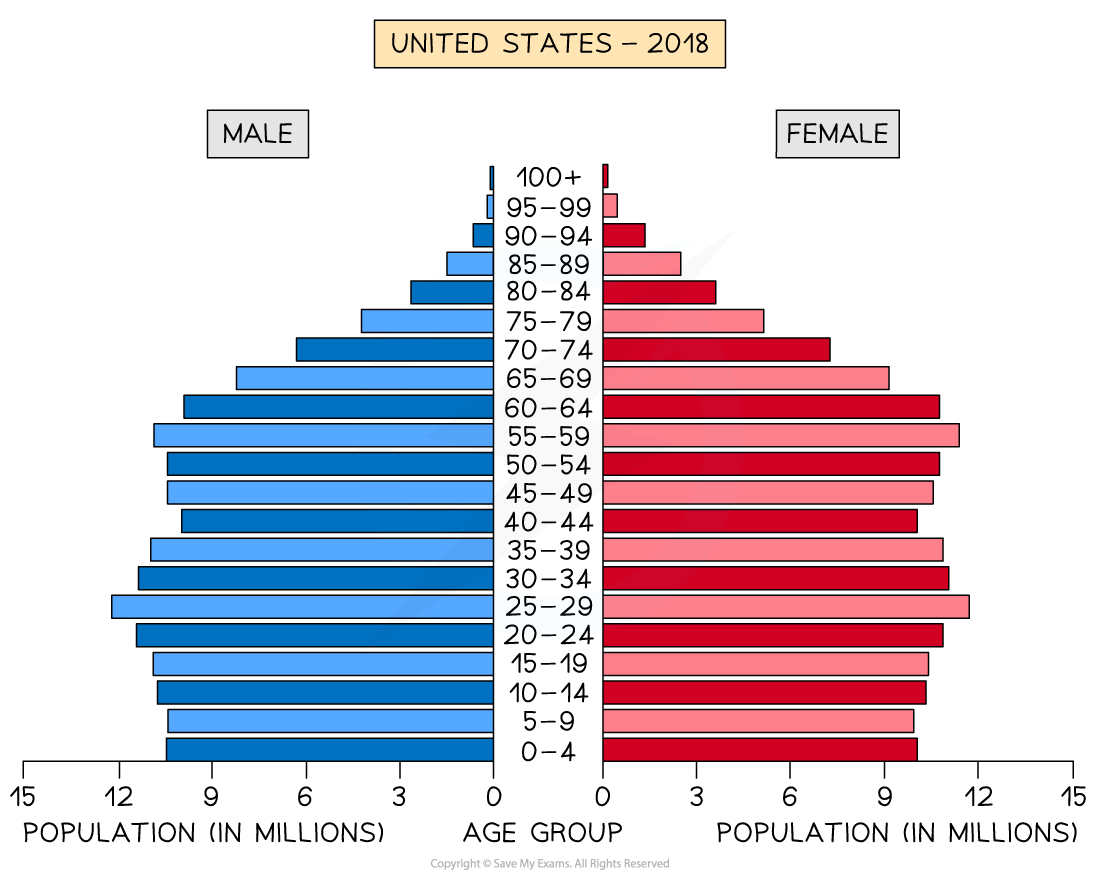
*Population Pyramid - USA *
-
This population pyramid indicates:
- Decreasing birth rate - there is a smaller population reading down from age 29
- Increasing life expectancy– indicated by the relatively straight sides reaching the age of 70, followed by a good proportion of people living much longer
- Decreasing death rate– indicated by the relatively straight sides reaching the age of 70
- Low infant mortality - hardly any change between 0-9 years
- Larger working age population - 15 to 69 represents a large proportion of the population
Exam Hint Population pyramids are not included in your examination. We have left them in here, as they are a useful tool for understanding the term 'population distribution'. The visual pyramid quickly helps us to understand differences in population distribution.
Effects of population changes
Spec point — Effects of population changes
-
Population changes can have major impacts within the economy, resulting in changes to consumption, production, lifestyle, standards of living and government policies (fiscal, monetary and supply-side)
-
Typical changes that occur are
- Progressively ageing populations as economies develop
- Falling birth rates as economies develop
- Swings in net migration as influenced by war, famine, natural disasters and government policy
Ageing populations
-
Many developed economies are experiencing ageing populations and an increase in the older dependent population
-
The implications of this include
- Increased pension payments by governments
- Increased need for care homes (public and private)
- Increased pressure on the healthcare service and social care results in higher government spending
- It also results in a smaller labour force and often Governments collect less tax
- Firms suffer worker shortages
- Labour shortages result in increased wage costs for firms
Falling birth rates
-
Falling birth rates have the following impact on an economy
-
School closures due to fewer children
-
Future labour shortages
-
Governments typically put in place incentives that encourage families to have more children
-
Governments may change the migration laws to encourage immigration so that labour shortages are prevented
- Excessive immigration can change the nature and culture of different regions within a country
-
Migration
-
In some countries migration can lead to an imbalance in the population structure e.g. the UAE has significantly more males than females
-
Rapid population growth caused by migration can lead to
- Increased pressure on services such as healthcare and schools resulting in increased costs for government
- A shortage of housing which generates social issues in society
- Increased traffic congestion, which is a negative externality
- Increased water and air pollution, which are negative externalities
- Food shortages
Was this revision note helpful?
Build on this topic