Economies & Diseconomies of Scale (Cambridge International IGCSE Economics)
An Introduction to Economies and Diseconomies of Scale
Spec point — How internal and external economies and diseconomies of scale can affect a firm/industry as the scale of production changes.
An Introduction to Economies and Diseconomies of Scale
-
As a firm grows, it is able to increases its scale of output generating efficiencies that lower its average costs (AC) of production
- These efficiencies are called economies of scale
- Economies of scale help large firms to lower their costs of production beyond what small firms are able to achieve
-
As a firm continues increasing its scale of output, it will reach a point where its average costs (AC) will start to increase
- The reasons for the increase in the average costs are called diseconomies of scale
-
Internal economies of scale occur as a result of the growth in the scale of production within the firm
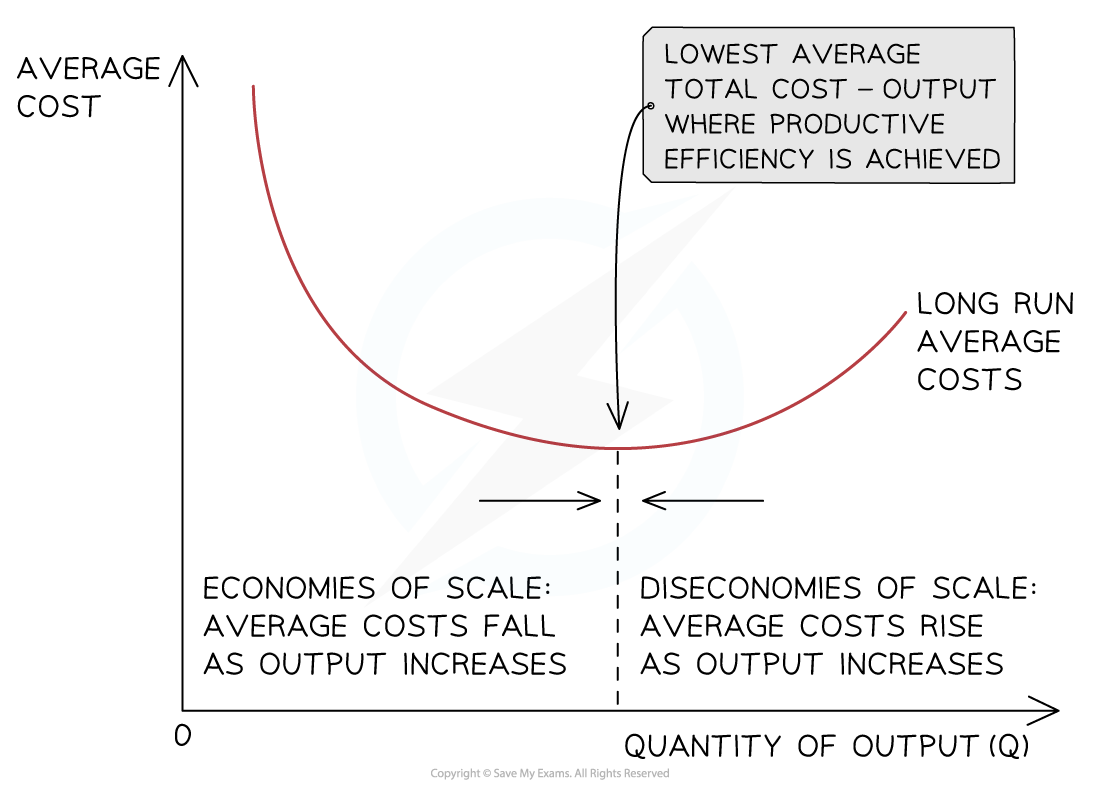
* Economies of scale occur when average costs decrease with increasing output and diseconomies of scale occur when average costs increase with increasing output*
Diagram analysis
- With relatively low levels of output, the firms average costs are high
- As the firm increases its output, it begins to benefit from economies of scale which lower the average cost per unit
- At some level of output, a firm will not be able to reduce costs any further - this point is called productive efficiency
- Beyond this level of output, the average cost will begin to rise as a result of diseconomies of scale
Types of Internal Economies and Diseconomies
Spec point — How internal and external economies and diseconomies of scale can affect a firm/industry as the scale of production changes.
Types of Internal Economies and Diseconomies of Scale
| Internal Economies of Scale | Diseconomies of Scale |
|---|---|
| - Financial Economies - Managerial Economies - Marketing Economies - Purchasing Economies - Technical Economies - Risk-bearing Economies | - Management Diseconomies - Communication Diseconomies - Geographical Diseconomies - Cultural Diseconomies |
External Economies of Scale
Spec point — How internal and external economies and diseconomies of scale can affect a firm/industry as the scale of production changes.
-
External economies of scale occur when there is an increase in the size of the industry in which the firm operates
- The firm is able to benefit from lower average costs (AC) generated by factors outside of the firm
Sources of External Economies of Scale
| Source | Explanation |
|---|---|
| Geographic Cluster | - As an industry grows, ancillary firms move closer to major manufacturers to cut costs and generate more business - This lowers the AC e.g. car manufacturers in Sunderland rely on the service of over 2,500 ancillary firms |
| Transport Links | - Improved transport links develop around growing industries in order to help get people to work and to improve the transport logistics - This **lowers the AC **e.g. Bangalore is know as India's Silicon Valley and transportation projects have been successful in transforming the movement of people and goods |
| Skilled Labour | - An increase in skilled labour can lower the cost of skilled labour, thereby lowering the AC - The larger the geographic cluster, the larger the pool of skilled labour |
| Favourable Legislation **** | - This often generates significant reductions in AC as governments support certain industries in order to achieve their wider objectives |
Was this revision note helpful?
Build on this topic