Policies to Alleviate Poverty (Cambridge International IGCSE Economics)
Exam board Cambridge International · IGCSEUpdated 2024-06-27
Policies Aimed at Alleviating Poverty
Spec point —
5.2.2· Policies including those promoting economic growth, improved education, more generous state benefits, progressive taxation, and national minimum wage.
- The poverty cycle diagram (below) was introduced in the previous subtopic and helps to explain the causes of poverty
- Any policy that helps to break the poverty cycle at any point will help to improve the standards of living within a country
- Policies used to alleviate poverty include promoting economic growth, improving education, providing more generous state benefits, progressive taxation, and the establishment/increase of a national minimum wage
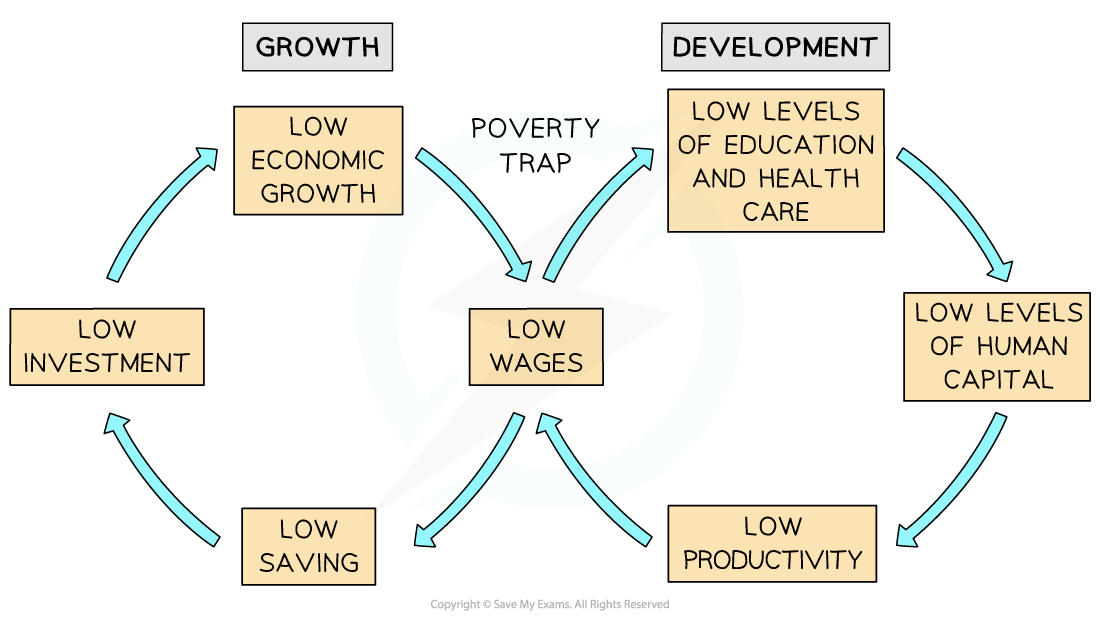
Policies which help to improve any factor in the diagram will help to alleviate poverty
How Different Policies Alleviate Poverty
| Policy | Explanation | Impact on Poverty Cycle |
|---|---|---|
| Promoting economic growth | - Removing protectionism or engaging in expansionary demand and supply-side policies will promote growth - Data shows that economic growth has a very positive impact on economic development - In most cases growth precedes development - Often in less developed countries, economic growth is linked to one industry and generates many negative externalities of production possibly resulting in decreased living standards | Higher growth → higher wages → better education/healthcare → better human capital → better productivity → higher income |
| Improving education | - Investing in this supply-side policy increases the potential output of the country (shifts the production possibility frontier outwards) | Higher education/skill levels → higher human capital → increased productivity → higher output → higher income |
| More generous state benefits | - State benefits are usually given to the poorest and most vulnerable people in society - State benefits include unemployment and disability payments, pension payments, heating discounts, public transport subsidies etc. | More benefits → higher wages → better education/healthcare → better human capital → better productivity → higher wages |
| Progressive taxation | - A progressive tax system redistributes from those with higher income to those with lower income and reduces income inequality - Redistribution often starts with the provision of free education and healthcare - Sometimes the benefits of a good progressive tax system are eradicated by the penalties imposed through multiple regressive (indirect) taxes | Higher redistribution → better education/healthcare→ better human capital → better productivity → higher income |
| Establishment/increase of national minimum wage | - Minimum wages are set above the free market rate - Firms are not allowed to pay anyone less than the legal rate | Higher wages → better education/healthcare → better human capital → better productivity → higher wages |
Was this revision note helpful?
Build on this topic