The Five Macroeconomic Aims (Cambridge International IGCSE Economics)
Economic Growth
Spec point —
4.2.1· Economic growth, full employment/low unemployment, stable prices/low inflation, balance of payments stability, redistribution of income. Reasons behind the choice of aims and the criteria that governments set for each aim.
-
Economic growth is a central macroeconomic aim of most governments
-
Many developed nations have an annual target growth rate of 2-3%
- This is considered to be sustainable growth
- Growth at this rate is less likely to cause excessive demand pull inflation
-
Politicians often use it as a metric of the effectiveness of their policies and leadership
-
Economic growth has positive impacts on confidence, consumption, investment, employment, incomes, living standards and government budgets
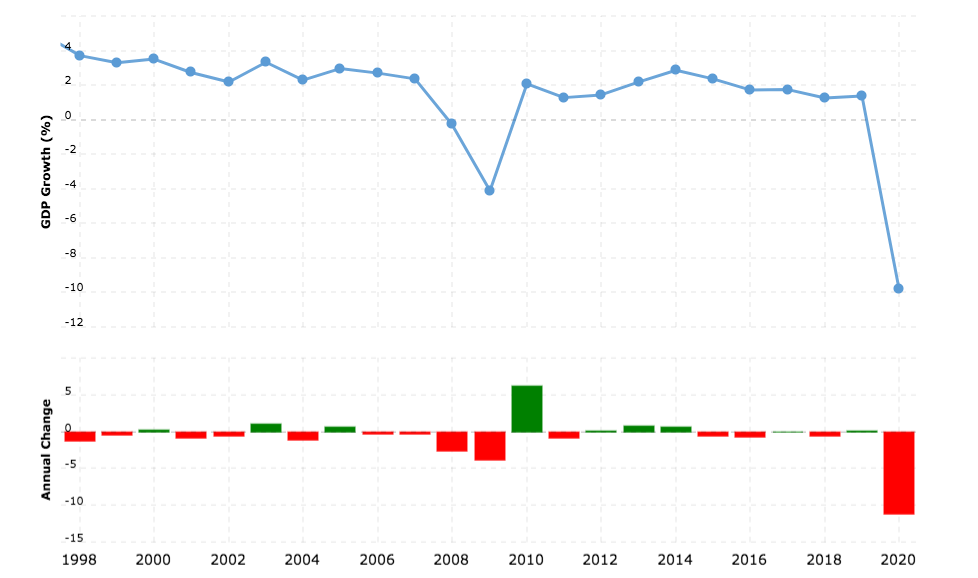
A diagram showing the economic growth rate of the UK since 1998 Source: Macrotrends
A Table Highlighting Some of the Economic Growth Trends in the UK Since 1998
| 1998-2007 | 2008-2015 | 2016-2019 | 2020 - |
|---|---|---|---|
| - Steady growth fluctuating between 2-4% | - Global financial crisis followed by rapid bounce back due to government intervention - and then steady growth | - Gradual disinflation possibly due to future expectations regarding the impact of the Brexit vote | - Supply chain issues due to Brexit. - Decreased consumption due to the impact of Covid 19. - These created a deep recession (short-lived due to government intervention) |
Low Unemployment
Spec point —
4.2.1· Economic growth, full employment/low unemployment, stable prices/low inflation, balance of payments stability, redistribution of income. Reasons behind the choice of aims and the criteria that governments set for each aim.
-
Someone is considered to be unemployed if they do not have a job and are actively seeking for one
-
The target unemployment rate often depends on the size of the economy e.g. India finds a rate of 6.5% good whereas Singapore aims for it to be under 2%
-
The closer an economy is to the **full employment level **of labour, the better (more efficiently) it is using its human resources
-
Within the broader** unemployment rate**, there is an increased emphasis on the unemployment rate within different sections of the population
-
E.g. Youth unemployment, ethnic/racial unemployment by group
- In 2021, black unemployment in the USA was 8.7% and white unemployment was 4.7%
-
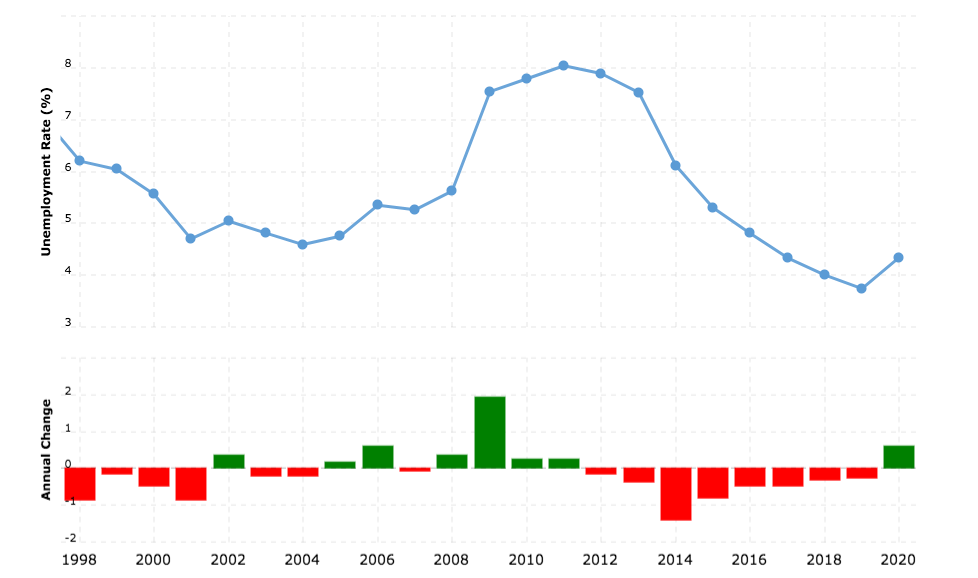
A diagram showing the unemployment rate in the UK from 1998 - 2020 Source: Macrotrends
-
Unemployment tends to be inversely proportional to real GDP growth
- When real GDP increases, unemployment falls
- When real GDP decreases, unemployment rises
-
Unemployment in the UK remained relatively high for the six years following the global financial crisis of 2007
Low and Stable Rate of Inflation
Spec point —
4.2.1· Economic growth, full employment/low unemployment, stable prices/low inflation, balance of payments stability, redistribution of income. Reasons behind the choice of aims and the criteria that governments set for each aim.
-
Most economies have a target inflation rate of 2% using the Consumer Price Index (CPI)
-
A low rate of inflation is desirable as it is a symptom of economic growth
-
The different causes of inflation (cost push or demand pull) require different policy responses from the Government
- Demand-side policies ease demand pull inflation
- Supply-side policies ease cost push inflation
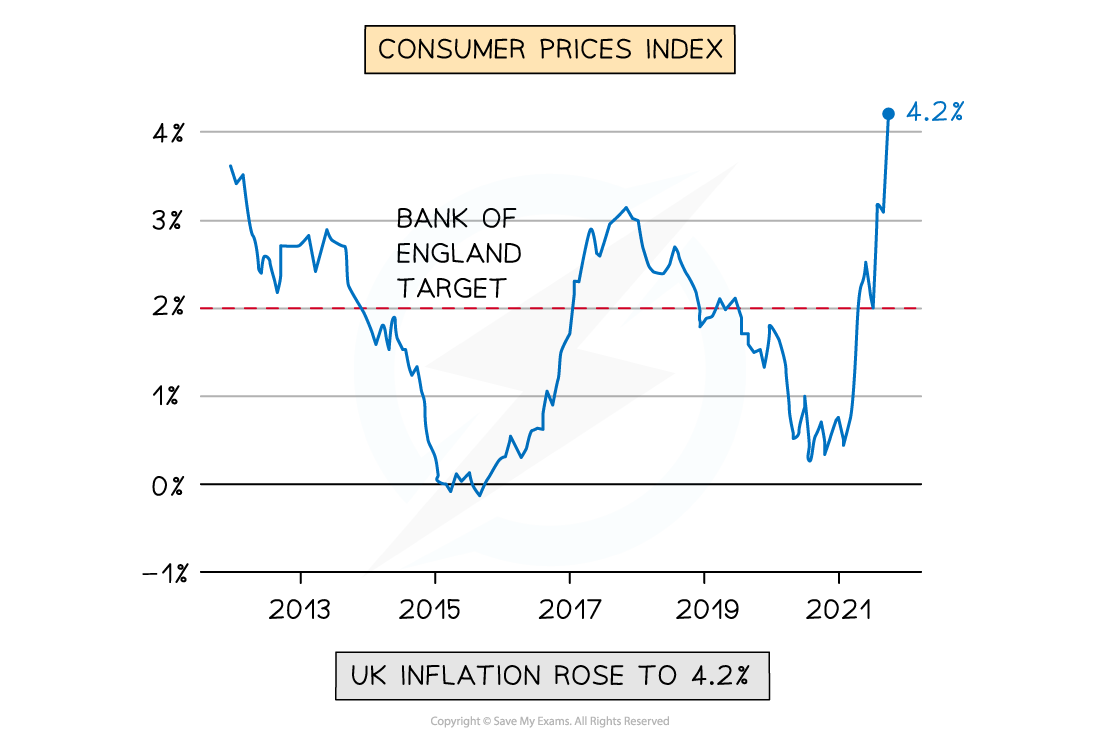
A diagram illustrating the inflation rate in the UK from 2012 to 2021 using the CPI
-
In the UK, a continual deviation from the target of 2% would not be considered as stable
- An inflation rate in April 2022 of 4-5% was considered to be unstable, eroding household purchasing power
-
A low and stable rate of inflation is important as it
- Allows firms to confidently plan for future investment
- Offers price stability to consumers
Balance of Payments Stability on the Current Account
Spec point —
4.2.1· Economic growth, full employment/low unemployment, stable prices/low inflation, balance of payments stability, redistribution of income. Reasons behind the choice of aims and the criteria that governments set for each aim.
-
The Balance of Payments (BoP) for a country is a record of all the financial transactions that occur between it and the rest of the world
- The current account focuses mainly on the financial transactions related to exports and imports of goods/services
-
Governments aim for Balance of Payments equilibrium on the Current Account
-
If exports > imports it will create a current account surplus
-
If imports > exports, it will create a current account deficit
- Each one of these conditions has advantages/disadvantages associated with it
- However, a current account deficit is more problematic in the long-run
-
-
The UK has traditionally run a small deficit
- As a % of GDP the UK current account deficit is insignificant so has not been problematic
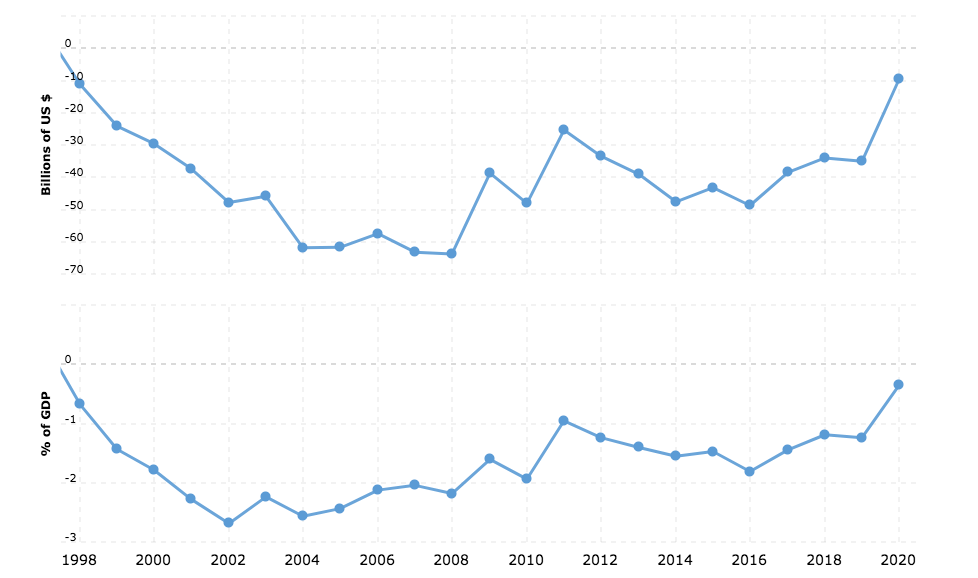
A diagram showing the UK Trade Deficit from 1998 to 2020. The bottom graph illustrates the trade deficit as a % of GDP and the top one illustrates the absolute value expressed in US$ Source: Macrotrends
-
In the diagram above the trade deficit has been falling steadily since 2016
- During this time period the value of exports was increasing slightly faster than the value of imports
The Redistribution of Income
Spec point —
4.2.1· Economic growth, full employment/low unemployment, stable prices/low inflation, balance of payments stability, redistribution of income. Reasons behind the choice of aims and the criteria that governments set for each aim.
-
The redistribution of income aims to reduce income inequality in an economy
- High levels of income inequality create social unrest and can ultimately lead to revolutions
- Perfect income equality is not desirable as it removes the incentive to work and study
-
Governments aim to redistribute income by taxing the wealthy and providing welfare payments to the poor
-
Unchecked capitalism has a natural outcome of high income inequality
- The wealthy are able to keep buying factors of production
- The concentration of ownership becomes more and more narrow with fewer individuals owning the bulk of the world's wealth
-
There is a need for governments to intervene to maintain acceptable levels of income inequality
-
Absolute poverty is usually worse in developing countries. However, in a developed economy such as Germany, a 1% increase in income inequality can push a lot more households into relative poverty
Was this revision note helpful?