Break-Even Calculations (Cambridge International IGCSE Business)
Calculating break-even
Spec point — "• Calculate break-even output from given data • Define, calculate and interpret the margin of safety • Use break-even analysis to help make simple decisions, e.g. impact of higher price"
Calculating the break-even point
-
The break-even point can be calculated using one of two formulas
- The first calculates the number of units which need to be sold to break-even
- The second calculates the value of the costs and revenue at which point the firm breaks even
Worked Example Mięsisty Burgers has the following financial information for the month of May
€ May Raw materials for each burger 2.10 Packaging for each burger 0.20 Fixed costs 1730 Selling price of each burger 4.95 (a) Using the information in the table, calculate the level of output required to break even in May. You are advised to show your workings (3 marks)
Step 1: Calculate the variable costs per burger
Final answer:
(1 mark)
Step 2: Substitute the values into the break-even formula
Final answer: (2 marks)
Step 3: Round to the nearest unit
653 burgers need to be sold to break even in May (2 marks for a correct answer)
Exam Hint Always round up the break even point to the nearest whole unit
The margin of safety
- The margin of safety is the amount by which the number of units sold is greater than the break even point
- The margin of safety provides useful information to a firm on how many sales they could lose before they start making a loss
- The margin of safety can be calculated using the following formula:
-
Businesses want their margin of safety to be as large as possible
- This means that if demand for their products drops unexpectedly, the business will continue to make a profit
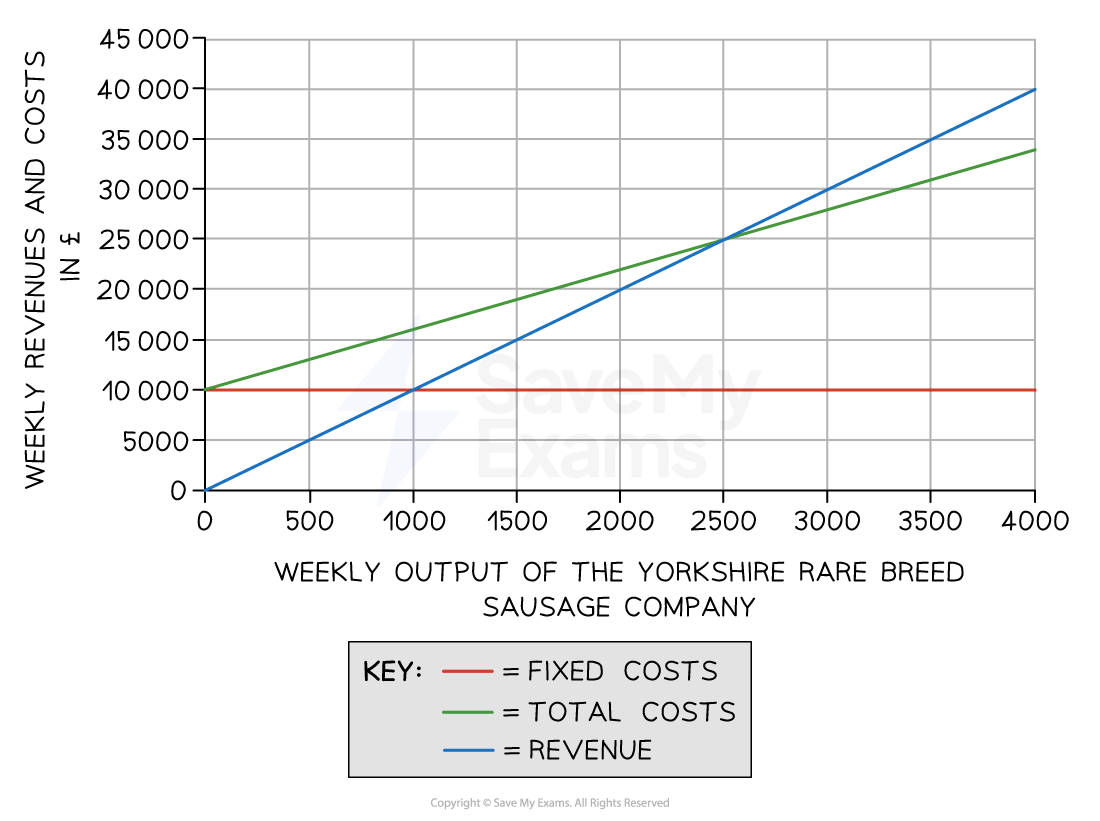
Worked Example Figure 1 shows the weekly break-even diagram for the Yorkshire Rare Breed Sausage Company.
Output, costs and revenues of the Yorkshire Rare Breed Sausage Company
Using Figure 1 above, calculate the weekly margin of safety. Show your workings and the formula used. (3)
Step 1: Write the formula down
(1 mark)
Step 2: Read from the chart and substitute values into the formula
Final answer: (1 mark for any correct working; 3 marks for the correct answer)
Exam Hint Use a ruler to help you to read break-even charts accurately.
Using break-even analysis to make decisions
-
Break-even calculations are a useful tool for a business to use in deciding how much to produce and calculating estimated levels of profit
-
It is particularly useful for communicating with stakeholders, including investors or lenders
- Knowing when the business will break-even or how much profit it is expected to make may attract or deter shareholders from investing in the business
-
Break-even analysis provides a basis for informed decision making
-
It helps the business to assess the costs and expected returns of new projects and expansion plans
- By considering the break-even point, businesses can assess the potential risks and rewards associated with different decisions
-
Ways in which break-even is used in decision making
Assessing the profit or loss
- It allows businesses to assess their profitability by determining the minimum level of sales needed to cover all costs
- It helps identify the level of sales required to avoid losses and provides a target for achieving profits
Managing the costs
- Break-even analysis helps in identifying fixed and variable costs and their impact on the business
- By understanding the cost structure businesses can evaluate their spending patterns and reduce unnecessary expenses
Pricing decisions
- Break-even analysis provides insights into pricing decisions by helping businesses determine the minimum price required to cover costs and achieve the desired level of profit
- It ensures that prices are set at a level that generates sufficient revenue to meet expenses and generate profits
Financial planning
- Break-even analysis assists in financial planning by providing a reference point for target setting, such as realistic sales targets and plans for necessary expenses
Redrawing the graph with changes
- Break-even analysis allows businesses to see the impact of changes in variables such as costs, prices, and sales volumes on the break-even point
- This helps in understanding the potential risks and uncertainties, such as a new competitor entering the market or suppliers increasing prices
Performance monitoring
- Break-even analysis serves as a benchmark for monitoring business performance over time
- By comparing actual sales and costs against the break-even point, businesses can assess their financial health and track progress
Was this revision note helpful?