Sexual Reproduction in Plants (Cambridge International IGCSE Biology)
Insect pollinated flowers
Spec point —
16.1.3· nan
-
Flowers are the reproductive organs of plants
-
The role of flowers is to enable plant sex cells, or gametes to come together in fertilisation
- The male gametes of plants are found in pollen grains
- The female gametes of plants are in ovules
-
The process by which pollen is transferred from the male part of a flower to the female part of a flower is known as pollination; this can be carried out in various ways, e.g. by insects or by wind
Insect pollinated flower structure
-
The most well known flower structure is that of the insect pollinated flower
-
The parts of an insect pollinated flower include:
- sepals
- petals
- stamens
- filaments
- anthers
- carpel
- style
- stigma
- ovary
- ovules
-
Insect pollinated flowers are adapted to allow insects to collect pollen from the male parts of the flower and easily transfer it to the female parts of another flower
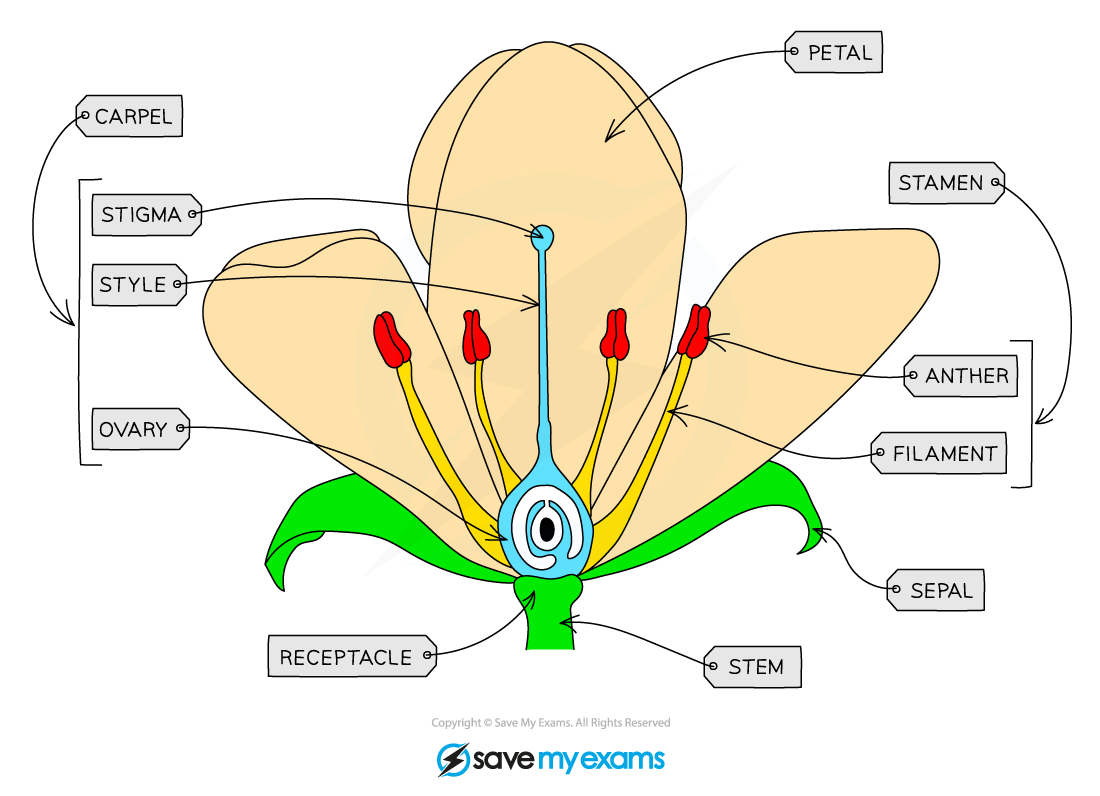
Insect pollinated flowers are adapted to attract insects and aid insect pollination
Flower structure and function table
| Structure | Description |
|---|---|
| Sepal | Protects unopened flower |
| Petals | Brightly coloured in insect-pollinated flowers to attract insects |
| Anther | Produces and releases pollen |
| Filaments | Provides support to the anther |
| Stigma | Sticky top of the female part of the flower which collects pollen grains |
| Style | A tube that connects the stigma and ovary |
| Ovary | Contains the ovules |
| Ovule | Structures inside the ovary that contain the female gametes |
Wind pollinated flowers
Spec point —
16.1.3· nan
-
Wind pollinated flowers are adapted so that wind can easily catch pollen grains and carry them to the stigmas of other flowers
-
The anthers and stigmas of wind pollinated flowers hang outside the flower so that:
- pollen can easily be blown away by the wind
- pollen can easily be caught by the stigmas of other flowers
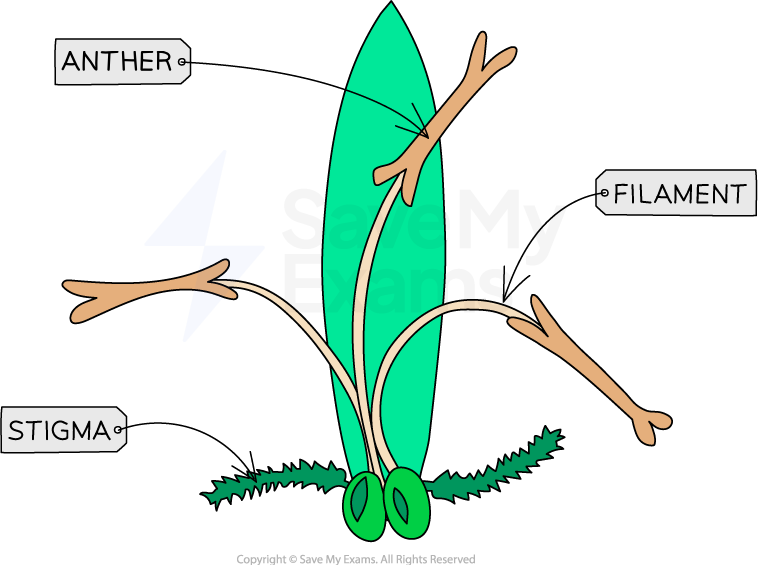
Wind pollinated flowers have anthers that hang outside the flower on long filaments, and feathery stigmas that can catch pollen easily
Pollination & fertilisation
Spec point —
16.1.3· Distinguish between the pollen grains of insect-pollinated and wind-pollinated flowers Describe pollination as the transfer of pollen grains from an anther to a stigma State that fertilisation occurs when a pollen nucleus fuses with a nucleus in an ovule Describe the structural adaptations of insect-pollinated and wind-pollinated flowers
Pollination & fertilisation
Pollen and pollination
-
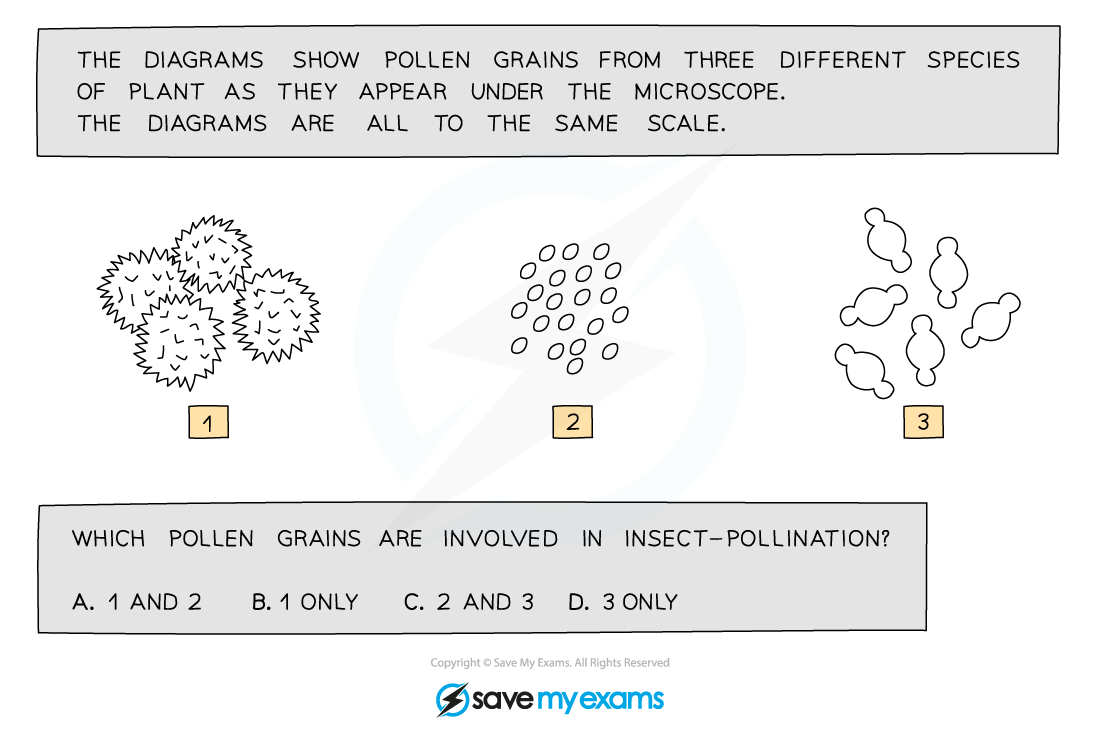
The pollen of different types of flower is adapted to aid pollination:
- Insect-pollinated flowers produce larger, heavier pollen grains that often contain spikes or hooks on the outside so they are better able to stick to insects
- Wind-pollinated flowers produce small, lightweight pollen grains that can be caught and carried easily by the wind
Worked Example
Observe the features of the different pollen grains
- The pollen grains are large and have spikes around the outside
- The pollen grains are small and smooth
- The pollen grains are medium-sized and have wing-like structures on each side
Consider how each feature may relate to the pollination method
- Large pollen grains are likely to be too heavy to be picked up by the wind, and spikes will mean that they can catch onto the bodies of insects
- Small pollen grains will be light enough to be carried by the wind
- Wing-like structures will catch the wind easily
Final answer: Answer:
- B 1 only
Pollination in insect and wind pollinated flowers
- Insect and wind pollinated flowers have structural adaptations which aid pollination:
Structural adaptations of an insect pollinated flower table
| Feature | Insect pollinated flower |
|---|---|
| Petals | Large and brightly coloured to attract insects |
| Scent and nectar | Scent and nectar are produced to encourage insects to visit the flower and push past stamen to get to nectar |
| Anthers | Held on stiff filaments within the flower so that they brush against insects |
| Stigma | Sticky stigmas within the flowers catch pollen grains when insects brush past |
Structural adaptations of a wind pollinated flower table
| Feature | Wind pollinated flower |
|---|---|
| Petals | Small and dull, often green or brown in colour |
| Scent and nectar | Scent and nectar are not produced; this would be a waste of energy |
| Anthers | Held on long filaments outside the flower to release pollen grains easily into the wind |
| Stigma | Feathery stigmas outside the flower catch airborne pollen grains |
Pollination and fertilisation
- Pollination can be defined as:
The transfer of pollen grains from an anther to a stigma
- This is distinct from fertilisation, which is:
The fusion of a pollen nucleus with an ovum nucleus
- After pollination, the pollen nuclei travel to the ovule and fuse with female gametes in a process called fertilisation
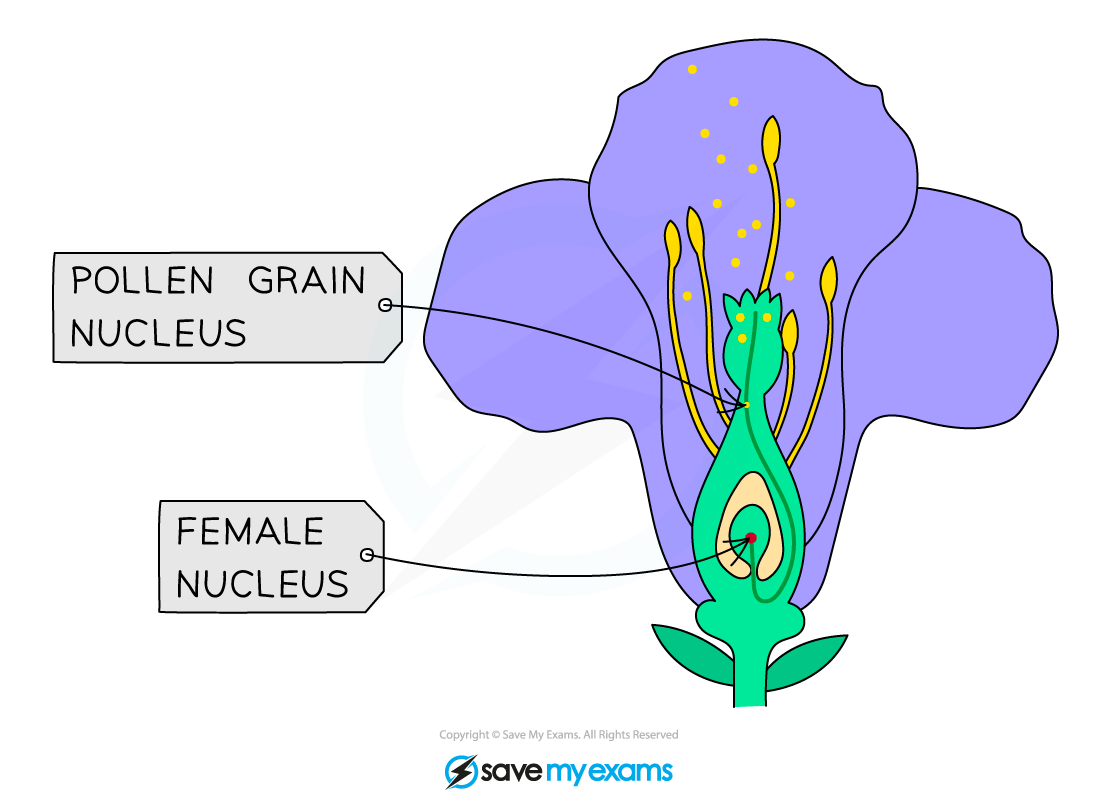
Pollen nuclei travel down a pollen tube in order to fuse with the female gametes inside the ovule; this is fertilisation
Exam Hint It is easy to get confused between pollination and fertilisation in plants; remember that they are not the same thing!
- Pollination is the transfer of pollen
- Fertilisation is the fusion of gametes
Factors affecting germination of seeds
Spec point —
16.1.3· Investigate and describe the environmental conditions that affect germination of seeds, limited to the requirement for: water, oxygen and a suitable temperature
-
Germination is the start of growth in the seed
-
Three factors are required for successful germination:
- water - allows the seed to swell up and the enzymes in the embryo to start working so that growth can occur
- oxygen - so that energy can be released for germination
- warmth - germination improves as temperature rises (up to a maximum) as the reactions which take place are controlled by enzymes
-
As carbon dioxide is not necessary for germination but also does not inhibit it, it makes no difference whether it is present or not
Investigating Germination
- Set up 4 boiling tubes each containing 10 cress seeds on cotton wool
- Set each test tube as shown in diagram below
- Leave tubes in set environment for a period of time: A, B and C incubated at 20°C; D placed in a fridge at 4°C
- Compare results and see which tube has the greatest number of germinated seeds
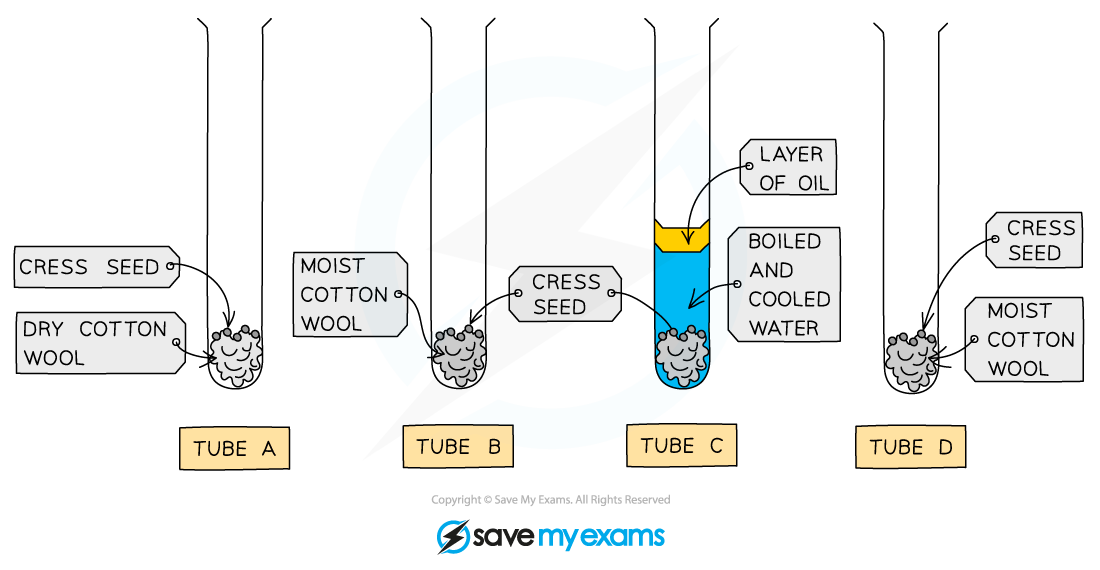
An investigation into the conditions required for germination of seedlings
Conditions required for germination results table
| Test tube | Factor being tested | Seeds germinated |
|---|---|---|
| A | Water / moisture | No |
| B | Control (all factors present) | Yes |
| C | Oxygen | No |
| D | Warm temperature | No |
- The results of this experiment prove that all three factors are required for the successful germination of the seeds and if any one factor is missing the seeds cannot germinate
Self- & cross-pollination: Extended
Spec point —
16.1.3· Describe self-pollination as the transfer of pollen grains from the anther of a flower to the stigma of the same flower or a different flower on the same plant Describe cross-pollination as the transfer of pollen grains from the anther of a flower to the stigma of a flower on a different plant of the same species Discuss the potential effects of self-pollination and cross-pollination on a population, in terms of variation, capacity to respond to changes in the environment and reliance on pollinators Describe the growth of the pollen tube and its entry into the ovule followed by fertilisation (details of production of endosperm and development are not required)
Self- & cross-pollination: Extended
- Cross-pollination occurs when the pollen from one plant is transferred to the stigma of another plant of the same species
- This is the way most plants carry out pollination as it improves genetic variation
- Occasionally, the pollen from a flower can land on its own stigma or on the stigma of another flower on the same plant - this is known as self-pollination
- Self-pollination reduces genetic variety of the offspring as all the gametes come from the same parent (and are therefore genetically identical)
- Lack of variation in the offspring is a disadvantage if environmental conditions change, as it is less likely that any offspring will have adaptations that suit the new conditions well
- On the other hand, cross-pollination relies completely on the presence of pollinators and this can be a problem if those pollinators are missing (e.g. the reduction in bee numbers is of great importance to humans as bees pollinate a large number of food crops) - this doesn’t apply to wind-pollinated plants
Pollen tube formation
-
After pollination, the following sequence of events take place:
- A pollen tube grows from the pollen grain down the style until it reaches the ovary
- Nuclei from pollen travel down the tube
- The nuclei enter the ovule and fuse with the nucleus of the female gamete (fertilisation)
- After fertilisation the ovules develop into seeds and the ovary develops into a fruit
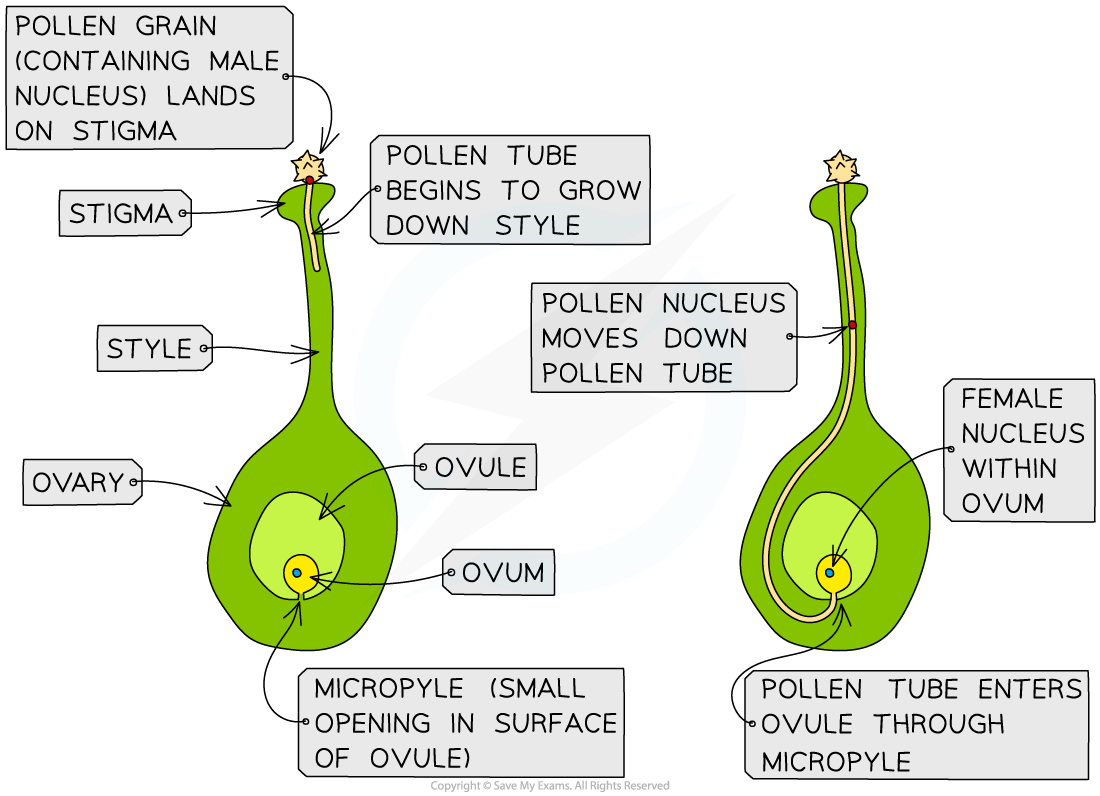
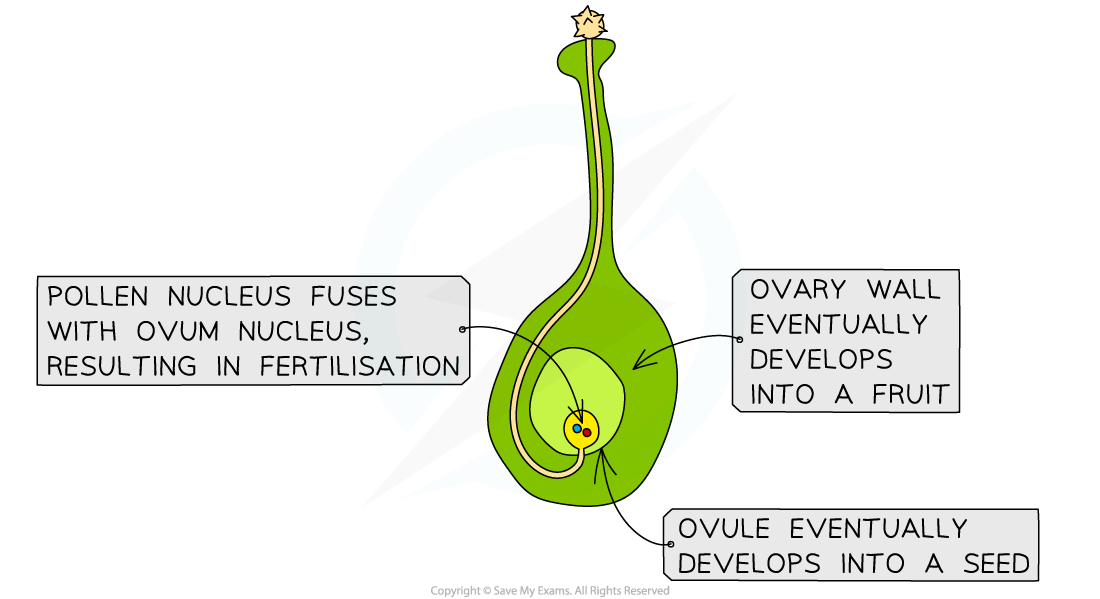
Growth of the pollen tube and its entry into the ovule followed by fertilisation
Exam Hint Remember that it is the nucleus of the pollen grain that travels down the pollen tube in the style for fertilisation and not the pollen grain itself. Make sure to be specific with your use of key words!
Was this revision note helpful?