The Cash Book (Cambridge International IGCSE Accounting)
Cash or Bank
Do I enter a transaction in the cash account or the bank account?
-
Enter the transaction in the cash account if physical money is exchanged
- Paying a supplier using cash
- Receiving cash from a customer
- Taking money from the till for personal use
-
Enter the transaction in the bank account if there is no physical money involved
- Transactions involving a bank transfer
- Paying an invoice or bill by cheque
- Receiving a cheque from a customer
- Standing orders and direct debits
-
Some transactions are entered into both the cash and bank accounts
- Depositing cash from the business into the business bank account
- Withdrawing cash from the business bank account for business use
The Cash Book
What is the cash book?
-
The cash book has two functions
- It is a book of prime entry
- It is a ledger account for both the cash and bank accounts
-
The cash book records all cash transactions
- Both physical cash and cash in the bank
-
The cash book is part of the double entry system
-
There are columns for the dates and details just like other ledger accounts
-
There are three columns for the value of the transaction on both sides of the cash book
-
Discount columns
- Discount allowed on the debit side
- Discount received on the credit side
-
Cash columns
-
Bank columns
-
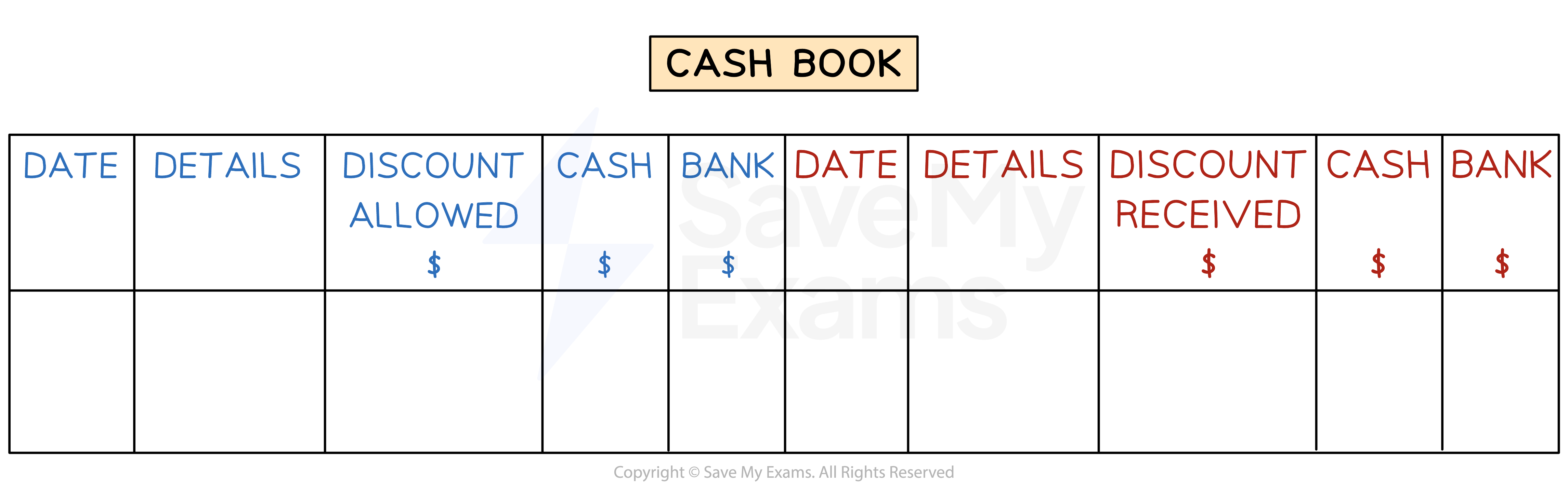
The layout of the cash book
Which side should the balances be on?
-
The balance for the cash account is always on the debit side
- Cash is always an asset
- It can never be a liability
-
The balance for the bank account can be on either side
- It is on the debit side if the business has money in the bank
- It is on the credit side if the business is overdrawn
How do I enter transactions into the cash book?
-
STEP 1 Identify whether the transaction affects the cash or bank account
-
STEP 2 Decide whether the account should be debited or credited
- Debit the account if the business is receiving money
- Credit the account if the business is losing money
-
STEP 3 Include any discount that was allowed or received
What are contra entries in the cash book?
-
A contra entry is for a transaction that is entered into both sides of the cash book
- It will be entered in the cash column on one side
- It will be entered in the bank column on the other side
-
The two transactions which result in contra entries are:
-
Withdrawing cash from the business bank account for business use
- Debit the cash account
- Credit the bank account
-
Depositing cash from the business into the business bank account
- Debit the bank account
- Credit the cash account
-
Exam Hint It is very easy to get confused when making contra entries into the cash book.
If the amount goes in the cash column, the details will say “bank”. If the amount goes in the bank column, the details will say “cash”.
For contra entries, remember that the name used for the details will be different to the name of the column where the entry is made.
Worked Example Worked Example
Yana is a sole trader. On 1 January 2024, Yana had $20 cash in hand and $850 in the bank. During January 2024, the following transactions took place. Prepare Yana’s cash book.
Jan 2 Purchased goods on credit, $350, from Liza 4 Paid electricity, $250, by telephone transfer 6 Sold goods on credit, $180, to Tobey 10 Withdrew cash, $300, from the bank for business use 11 Cash sales, $50, were paid directly into the bank account 18 Paid Liza, $320, by credit transfer, in full settlement of the invoice from 2 January 2024 21 Tobey paid his account of £180 by cheque after deducting 5% cash discount 28 Paid rent, $500, by direct debit 31 Paid $200, cash, for wages Answer:
Jan 1 Debit balance of $20 for cash and debit balance of $850 for bank 2 No entry into the cash book as there was no exchange of cash 4 $250 credit entry to the bank account 6 No entry into the cash book as there was no exchange of cash 10 Contra entry - debit the cash account and credit the bank account 11 $50 debit entry to the bank account 18 $350 - $320 = $30
$320 credit entry to the bank account with $30 discount21 5% ✕ $180 = $9 and $180 - $9 = $171
$171 debit entry to the bank account with $9 discount28 $500 credit entry to the bank account 31 $200 credit entry to the cash account Yana
Cash Book
Date Details Discount Allowed
$**Cash
$Bank
$Date Details Discount Received
$Cash
$Bank
**$Final answer: 2024
Jan 1Final answer: Balance b/d Final answer: 20 Final answer: 850 Final answer: 2024
Jan 4Final answer: Electricity Final answer: 250 Final answer: Jan 10 Final answer: Bank Final answer: 300 Final answer: Jan 10 Final answer: Cash Final answer: 300 Final answer: Jan 11 Final answer: Sales Final answer: 50 Final answer: Jan 18 Final answer: Liza Final answer: 30 Final answer: 320 Final answer: Jan 21 Final answer: Tobey Final answer: 9 Final answer: 171 Final answer: Jan 28 Final answer: Rent Final answer: 500 Final answer: Jan 31 Final answer: Wages Final answer: 200
Balancing the Cash Book
How do I balance the cash book?
-
Balance the cash columns just like any other ledger account
- Ignore the other columns
- Remember the balance is always brought down onto the debit side
-
Balance the bank columns just like any other ledger account
-
Ignore the other columns
-
The balance will be brought down onto the:
- debit side if the business has money in the bank
- credit side if the business is overdrawn
-
-
Do not balance the discount columns
- You just need to total them up
- They will likely be different totals
Where do I put the totals for the discount columns?
-
The cash book is the book of prime entry for discount
- It records the discounts allowed and received
- It is not part of the double entry system for discount
-
Enter the discount in the relevant accounts
-
The total on the left-hand side is the discount allowed
-
Debit the whole total to the discount allowed account
- Label the entry as “cash book”
- You do not need to put a separate entry for each transaction
-
Credit the relevant trade receivables accounts in the sales ledger
-
-
The total on the right-hand side is the discount received
-
Debit the relevant trade payables accounts in the purchases ledger
-
Credit the whole total to the discount received account
- Label the entry as “cash book”
- You do not need to put a separate entry for each transaction
-
Worked Example Yana’s cash book for January 2024 is shown below. Balance the cash book and bring down the balances at 1 February 2024.
Yana
Cash Book
Date Details Discount Allowed
$**Cash
$Bank
$Date Details Discount Received
$Cash
$Bank
$2024
Jan 1Balance b/d 20 850 2024
Jan 4Electricity 250 Jan 10 Bank 300 Jan 10 Cash 300 Jan 11 Sales 50 Jan 18 Liza 30 320 Jan 21 Tobey 9 171 Jan 28 Rent 500 Jan 31 Wages 200 Answer:
Balance the cash account:
Total of the cash debit entries = $320
Total of the cash credit entries = $200
Difference in the cash totals = $120
- This goes on the credit side as that total is the smallest
Balance the bank account:
Total of the bank debit entries = $1 071
Total of the bank credit entries = $1 370
Difference in the bank entries = $299
- This goes on the debit side as that total is the smallest
Yana
Cash Book
Date Details Discount Allowed
$Cash
$Bank
$Date Details Discount Received
$Cash
$Bank
$2024
Jan 1Balance b/d 20 850 2024
Jan 4Electricity 250 Jan 10 Bank 300 Jan 10 Cash 300 Jan 11 Sales 50 Jan 18 Liza 30 320 Jan 21 Tobey 9 171 Jan 28 Rent 500 Final answer: Jan 31 Final answer: Balance c/d Final answer: 299 Jan 31 Wages 200 Final answer:** Final answer: ** Final answer:** ** Final answer: Jan 31 Final answer: Balance c/d Final answer:** ** Final answer: 120 Final answer:** Final answer: 9 Final answer: 320 Final answer: 1 370 Final answer: 30 Final answer: 320 Final answer: 1 370 Final answer: Feb 1 Final answer: Balance b/d Final answer: 120 Final answer: Feb 1 Final answer: Balance b/d Final answer: 299
Was this revision note helpful?
Build on this topic