Calculating Values using Control Accounts (Cambridge International IGCSE Accounting)
Calculating values using control accounts
How can I use a ledger account to find a missing value?
-
If you are missing just one value from an account then you can find it
-
STEP 1 Draw up the ledger account
-
STEP 2 Fill in the known values
-
STEP 3 Find the balancing figure for the account
- This is the missing value
What information can I find using a sales ledger control account?
-
You can use a sales ledger control account to find the following information:
- The trade receivables balance at the start of the financial year
- The trade receivables balance at the end of the financial year
- Credit sales
- Credit sales returns
- Receipts from trade receivables during the year
- Discount allowed to trade receivables
- Irrecoverable debts written off
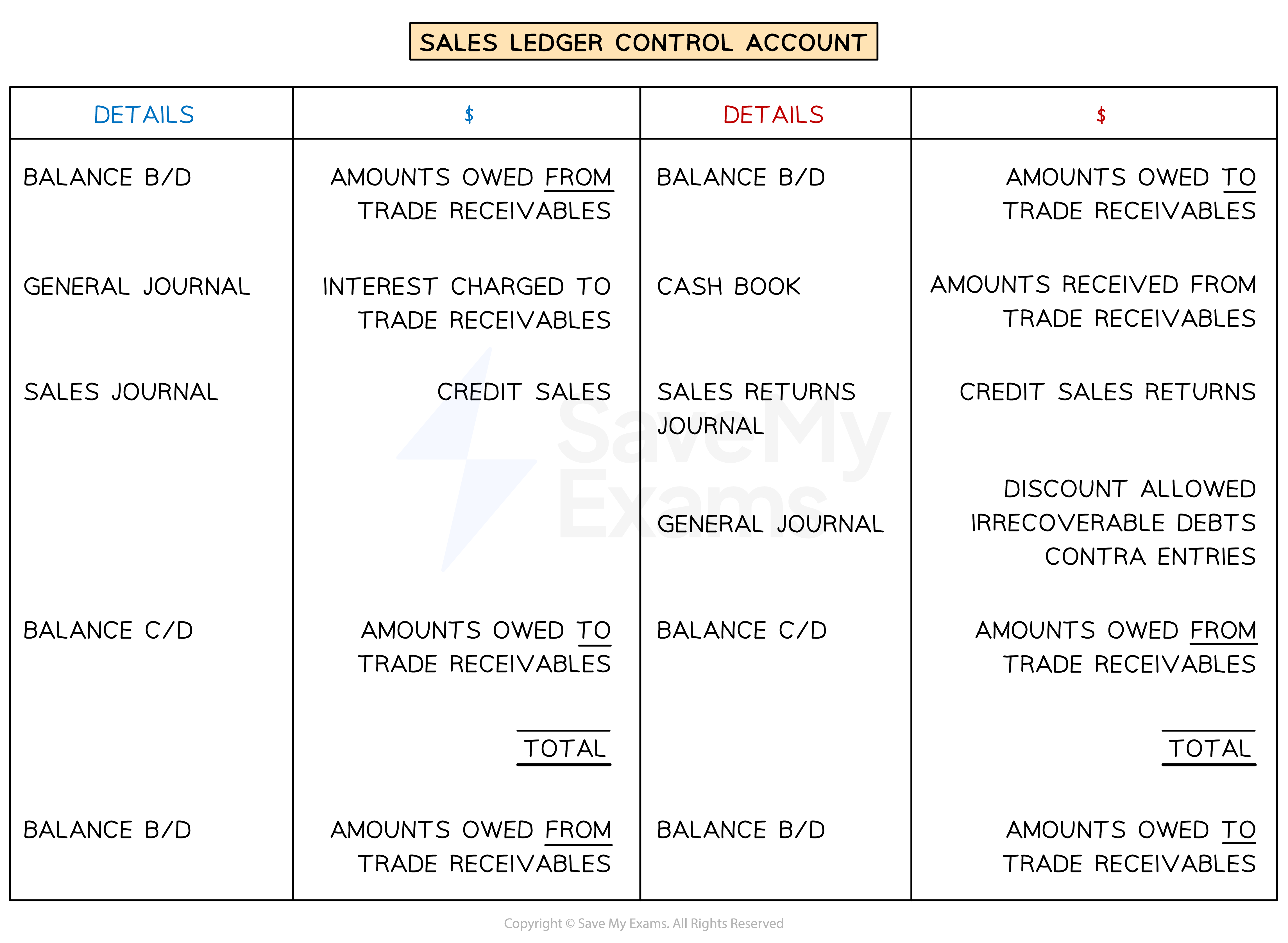
Layout of a sales ledger control account
Exam Hint Exam questions commonly ask you to find the value of the credit sales.
Credit sales = payments from credit customers
- opening trade receivables
- closing trade receivables
- cash discounts allowed
- credit sales returns
- irrecoverable debts written off
- contra entries
- interested charged to credit customers
What information can I find using a purchases ledger control account?
-
You can use a purchases ledger control account to find the following information:
- The trade payables balance at the start of the financial year
- The trade payables balance at the end of the financial year
- Credit purchases
- Credit purchases returns
- Payments to trade payables during the year
- Discount received from trade payables
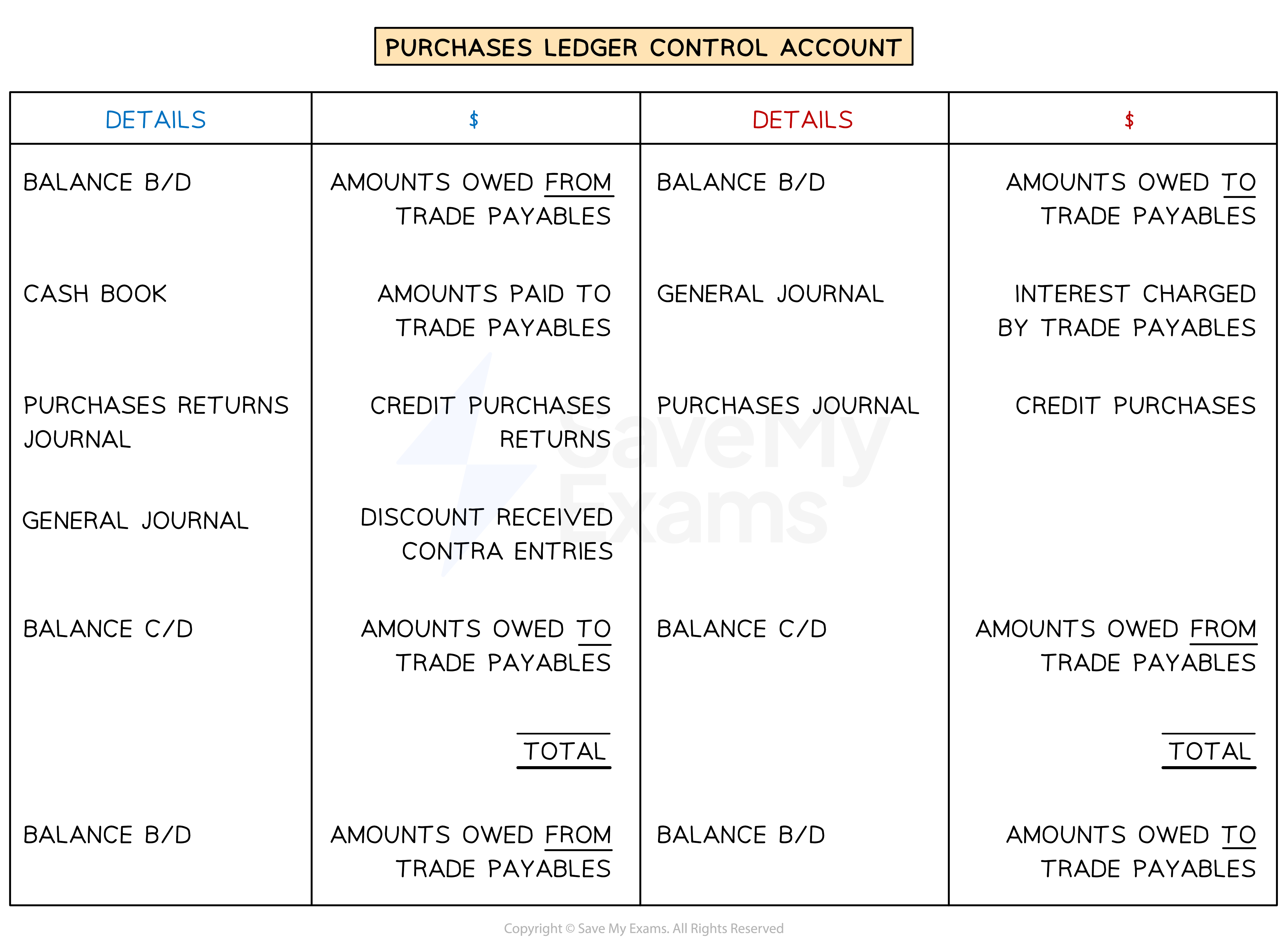
Layout of a purchases ledger control account
Exam Hint Exam questions commonly ask you to find the value of the credit purchases.
Credit purchases = payments to credit suppliers
- opening trade payables
- closing trade payables
- cash discounts received
- credit purchases returns
- contra entries
- interested charged by credit suppliers
What information can I find using a cash book?
-
You can use a cash book to find the following information:
-
Amounts paid by the business
- Cash purchases
- Expenses
- Payments to trade payables
- Drawings
-
Amounts received by the business
- Cash sales
- Income
- Receipts from trade receivables
- Capital introduced
-
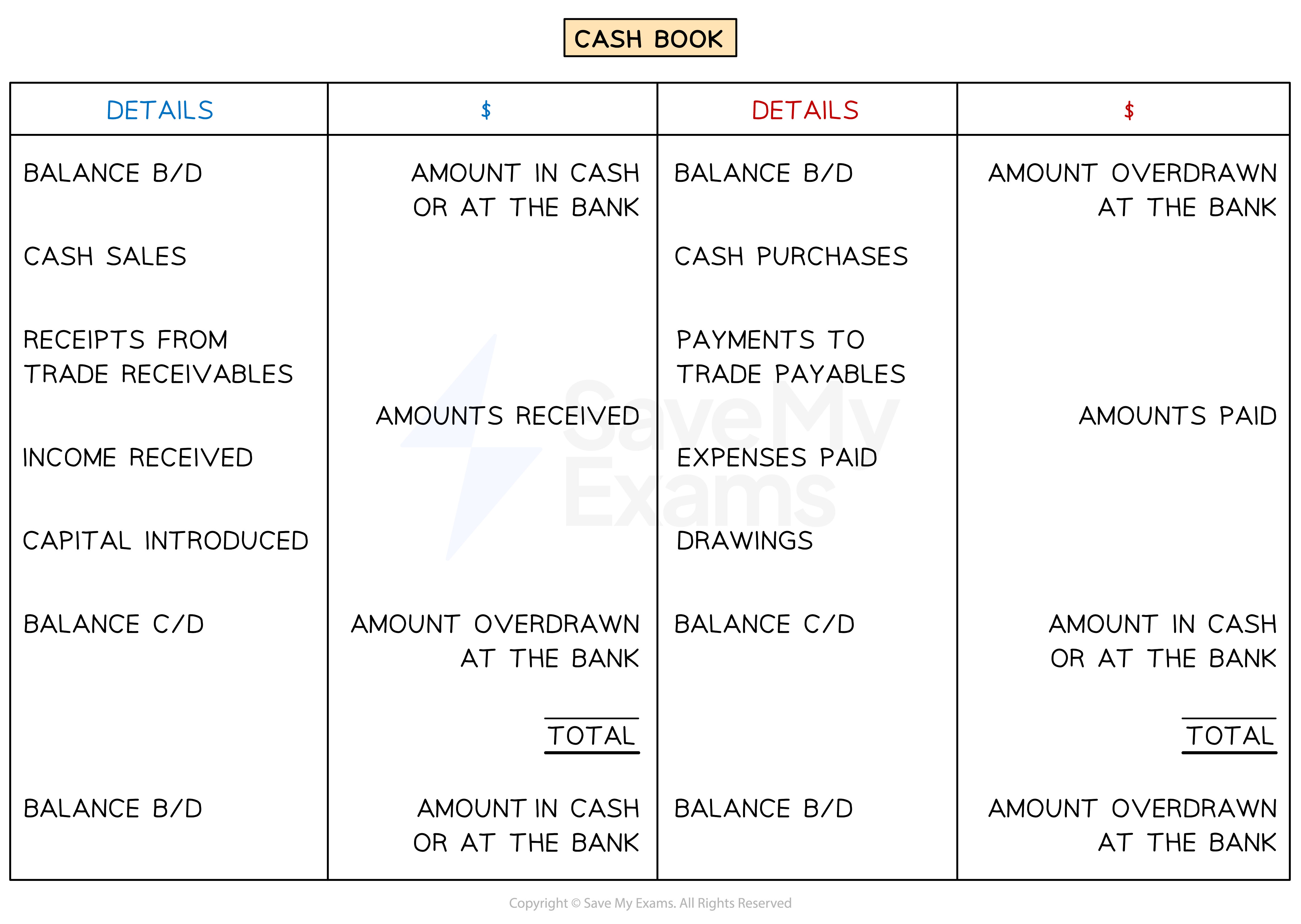
Layout of a cash book
Exam Hint Remember sales and purchases can be made on a credit or cash basis.
Total sales = Credit sales + Cash sales
Total purchases = Credit purchases + Cash purchases
Worked Example Mini is a sole trader who does not keep full accounting records. Mini provided the following information.
1 January 2023
$**31 December 2023
$Shop fittings 9 000 9 000 Inventory 35 600 39 800 Trade receivables 19 200 18 400 Bank 6 000 9 600 Trade payables 20 800 16 000 Expenses owing 300 420 Receipts and payment summary for the year ended 31 December 2023:
$ Receipts from trade receivables 117 500 Payments to trade payables 72 600 Drawings 33 500 General expenses 30 600 Purchase of shop fittings 3 000 Cash sales 38 000 Cash purchases 12 200 No cash discount was allowed or received during the year.
Prepare the trading section of the income statement for Mini for the year ended 31 December 2023.
Answer:
Find the credit sales by using a sales ledger control account
- The credit sales will be the balancing figure
Date Details $* Date Details *$ 2023
Jan 1* *
Balance b/d* *
19 2002023
Dec 31* *
Bank (receipts)* *
117 500Dec 31 Sales 116 700 Dec 31 Balance c/d 18 400 135 900 135 900 2024
Jan 1* *
Balance b/d* *
18 400
- Find the total sales by adding the credit sales to the cash sales
Total sales = $116 700 + $38 000 = $154 700
Find the credit purchases by using a purchases ledger control account
- The credit purchases will be the balancing figure
Date Details $*** Date Details *$ 2023
Dec 31* *
Bank (payments)* *
72 6002023
Jan 1Balance b/d * *
20 800Dec 31 Balance c/d 16 000 Dec 31 Purchases 67 800 88 600 88 600 2024
Jan 1* *
Balance b/d* *
16 000
- Find the total purchases by adding the credit purchases to the cash purchases
Total purchases = $67 800 + $12 200 = $80 000
- Prepare the trading section of the income statement using the usual format
Final answer: Mini
Final answer: Income Statement for the year ended 31 December 2023Final answer: $** Final answer: $ Final answer: Revenue Final answer: 154 700 Final answer: Less: Cost of sales Final answer:** Opening inventory ** Final answer: 35 600 Final answer:** Purchases ** Final answer: 80 000 Final answer: 115 600 Final answer:** Less: Closing inventory Final answer: 39 800 Final answer: 75 800 Final answer: Gross profit Final answer: 78 900
Was this revision note helpful?
Build on this topic