The Young Modulus (Cambridge International AS Physics)
Stress, Strain & the Young Modulus
Spec point —
6.1.5
Stress
- Tensile stress is the applied force per unit cross sectional area of a material
-
Where:
- *σ *is tensile stress in Pa
- F is applied force in N
- A is the cross-sectional area of the object in m2
-
The ultimate tensile stress is the maximum force per original cross-sectional area a wire is able to support at the point it breaks
Strain
-
Strain is the extension per unit length
- Strain is the deformation of a solid due to stress in the form of elongation or contraction
-
Note that strain, ε , is a dimensionless unit because it is the ratio of lengths given by the equation
-
Where:
- x is extension in metres (m)
- L is the original length of the object, also in metres (m)
Young modulus
-
The Young modulus, E , is a measure of the ability of a material to withstand changes in length when a load is added
- Young modulus is a measure of how **stiff **or elastic a material is
-
The Young Modulus is defined as the** ratio of stress and strain** and is given by the equation
-
Where:
- *E *is Young modulus where its unit are the same as stress: Pa (since strain is unitless)
-
For a material demonstrating elastic behaviour, stress and strain, like force and extension, are also directly proportional to one another
-
The directly proportional nature of the stress-strain relationship can be shown by drawing a stress-strain graph
- The gradient of the linear section of a stress-strain graph is the Young modulus
Stress-strain graph
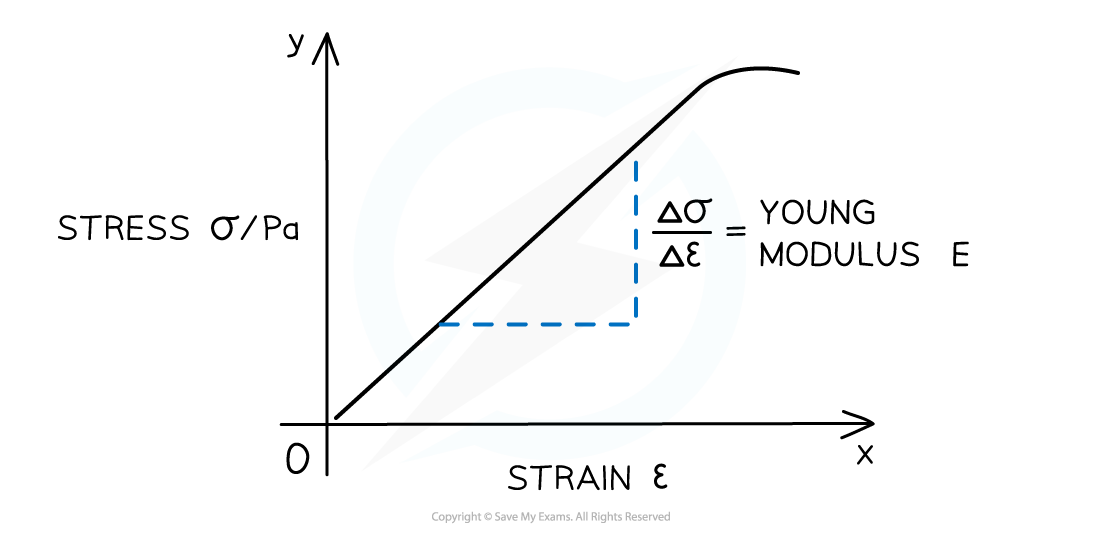
A stress-strain graph is a straight line with its gradient equal to Young modulus
Worked Example A metal wire that is supported vertically from a fixed point has a load of 92 N applied to the lower end.
The wire has a cross-sectional area of 0.04 mm2 and obeys Hooke’s law.
The length of the wire increases by 0.50%. What is the Young modulus of the metal wire?
A. 4.6 × 10⁷Pa
B. 4.6 × 10¹² Pa
C. 4.6 × 10⁹ Pa
D. 4.6 × 10¹¹ Pa
Answer: D
Step 1: List the known quantities:
- Load force, F = 92 N
- Cross-sectional area, *A *= 0.04 mm2
- Extension is 0.50% of the original length
Step 2: Determine the stress:
- Convert the area to m2
- Substitute this into the stress equation
Step 3: Determine strain:
- Strain is defined as the extension per unit length
- If extension is 0.50% of length, then strain is simply this value as a decimal number
Step 4: Calculate the Young modulus:
- Substitute these values into the equation
Exam Hint To remember whether stress or strain comes first in the Young modulus equation, try thinking of the phrase ‘When you’re stressed, you show the strain’ i.e. .
Young's Modulus Experiment
Equipment
- To measure the Young modulus of a metal in the form of a wire requires the wire to be clamped over a pulley as shown in the diagram below
Experimental equipment to determine the Young modulus
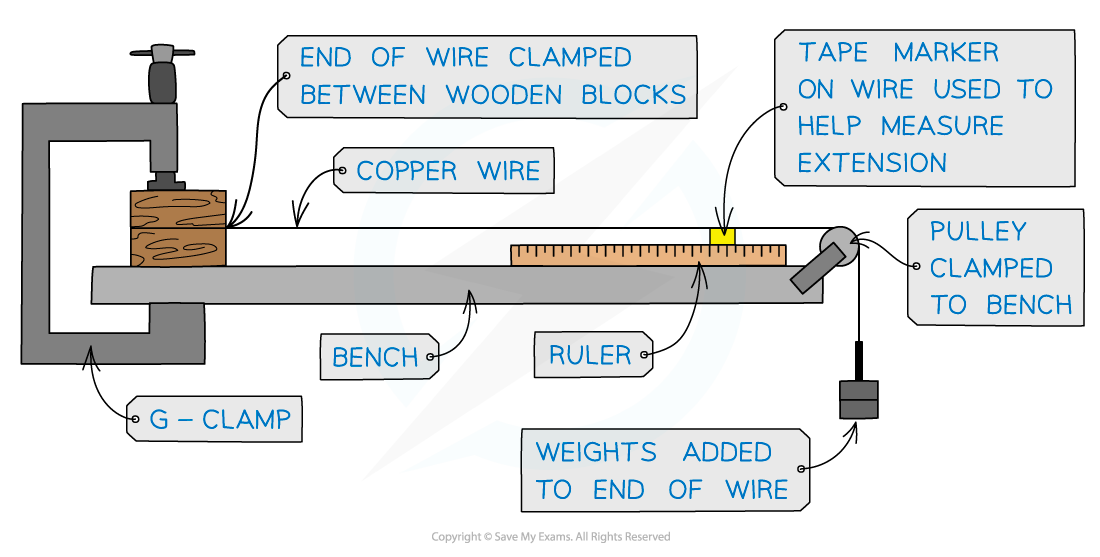
As the wire stretches, the tape marker moves along the ruler, showing the extension of the wire. This is based on the assumption that the wire stretches the same amount at all points along its length.
-
A tape or reference marker is needed on the wire to accurately measure the extension with the applied load
- The independent variable is the load
- The dependent variable is the extension
Method
- Measure the original length of the wire using a metre ruler and mark this reference point with tape
- Measure the diameter of the wire with a micrometre screw gauge or digital callipers
- Add the first mass and calculate the weight used to create the extension e.g. 300 g
- Record the total length from the reference point on the metre ruler
- Add more mass and record the new total length from the metre ruler
- Subtract the original length from the new total length to obtain the extension
Improving experiment and reducing uncertainties
- Reduce uncertainty of the cross-sectional area by measuring the diameter* d* in several places along the wire and then calculating an average
- After each reading remove the load and check that the wire returns to its original shape after each reading
- Take several readings with each loads and find the average extension
- Use a Vernier scale to measure the extension of the wire
Measurements required to determine the Young modulus
- Determine extension from final and initial readings
Example table of results
| Mass / kg | Load / N | Initial length / mm | Final length / mm | Extension / × 10−3m |
|---|---|---|---|---|
| 0.2 | 2.0 | 500 | 500.1 | 0.1 |
| 0.3 | 2.9 | 500.1 | 500.4 | 0.3 |
| 0.4 | 3.9 | 500.4 | 501.0 | 0.6 |
| 0.5 | 4.9 | 501.0 | 501.9 | 0.9 |
| 0.6 | 5.9 | 501.9 | 503.2 | 1.3 |
| 0.7 | 6.9 | 503.2 | 504.9 | 1.7 |
| 0.8 | 7.8 | 504.9 | 507.0 | 2.1 |
Table with additional data
| QUANTITY / UNIT | SIZE |
|---|---|
| Length L / m | 1.382 |
| Diameter 1 / mm | 0.277 |
| Diameter 2 / mm | 0.280 |
| Diameter 3 / mm | 0.275 |
| Average diameter / mm | 0.277 |
-
Plot a graph of force against extension and draw a line of best fit
-
Determine the gradient of the force-extension graph
Force-extension graph
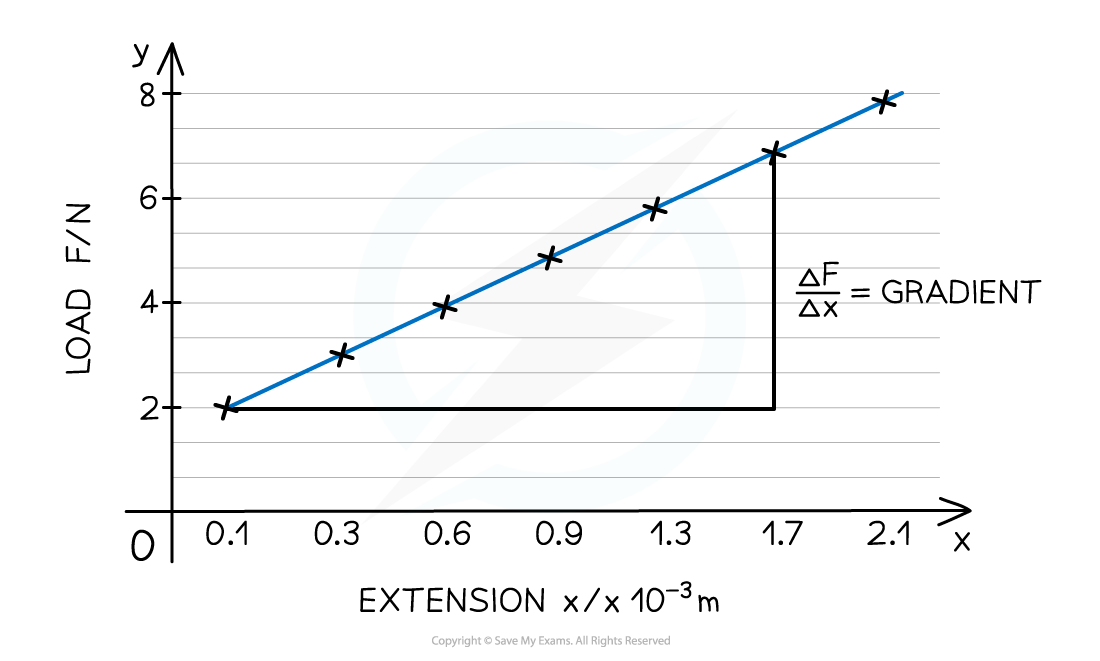
This gradient is neither stress nor strain, but can be used to calculate Young's modulus
- Calculate the cross-sectional area A of the wire from:
where d is the average diameter of the wire
- Calculate the Young modulus from:
using the gradient of the force-extension graph, the initial length of the wire and it's average cross-sectional area
Exam Hint Although every care should be taken to make the experiment as reliable as possible, you will be expected to suggest improvements in producing more accurate and reliable results (e.g. repeat readings and use a longer length of wire)
Was this revision note helpful?
Build on this topic