Electromagnetic Spectrum (Cambridge International AS Physics)
Properties of Electromagnetic Waves
-
All electromagnetic waves have the following properties in common:
- They are all **transverse **waves
- They can all travel in a vacuum
- They all travel at the same speed in a vacuum
-
A vacuum is also known as free space where the speed of light is** 3 × 10**8ms-1
- The speed of light in air is approximately the same as that in a vacuum
-
Since electromagnetic waves are transverse, they can be reflected, refracted, diffracted, polarised and produce interference patterns
-
There are seven principal regions of the electromagnetic spectrum, which all together form a continuous spectrum
Wavelengths of Electromagnetic Waves
- The principal regions of the electromagnetic spectrum are arranged in a specific order based on their wavelengths or frequencies
- This order is shown in the diagram below from longest wavelength (lowest frequency) to shortest wavelength (highest frequency)
Wavelengths across the EM spectrum
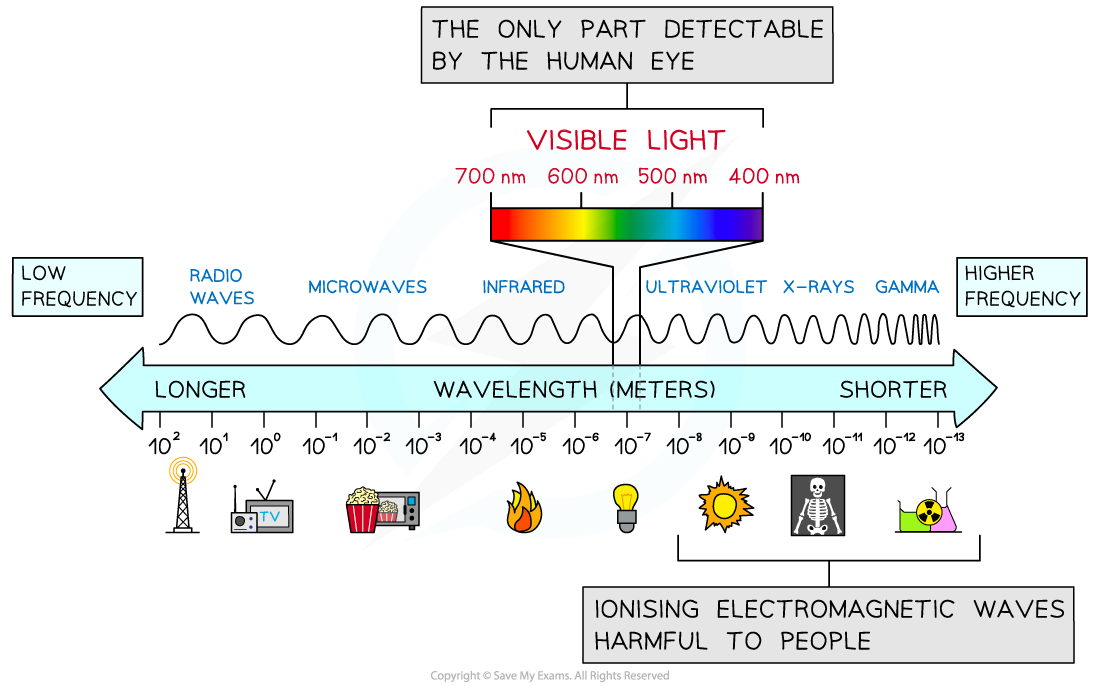
Energy, wavelength and frequency for each part of the electromagnetic spectrum
-
The higher the frequency, the higher the energy of the radiation
-
Radiation with higher energy is
- highly ionising
- Harmful to cells and tissues causing cancer (e.g. UV, X-rays, Gamma rays)
-
Radiation with lower energy is:
- Useful for communications
- Less harmful to humans
-
The approximate wavelengths in a vacuum of each radiation is listed in the table below:
EM spectrum wavelengths and frequencies
| Radiation | Wavelength range / m |
|---|---|
| Radio | > 0.1 |
| Microwaves | 0.1 to 1 × 10⁻³ |
| Infrared | 1 × 10⁻³ to 7 × 10⁻⁷ |
| Visible | 7 × 10⁻⁷ to 4 × 10⁻⁷ |
| Ultraviolet | 4 × 10⁻⁷ to 1 × 10⁻⁸ |
| X Rays | 1 × 10⁻⁸ to 4 × 10⁻¹³ |
| Gamma Rays | 4 × 10⁻¹³ to 10−16 |
-
To alternatively find the range of frequencies, convert the wavelengths using the wave equation: c = fλ
- Where c is the speed of light: 3.0 × 10⁸ m s−1
Worked Example A is a source emitting microwaves and B is a source emitting X-rays. The table suggests the frequencies for A and B.
Which row is correct?
Frequency emitted by A / Hz Frequency emitted by B / Hz A 3 × 10⁹ to 3 × 10¹¹ > 1019 B 1 × 10¹² to 1 × 10¹³ 3 × 10¹⁶ to 7.5 × 10²⁰ C 3 × 10⁹ to 3 × 10¹¹ 3 × 10¹⁶ to 7.5 × 10²⁰ D 4 × 10¹⁴ to 8 × 10¹⁴ 5 × 10¹³ to 7 × 10¹⁵ Answer: C
Step 1: Recall the wavelength ranges of microwaves and X rays:
- The wavelength range of microwaves is 0.1 m to 1 × 10⁻³ m
- The wavelength range of X rays is 1 × 10⁻⁸ m to 4 × 10⁻¹³ m
Step 2: Apply the wave equation to find frequency ranges:
- The speed of electromagnetic radiation is c , so to calculate frequency f use
- The frequency range of microwaves is
- This eliminates B and D because source A emits microwaves
- The frequency range of X rays is
- Both frequency ranges match option C
Exam Hint You will be expected to memorise the range of wavelengths for each type of radiation, however you don’t need to learn the frequency ranges by heart. Since all EM waves travel at the speed of light, you can convert between frequency and wavelength using the wave equation in an exam question.
Visible Light
-
Visible light is the only part of the spectrum detectable by the human eye
-
Visible light has wavelengths in the range 400 - 700 nm
- In the natural world, many animals, such as birds, bees and certain fish, are able to perceive beyond visible light and can see infra-red and UV wavelengths of light
Was this revision note helpful?
Build on this topic