Elastic & Inelastic Collisions (Cambridge International AS Physics)
Elastic Collisions
-
When two objects collide, they may spring apart retaining all of the kinetic energy of the system
-
This would be a perfect elastic collision
-
In an elastic collision, all of the kinetic energy is conserved
-
Recall the kinetic energy equation:
-
Where:
- Ek = kinetic energy in joules (J)
- m = mass in kilograms (kg)
- v = velocity in metres per second (m s-1)
-
Kinetic energy depends on the speed of an object
-
In a perfectly elastic collision:
the relative speed of approach = the relative speed of separation
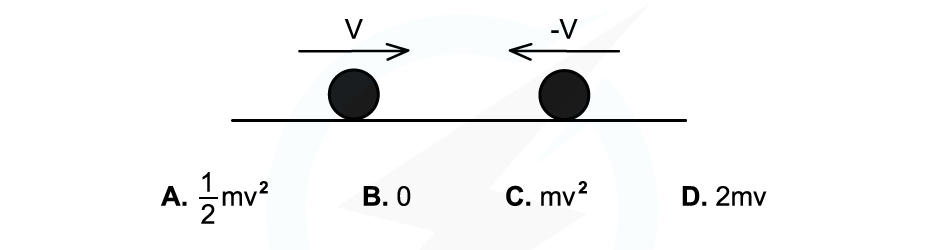
Worked Example Two similar spheres, each of mass m and velocity v are travelling towards each other.
The spheres have a head-on elastic collision. What is the total kinetic energy after the impact?
Answer:
Step 1: Equate the kinetic energy before and after the collision
- In an elastic collision, the kinetic energy of the system is conserved
Step 2: Write an expression for the kinetic energy before the collision
- Therefore, the correct answer is C
Exam Hint Despite velocity being a vector, kinetic energy is never negative because v2 is always positive.
Inelastic Collisions
-
Whilst the momentum of a system is always conserved in interactions between objects, kinetic energy is not always conserved
-
An inelastic collision is one where kinetic energy is not conserved
-
The kinetic energy is transferred to other energy stores
-
Inelastic collisions occur when two objects collide and they crumple and deform
-
If the total momentum is zero, all of the kinetic energy of the system may be transferred away from the system and the objects will come to a halt
-
Or some of the kinetic energy of the system may be transferred away and the objects will move as one body at a slower speed than the original objects
-
A perfectly inelastic collision is when two objects stick together after collision
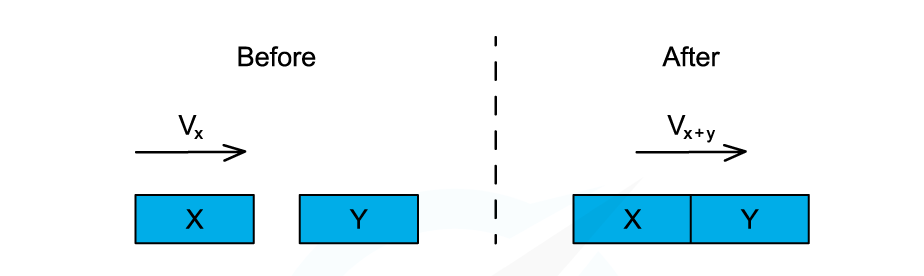
Worked Example Two trolleys X and Y are of equal mass. Trolley X moves towards trolley Y which is initially stationary.
After the collision, the trolleys join and move together.
Prove that this collision is inelastic.
Answer:
Step 1: Write an expression for the kinetic energy of the system before the collision
- Object Y is stationary before the collision, so its kinetic energy is zero
Step 2: Write an expression for the kinetic energy of the system after the collision
- Both trolleys are of equal mass, therefore mx + my = 2m
Step 3: Use conservation of momentum to find the speed after the collision
Step 4: Compare the expressions and determine if they are equal
- The kinetic energy before the collision is not equal to the kinetic energy after the collision
- Therefore, the collision is inelastic
Exam Hint Although kinetic energy may not always be conserved, remember momentum will always be conserved.
Was this revision note helpful?
Build on this topic