Nucleon & Proton Number (Cambridge International AS Physics)
Nucleon & proton number
- The nuclide notation of an element is used to describe the constituents of the nuclei
- An example of this notation for Lithium is:
-
Where:
- Li = lithium
- 7 = mass number or nucleon number
- 3 = atomic number or proton number
-
The mass number is the number of particles in the nucleus
- The nucleus contains protons plus neutrons
-
The atomic number is the number of protons in the atom
- Since atoms are neutral, this is also equal to the number of electrons in the atom
-
When given an atomic symbol, you can therefore figure out the number of protons, neutrons and electrons in the atom:
- Protons: The atomic number
- Electrons: Atoms are neutrals, so the number of negative electrons is equal to the number of positive protons. Therefore, this is also the atomic number
- Neutrons: Subtract the proton number from the nucleon number
-
For the lithium atom, these numbers would be:
- Protons: 3
- Electrons: 3
- Neutrons: 7 − 3 = 4
-
The term nucleon is the used to mean a particle in the nucleus – i.e. a proton or neutron
-
The term nuclide is used to refer to a nucleus with a specific combination of protons and neutrons
Worked Example The atom is a neutral atom.
State the number of protons, neutrons and electrons in this atom.
Protons Neutrons Electrons A 77 192 77 B 155 77 77 C 192 77 192 D 77 115 77 Answer: D
Step 1: Determine the nucleon and atomic numbers
- Nucleon number = 192
- Atomic number = 77
Step 2: Determine the number of protons
- Number of protons = atomic number
- Number of protons = 77
Step 3: Determine the number of neutrons
- Number of neutrons = nucleon number − atomic number
- Number of neutrons = 192 − 77
- Number of neutrons = 115
Step 4: Determine the number of electrons
- Number of electrons = number of protons
- Number of electrons = 77
Isotopes
Spec point —
11.1.4
- Although all atoms of the same element always have the same number of protons (and hence electrons), the number of neutrons can vary
- An isotope is an atom (of the same element) that has an equal number of protons but different number of neutrons
- The isotopes of hydrogen are deuterium and tritium:
Isotopes of hydrogen
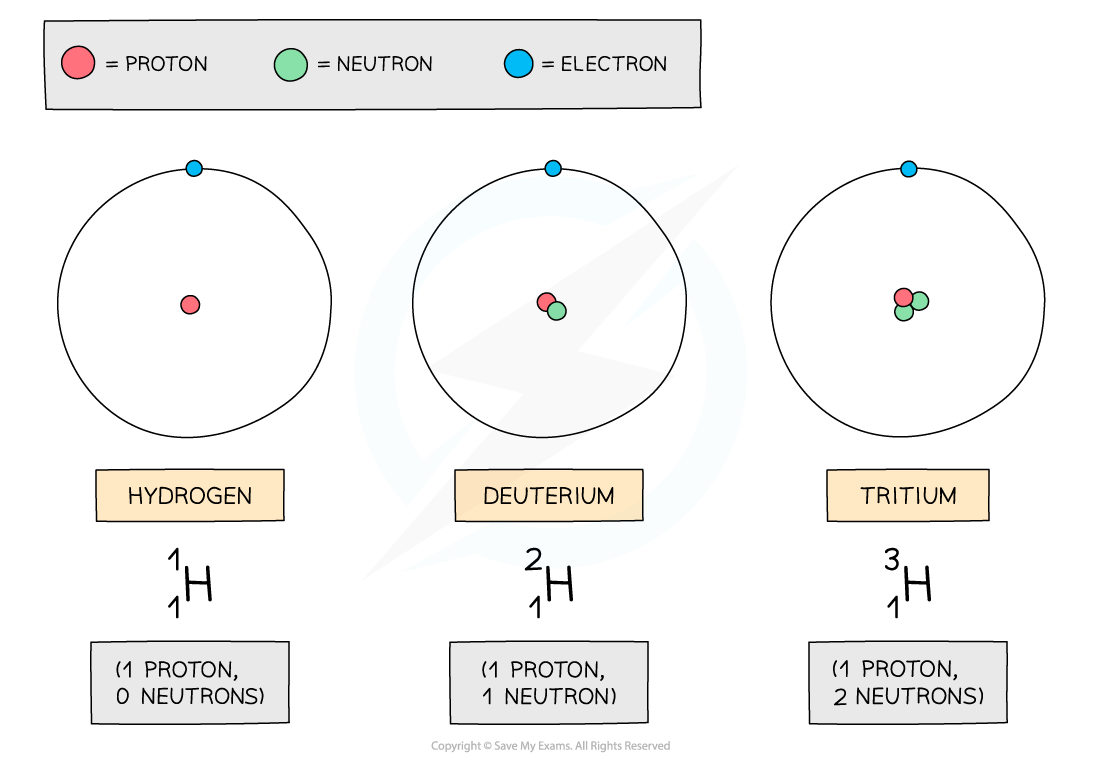
The three atoms shown above are all forms of hydrogen, but they each have different numbers of neutrons
- Remember, the neutron number of an atom is found by subtracting the proton number from the nucleon number
- Since nucleon number includes the number of neutrons, an isotope of an element will also have a different nucleon number
- Since isotopes have an imbalance of neutrons and protons, they are unstable. This means they constantly decay and emit radiation to achieve a more stable form
- This can happen from anywhere between a few nanoseconds to 100,000 years
Worked Example One of the rows in the table shows a pair of nuclei that are isotopes of one another.
Which row shows the correct isotopes?
Nucleon number Number of neutrons A 39
3519
22B 37
3520
18C 37
3518
20D 35
3520
18Answer: B
Step 1: Recall the properties of isotopes
- Isotopes are nuclei with the same number of protons but a different number of neutrons
- The nucleon number (mass number) is the total number of particles in the nucleus (protons + neutrons)
- Therefore, isotopes have a different nucleon number too
Step 2: Calculate the number of protons in the first nucleus
- Nucleon number = 37
- Neutrons = 20
- Protons = nucleon number − neutrons
- Protons = 37 − 20 = 17
Step 3: Calculate the number of protons in the second nucleus
- Nucleon number = 35
- Neutrons = 18
- Protons = 35 − 18 = 17
Step 4: Conclusion
- The nuclei in answer B have the same number of protons and different numbers of neutrons, therefore these nuclei are isotopes of one another
AZX Notation
- Atomic symbols are written in a specific notation called AZX notation
-
Where:
- X = chemical symbol of the element
- A = nucleon (mass) number
- Z = proton (atomic) number
-
The number A represents the nucleon number or the mass number
- Nucleon number (A) = total number of protons and neutrons in the nucleus
-
The lower number Z represents the proton or atomic number
- Proton number (Z)= total number of protons in the nucleus
Was this revision note helpful?