The Diffraction Grating (Cambridge International AS Physics)
The Diffraction Grating Equation
- A diffraction grating is a piece of optical equipment that creates a diffraction pattern when it diffracts monochromatic light into bright and dark fringes
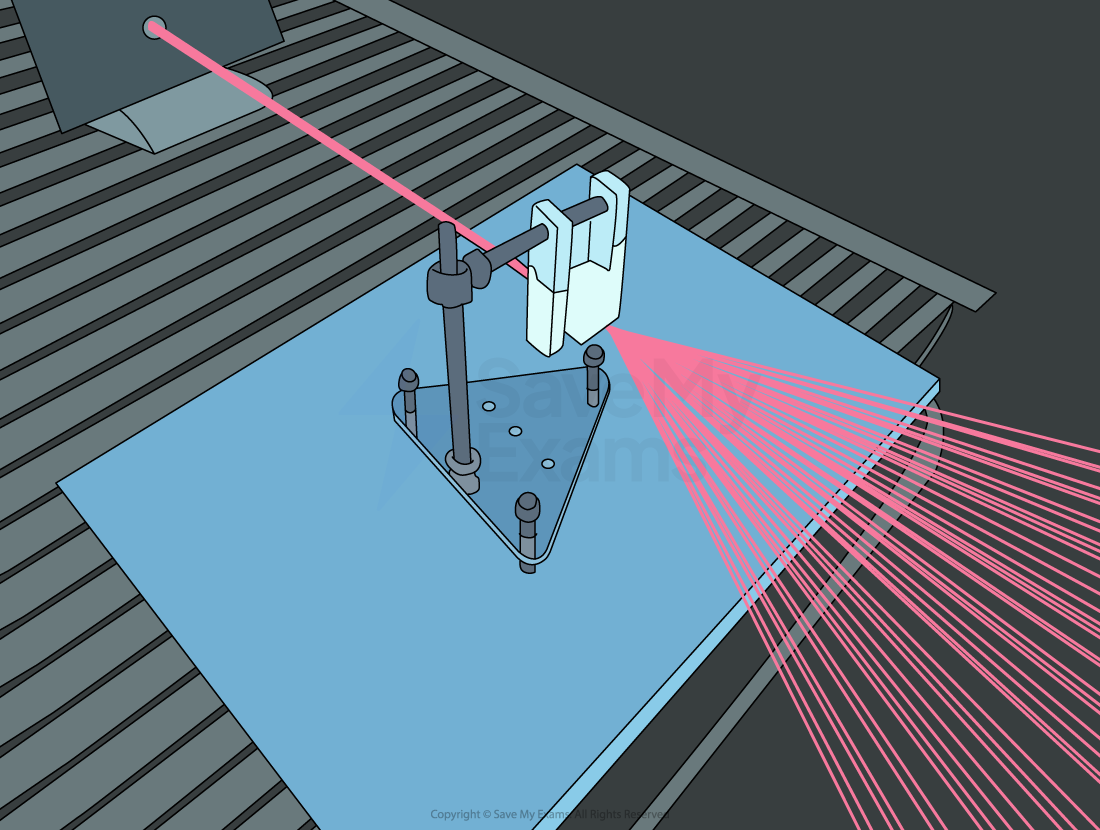
A laser light is diffracted using a diffraction grating
- A diffraction grating consists of a large number of very thin, equally spaced parallel slits carved into a glass plate
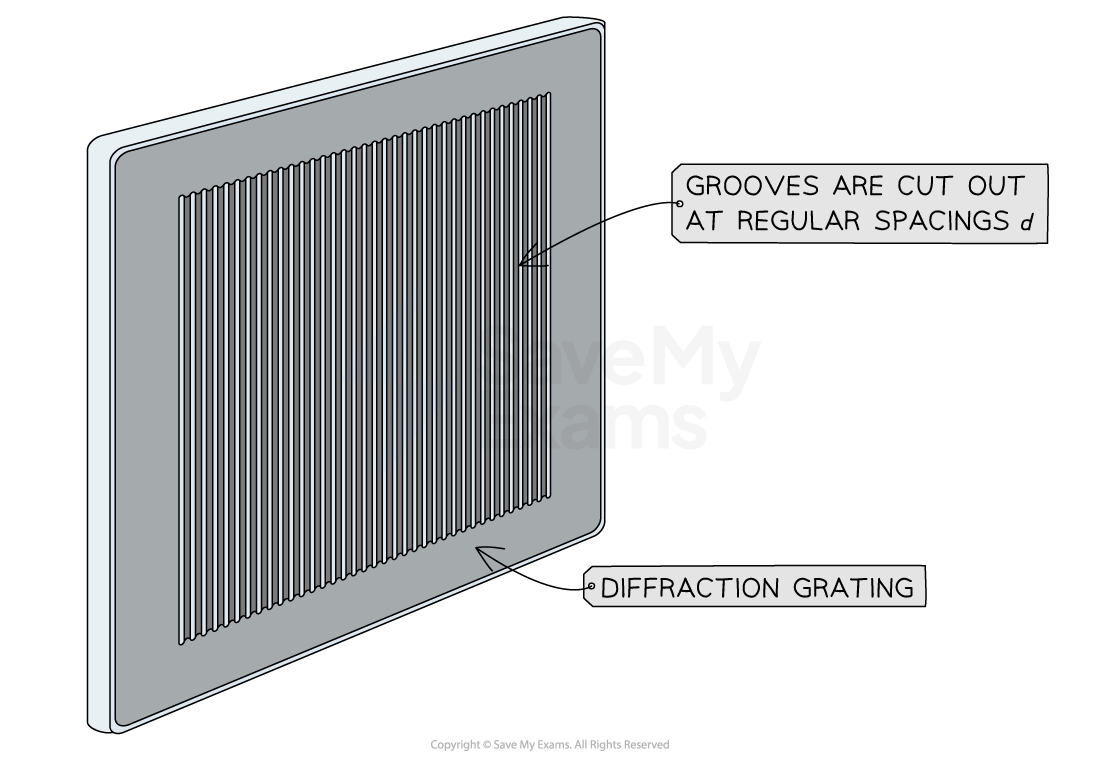
A diffraction grating consists of many parallel equally spaced slits cut into the glass plate
- Just like for single and double-slit diffraction the regions where constructive interference occurs are also the regions of maximum intensity
- Their location can be calculated using the diffraction grating equation
-
Where:
- d = spacing between adjacent slits (m)
- θ = angle between the zero-order and nth-order maxima (degrees)
- n = order of maxima (n = 0, 1, 2, 3...)
- *λ *= wavelength of light source (m)
Slit spacing
-
Diffraction gratings come in different sizes
- The sizes are determined by the number of lines per millimetre (lines / mm) or lines per m
- This is represented by the symbol N
-
d can be calculated from N using the equation
- If *N *is given in terms of lines per mm then *d *will be in mm
- If *N *is given in terms of lines per m then *d *will be in m
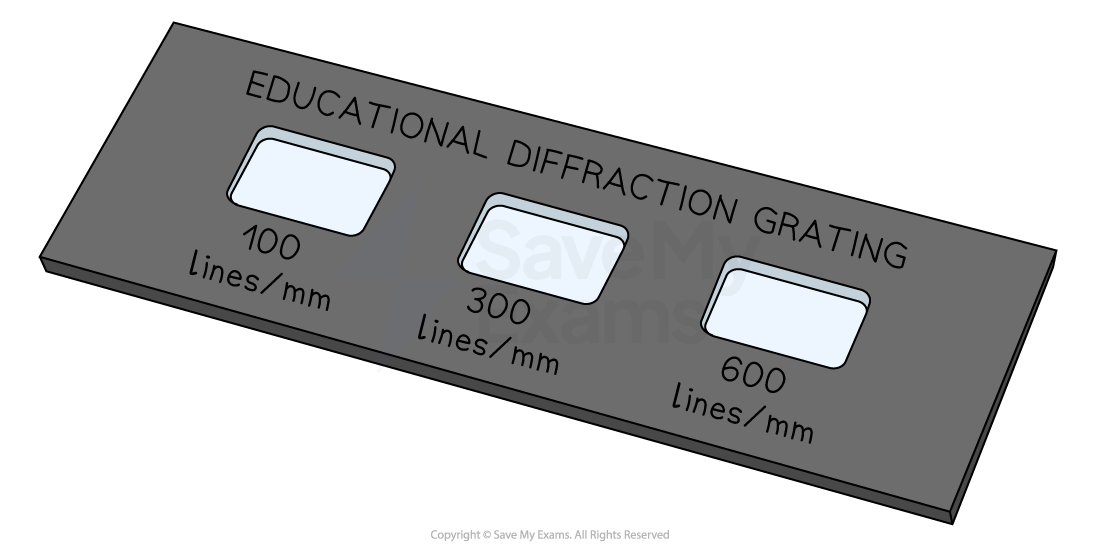
Diffraction gratings come in different sizes according to the number of lines per mm
Angular separation
- The angular separation of each maxima is calculated by rearranging the grating equation to make θ the subject
- The angle θ is taken from the centre meaning the higher orders of *n *are at greater angles
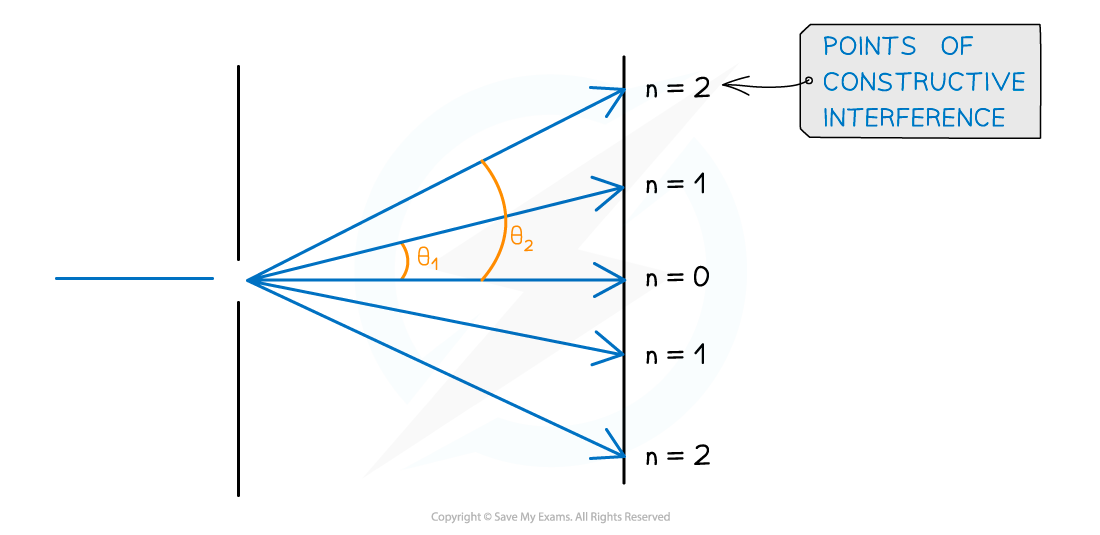
Angular separation increases as the order of maxima increases
- The angular separation between two angles is found by subtracting the smaller angle from the larger one
- The angular separation between the first and second maxima at n1 and n2 is θ2 – θ1
Orders of maxima
-
The maximum angle of diffraction with which maxima can be seen is when the diffracted light travels along the plane of the grating
- This means θ = 90° and sin θ = 1
-
The highest order of maxima visible is therefore calculated by the equation:
-
Since n is an integer number of maxima, if the value obtained is a decimal it must be rounded down to determine the highest-order visible
- E.g If n is calculated as 2.7 then n = 2 is the highest-order visible
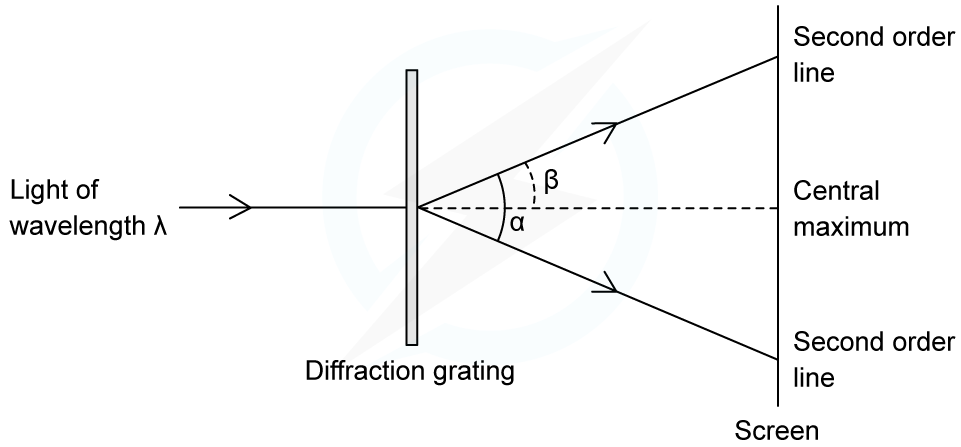
Worked Example An experiment was set up to investigate light passing through a diffraction grating with a slit spacing of 1.7 µm. The fringe pattern was observed on a screen. The wavelength of the light is 550 nm.
Calculate the angle α between the two second-order lines.
Answer:
Step 1: List the known quantities
- Order of maxima, n = 2
- Diffraction slit spacing, d = 1.7 µm = 1.7 × 10⁻⁶ m
- Wavelength, *λ *= 550 nm = 550 × 10–9 m
Step 2: Rearrange for β and substitute in the values
Step 3: Calculate α
- *β *is the angle from the centre to the second-order line
Exam Hint Take care that the angle θ is the correct angle taken from the centre and not the angle taken between two orders of maxima.
Determining the Wavelength of Light
Method
- The wavelength of light can be determined by rearranging the grating equation to make the wavelength *λ *the subject
-
The value of θ, the angle to the specific order of maximum measured from the centre, can be calculated through trigonometry
-
Create a right angled triangle to determine the angle of diffraction,* θ*
- The distance from the grating to the screen is marked as D
- The distance between the centre and the order of maxima (e.g. n = 2 in the diagram below) on the screen is labelled as h, *the fringe spacing
-
Measure both of these values with a ruler
-
Obtain the ratio
Order of maxima and wavelength
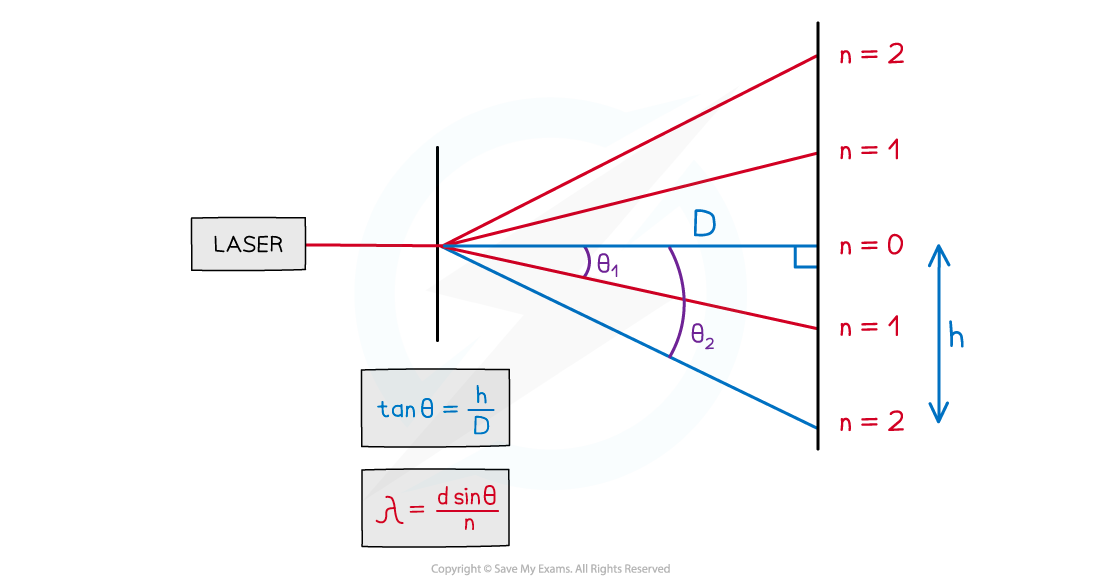
The wavelength of light is calculated by the angle to the order of maximum
- Calculate the inverse of tan to find
- Substitute for θ back into the diffraction grating equation to find the value of the wavelength (with the corresponding order n)
Improving the experiment and reducing uncertainties
- The fringe spacing can be subjective depending on its intensity on the screen. Take multiple measurements of h (between 3-8) and find the average
- Use a Vernier scale to record h, in order to reduce percentage uncertainty
- Reduce the uncertainty in h by measuring between the two nth-order maxima and halving
- Increase the grating to screen distance *D *to increase the fringe separation (although this may decrease the intensity of light reaching the screen)
- Conduct the experiment in a darkened room, so the fringes are clearer
- Use grating with more lines per mm, so values of h are greater to lower percentage uncertainty
Was this revision note helpful?
Build on this topic