Potential Difference (Cambridge International AS Physics)
Defining Potential Difference
-
A cell makes one end of the circuit positive and the other negative. This sets up a potential difference (p.d.) across the circuit
-
The potential difference across a component in a circuit is defined as: The energy transferred per unit charge flowing from one point to another
-
Potential difference (sometimes called voltage) is measured in volts (V). One volt is the same as one joule per coulomb (J C-1)
- If a bulb has a potential difference of 3 V, every coulomb of charge passing through the bulb will transfer 3 J of energy to the bulb
-
The potential difference of a power supply connected in series is always shared between the components in the circuit
Potential difference in a series circuit
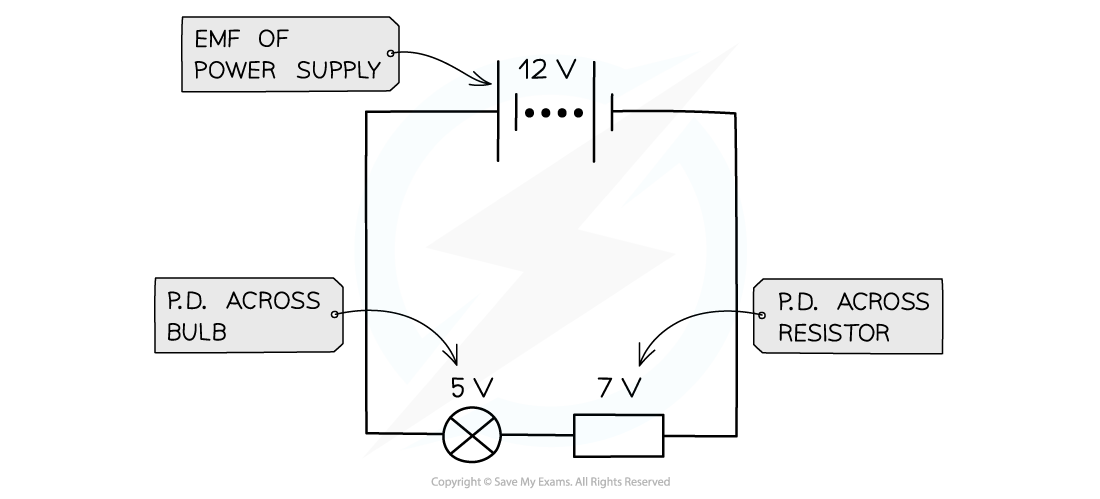
The potential difference is the voltage across each component in a circuit
-
Potential difference is measured using a voltmeter
-
A voltmeter is always set up in parallel so that it can measure the difference in electrical potential on each side of the component
- This is a measure of how much energy has been transferred to the component
Potential difference in a parallel circuit
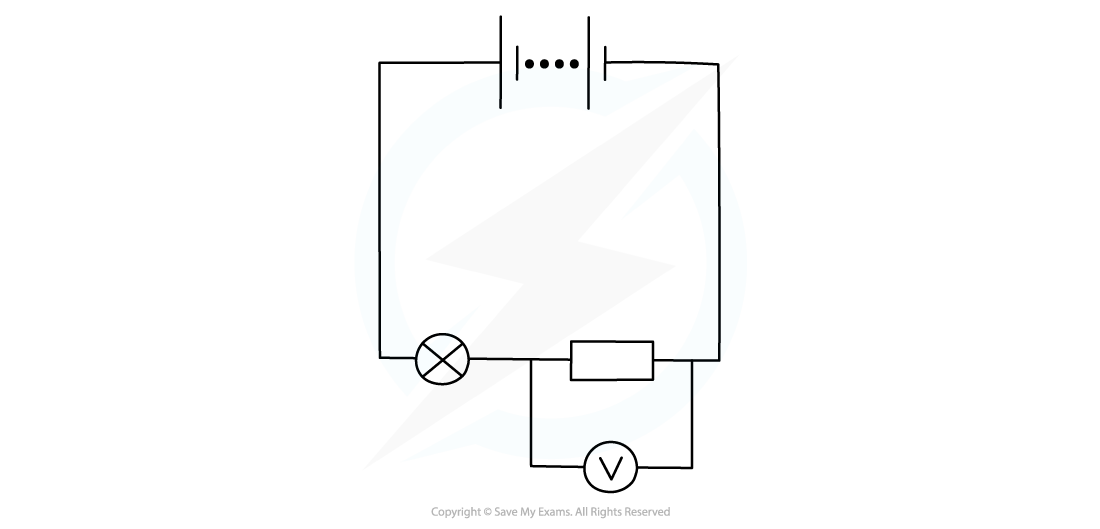
Potential difference can be measured by connecting a voltmeter in parallel between two points in a circuit.
Calculating Potential Difference
-
The potential difference is defined as the energy transferred per unit charge
-
Another measure of energy transfer is work done
-
Therefore, potential difference can also be defined as the work done per unit charge
- V = potential difference (V)
- W = work done (J)
- Q = charge (C)
Worked Example A lamp is connected to a 240 V mains supply and another to a 12 V car battery. Both lamps have the same current, yet the 240 V lamp glows more brightly.
Explain in terms of energy transfer why the 240 V lamp is brighter than the 12 V lamp.
Answer:
- Both lamps have the same current, which means charge flows at the same rate in both
- The 240 V lamp has a potential difference 20 times greater than the 12 V lamp
- Potential difference is the energy transferred (work done) per unit charge
- This means the energy transferred by each coulomb of charge to the 240 V lamp is 20 times greater than for the 12 V lamp
- This makes the 240 V lamp shine much brighter than the 12 V lamp

Exam Hint Think of potential difference as being the energy per coulomb of charge transferred between two points in a circuit
Was this revision note helpful?