11 markeasy
What is a reasonable estimate of the number of seconds in a year?
Choose your answer
5 × 10⁵ s
1 × 10⁶ s
3 × 10⁷ s
7 × 10⁸ s
15 questions · 92 marks · ≈ 2 hours · spans 8 of 64 topics
Assembled from the topic question banks — not an official Cambridge International paperWhat is a reasonable estimate of the number of seconds in a year?
Choose your answer
5 × 10⁵ s
1 × 10⁶ s
3 × 10⁷ s
7 × 10⁸ s
Which of the following is an SI base unit?
Choose your answer
Current
Gram
Kelvin
Volt
A student uses a digital ammeter to measure a current. The reading of the ammeter is found to fluctuate between 1.98 A and 2.02 A.
The manufacturer of the ammeter states that any reading has a systematic uncertainty of ±1%.
Which value of current should be quoted by the student?
Choose your answer
(2.00 ± 0.01) A
(2.00 ± 0.02) A
(2.00 ± 0.03) A
(2.00 ± 0.04) A
Which pair contains one vector and one scalar quantity?
| A | Displacement | Acceleration |
|---|---|---|
| B | Force | Kinetic energy |
| C | Momentum | Velocity |
| D | Power | Speed |
Choose your answer
Complete Table 1.1 to show the name and symbol of each physical quantity and the corresponding unit.
Table 1.1
| physical quantity | symbol | unit |
|---|---|---|
| velocity | m s-1 | |
| N m | ||
| stress | ||
| kg m-3 |
Calculate a reasonable estimate for the work done by a person lifting a dining room chair 1.0 m above the ground.
Analogue voltmeters and cathode-ray oscilloscopes (c.r.o.) are both devices which can measure potential differences.
For the analogue voltmeter and the c.r.o., describe one example of:
(i) a systematic error that can affect both devices
(1 mark)
(ii) a systematic error that can only affect the analogue voltmeter
(1 mark)
(iii) a random error that can affect both devices
(1 mark)
(iv) a random error that can only affect the analogue voltmeter.
(1 mark)
The potential difference across a resistor is measured using the analogue voltmeter shown in Fig. 1.1.
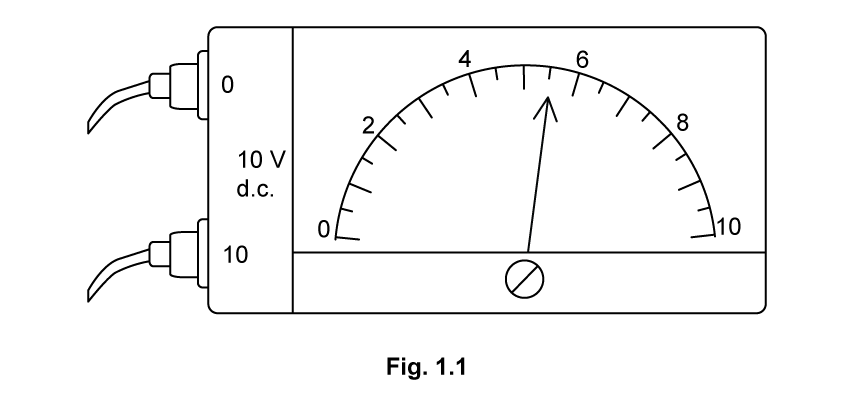
The resistor is labelled as having a resistance of 125 Ω ± 3%.
(i) Calculate the power dissipated by the resistor.
(2 marks)
(ii) Calculate the percentage uncertainty in the calculated power.
(2 marks)
(iii) Determine the value of the power, with its absolute uncertainty, to an appropriate number of significant figures.
power = ..................................... ± ..................................... W [2]
A microphone connected to a cathode ray oscilloscope (c.r.o.) detects a sound wave of frequency f. The signal from the microphone is observed on the c.r.o. as shown in Fig. 1.2.
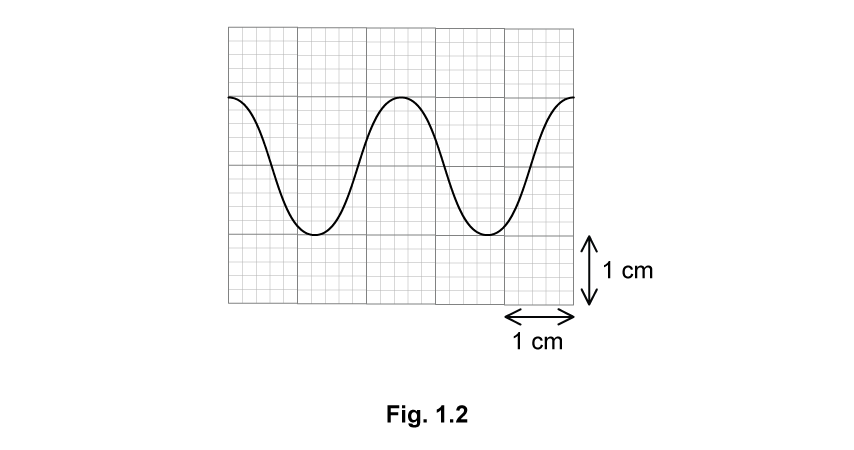
The time-base setting of the c.r.o. is 0.50 ms cm–1. The Y-plate setting is 2.5 mV cm–1.
Using the trace in Fig. 1.2, determine
(i) the amplitude of the signal, in mV
amplitude = ................................................... mV [2]
(ii) the frequency, in Hz
frequency = .................................................... Hz [3]
Extract:
A microphone connected to a cathode ray oscilloscope (c.r.o.) detects a sound wave of frequency f. The signal from the microphone is observed on the c.r.o. as shown in Fig. 1.2. The time-base setting of the c.r.o. is 0.50 ms cm^–1^. The Y-plate setting is 2.5 mV cm^–1^.
(i) Amplitude: Y-plate setting = 2.5 mV cm^–1^; amplitude reading = 1 large square = 1 cm; Amplitude, A = 1 × 2.5 = 2.5 mV. (1 division = 0.2 cm)
(i) Determine the percentage uncertainty in amplitude caused by reading the scale on the c.r.o.
(2 marks)
(ii) State the amplitude with its actual uncertainty.
amplitude = ................................ ± ................................ mV [1]
The resistive force acting on a spherical raindrop falling vertically in the air can be described by the relationship
where is the radius of the raindrop, is the velocity of the raindrop, and is a constant.
Fig. 1.1 shows the forces acting on the raindrop as it accelerates downwards.
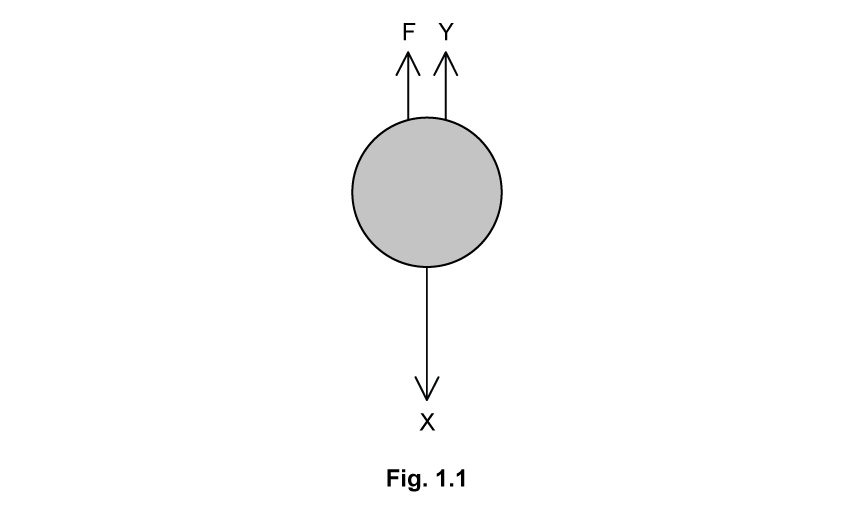
The raindrop has a radius of 1.5 mm and falls at a velocity of 3.5 m s−1. The constant k has a magnitude of 0.0124 in air.
Other than the resistive force F, two other forces, X and Y, act on the raindrop drop as it falls through the air.
(i) State the names of forces X and Y.
(2 marks)
(ii) Calculate the magnitude of the resistive force F in µN.
(2 marks)
(iii) Force X has a value of 137 µN and force Y has a value of 0.18 µN.
Using Fig. 1.1, determine the magnitude and direction of the resultant force on the raindrop.
(3 marks)
Extract:
(iii) Determine the magnitude and direction of the resultant force on the raindrop: Resultant force = X − Y − F. Resultant force = 137 − 0.18 − 65.1 = 71.72 µN. Magnitude of the resultant = 72 µN (2 s.f.). Direction of the resultant = downwards / in the direction of X.
On a windy day, the resultant force on the raindrop is 105 µN at an angle of θ to the vertical as shown in Fig. 1.2.
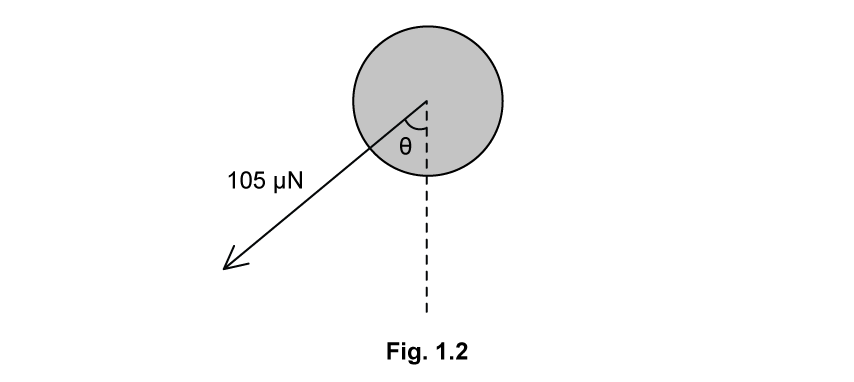
Use your answer to (a)iii to show that the angle θ between the resultant and the vertical is about 47°.
A raindrop falls vertically from rest in air. The variation with time of the speed of the raindrop is shown in the graph.
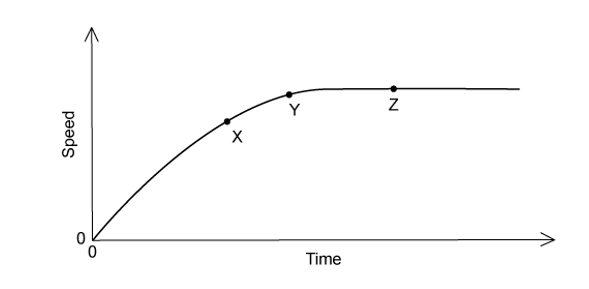
Which statement about the raindrop is correct?
Choose your answer
at point X, the raindrop has an acceleration of 9.81 m s–2
at point Z, the force on the raindrop due to air resistance has reached its maximum value and so the acceleration of the raindrop has also reached its maximum value
at point Z, the force due to air resistance is equal and opposite to the weight of the raindrop and so the speed of the raindrop is zero
the resultant force on the raindrop at point Y is less than the resultant force on the raindrop at point X
A bus driver drives with a constant acceleration of 5.0 m s–2 from an initial velocity of 3.0 m s–1. After 2.5 seconds, they slow down to stop at a set of traffic lights at 4.0 m s–2, eventually coming to a complete stop. Assume that air resistance is negligible.
Calculate the distance between where the bus began to accelerate and the traffic lights where the bus stops.
Extract:
A bus driver drives with a constant acceleration of 5.0 m s^–2^ from an initial velocity of 3.0 m s^–1^. After 2.5 seconds, they slow down to stop at a set of traffic lights at 4.0 m s^–2^, eventually coming to a complete stop. Assume that air resistance is negligible.
On Fig. 1.1 draw the velocity–time graph for the motion of the bus.
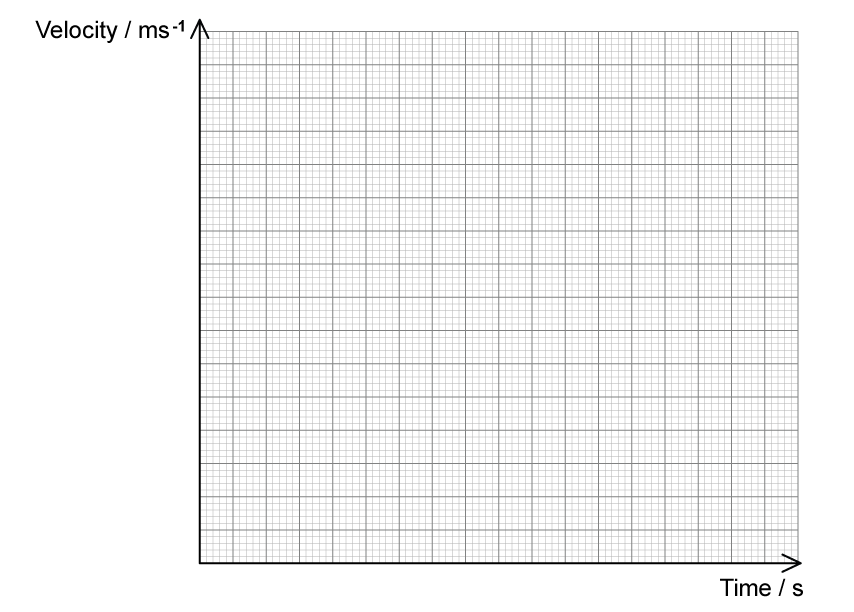
Fig. 1.1
The acceleration of free fall on planet X is of the acceleration of free fall on Earth.
The mass of a body on planet X is 60 kg.
What is its weight on planet X?
Choose your answer
10 N
59 N
98 N
360 N
A car has a horizontal driving force of 2.0 kN acting on it and a resistive force a quarter of this size. It has a forward horizontal acceleration of 2.0 m s–2
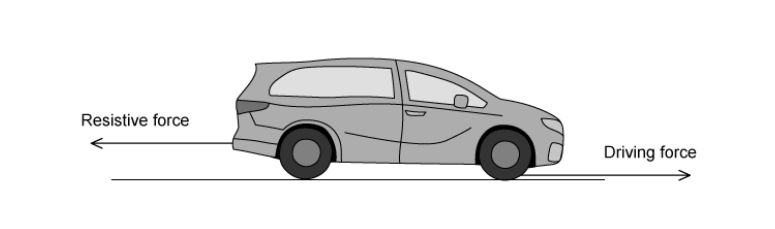
What is the mass of the car?
Choose your answer
500 kg
750 kg
1250 kg
2000 kg
A car accelerates from rest. The graph shows the momentum of the car plotted against time.
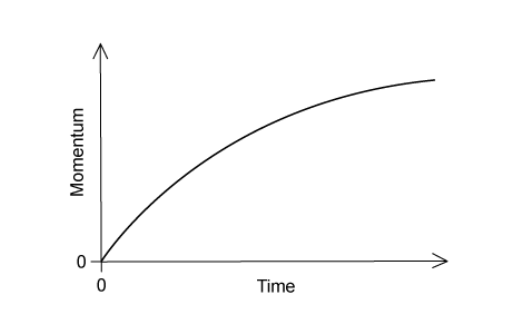
What is the meaning of the gradient of the graph at a particular time?
Choose your answer
the velocity of the car
the resultant force on the car
the kinetic energy of the car
the rate of change of kinetic energy of the car
A stationary uranium nucleus decays by emitting an α particle and thorium nucleus.
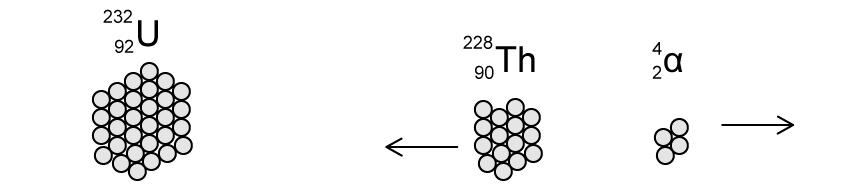
Discuss how the principle of conservation of momentum applies in this explosion.
Extract:
A stationary uranium nucleus decays by emitting an α particle and thorium nucleus.
Assume that all of the energy released in the emission process is transferred as kinetic energy to the α particle and the recoiling nucleus and is equal to 6.55 MeV.
Calculate the kinetic energy of the Thorium nucleus and α particle in MeV.
Extract:
A stationary uranium nucleus decays by emitting an α particle and thorium nucleus. Mass of Thorium nucleus, M_th = 228 u; Mass of alpha particle, M_α = 4 u; Unified atomic mass unit, u = 1.661 × 10^−27 kg = 931.5 MeV Assume that all of the energy released in the emission process is transferred as kinetic energy to the α particle and the recoiling nucleus and is equal to 6.55 MeV. Kinetic energy of α particle, E_kα = 6.44 MeV; Kinetic energy of Thorium nucleus, E_kth = 0.11 MeV
Show that momentum is conserved in this decay.
Collisions can occur between neutrons and stationary Uranium nuclei, for example, during nuclear fission.
Discuss how this collision would be if this was inelastic as opposed to elastic.
A student uses a motion sensor connected to a laptop to investigate the motion of a hollow ball of mass 1.5 × 10⁻² kg falling through the air.
The ball is dropped from rest. It reaches terminal velocity before it reaches the ground.
The upthrust on the ball is negligible.
Explain briefly why the acceleration of the ball
(i) decreases with time
(2 marks)
(ii) is 9.8 m s–2 initially.
(1 mark)
Extract:
A student uses a motion sensor connected to a laptop to investigate the motion of a hollow ball of mass 1.5 × 10^–2^ kg falling through the air. The ball is dropped from rest. It reaches terminal velocity before it reaches the ground. The upthrust on the ball is negligible.
The variation with time t of the velocity v of the ball as it falls towards the ground is shown in Fig. 1.1.
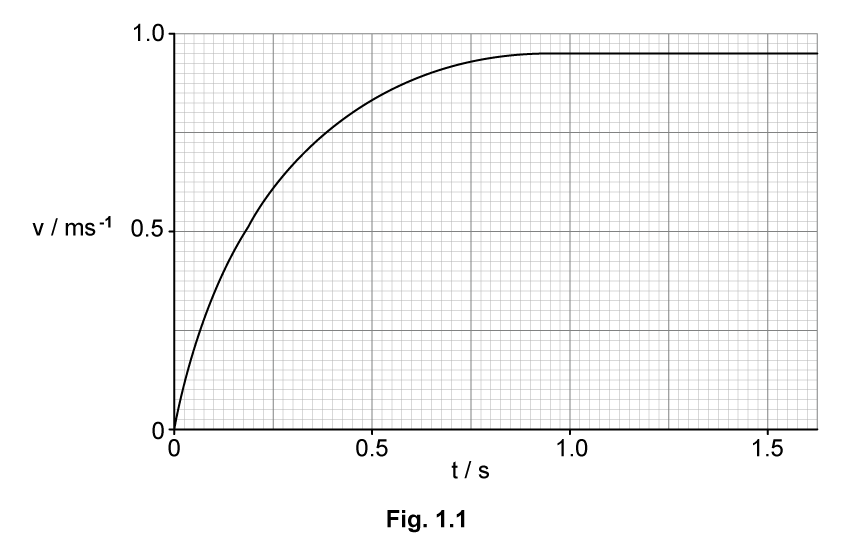
(i) Use Fig. 1.1 to determine the magnitude of the acceleration of the ball at time t = 0.25 s.
(3 marks)
(ii) Calculate the resultant force acting on the ball at time t = 0.25 s.
(2 marks)
Extract:
A student uses a motion sensor connected to a laptop to investigate the motion of a hollow ball of mass 1.5 × 10^–2^ kg falling through the air. The ball is dropped from rest. It reaches terminal velocity before it reaches the ground. The upthrust on the ball is negligible.
(i) Use Fig. 1.1 to determine the magnitude of the acceleration of the ball at time t = 0.25 s. [Acceleration ≈ 1.15 m s^–2^] (ii) Calculate the resultant force acting on the ball at time t = 0.25 s. [F = ma = 0.015 × 1.15 = 0.017 N]
Use your answers in (b) to determine the drag on the ball at time t = 0.25 s.
Extract:
A student uses a motion sensor connected to a laptop to investigate the motion of a hollow ball of mass 1.5 × 10^–2^ kg falling through the air. The ball is dropped from rest. It reaches terminal velocity before it reaches the ground. The upthrust on the ball is negligible.
The student adds a small amount of sand inside the hollow ball and repeats the experiment. The ball is dropped from rest and reaches terminal velocity before it reaches the ground.
(i) Describe how the forces acting on the ball filled with sand at v = 0.50 m s–1 compare with the forces acting on the hollow ball at this speed.
(2 marks)
(ii) State and explain how the terminal velocity of the ball filled with sand will differ from the terminal velocity of the hollow ball.
(3 marks)
A fast-moving asteroid B collides with a slower-moving asteroid A as shown in Fig. 1.1. Asteroid B becomes embedded within asteroid A as shown.
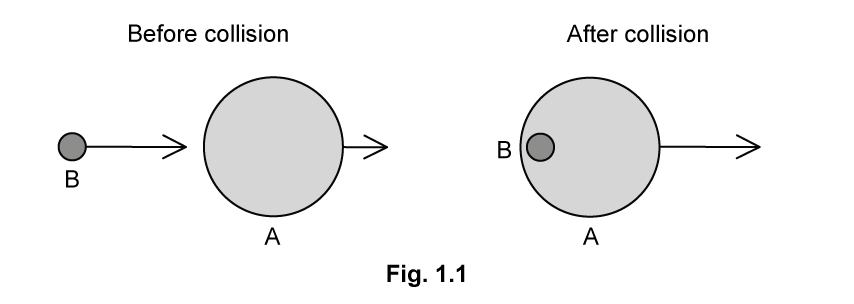
Before the collision, asteroid A had a velocity of 3.61 km s−1 and a momentum of 2.00 × 10¹⁷ kg m s−1.
(i) State the principle of conservation of linear momentum.
(2 marks)
(ii) Show that the mass of asteroid A was about 5.5 × 10¹³ kg.
(2 marks)
Extract:
A fast-moving asteroid B collides with a slower-moving asteroid A as shown in Fig. 1.1. Asteroid B becomes embedded within asteroid A as shown. Before the collision, asteroid A had a velocity of 3.61 km s^−1^ and a momentum of 2.00 × 10^17^ kg m s^−1^. (ii) Show that the mass of asteroid A was about 5.5 × 10^13^ kg. Mass of asteroid A: m_A = 5.54 × 10^13 kg
Calculate the combined velocity, in km s−1, of the asteroids after the collision.
mass of asteroid B = 6.40 × 10¹² kg
velocity of asteroid B before the collision = 14.0 km s−1
Extract:
(ii) Show that the mass of asteroid A was about 5.5 × 10^13 kg. Mass of asteroid A = 5.54 × 10^13 kg.
Calculate the combined velocity, in km s^−1, of the asteroids after the collision. mass of asteroid B = 6.40 × 10^12 kg; velocity of asteroid B before the collision = 14.0 km s^−1. Combined velocity v = 4.69 km s^−1 (3 s.f.).
A short time later, the combined asteroid AB collides with a stationary asteroid C. Immediately following the collision, the asteroids are deflected by the angles shown in Fig. 1.2.
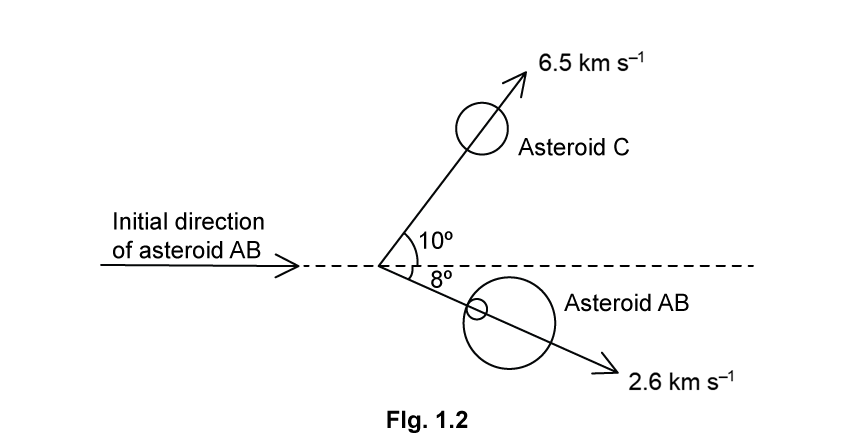
Show that the mass of asteroid C is about 2.0 × 10¹³ kg.
Extract:
Calculate the combined velocity of the asteroids after the collision: v = 4686 = 4.69 km s^−1^ (3 s.f.)
A short time later, the combined asteroid AB collides with a stationary asteroid C. Immediately following the collision, the asteroids are deflected by the angles shown. Asteroid AB travels at 2.6 kilometres per second at an 8-degree angle to the initial direction of AB, and asteroid C travels at 6.5 kilometres per second at a 10-degree angle to the initial direction of AB. Mass of asteroid AB, m_AB = (6.4 × 10^12) + (5.54 × 10^13) = 6.18 × 10^13 kg. Mass of asteroid C, m_C = 2.04 × 10^13 kg.
Determine if the collision in (c) is elastic or inelastic.