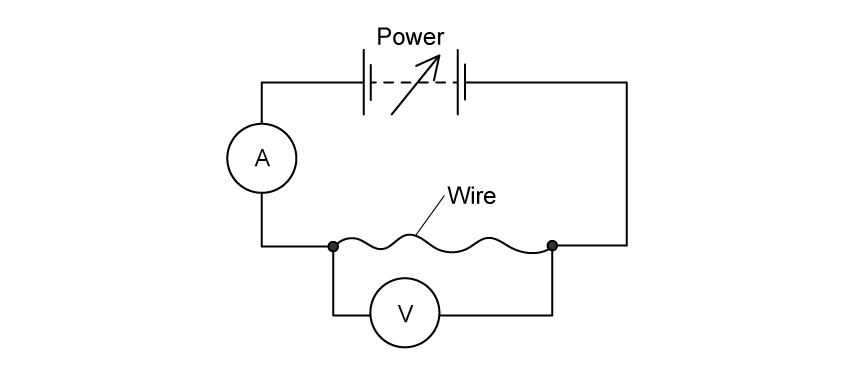
A straight wire of unstretched length L has an electrical resistance R. The area of the cross-section *A *of the wire may be assumed to be constant.
State the relation between R, L, A and the resistivity *ρ *of the material of the wire.
Measurements made for a sample of metal wire are shown in Table 1.1.
Table 1.1
| Quantity | Measurement |
|---|---|
| resistance diameter length | 6.1 Ω 0.44 mm 1390 mm |
State the most appropriate instrument to use to measure
(i) the resistance of the wire
(1 mark)
(ii) the diameter of the wire
(1 mark)
(iii) the length of the wire.
(1 mark)
Extract:
State the relation between R, L, A and the resistivity ρ of the material of the wire: R = ρL/A
Measurements made for a sample of metal wire are shown in Table 1.1: resistance 6.1 Ω, diameter 0.44 mm, length 1390 mm.
Show that the resistivity of the metal is 6.67 × 10⁻⁷ Ω m.
Extract:
A straight wire of unstretched length L has an electrical resistance R. The area of the cross-section A of the wire may be assumed to be constant. State the relation between R, L, A and the resistivity ρ of the material of the wire. R = ρL/A
State and explain what would happen to the resistivity of the wire if the diameter was doubled.