17 markseasy
1 mark
Define a transverse wave.
2 marks
State two properties of a longitudinal wave.
2 marks
State two examples of transverse waves.
2 marks
State two examples of longitudinal waves.
5 questions · 44 marks · ≈ 44 min
Define a transverse wave.
State two properties of a longitudinal wave.
State two examples of transverse waves.
State two examples of longitudinal waves.
Fig. 1.1 shows graphs of waves X and Y. The scales of the graphs are identical.
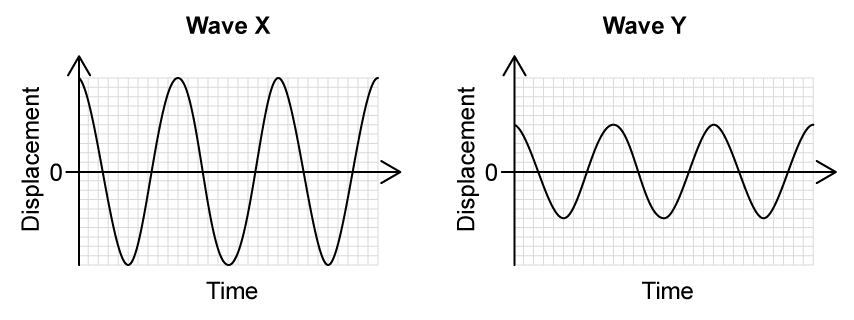
Fig. 1.1
Describe two similarities between the properties of waves X and Y.
Extract:
Fig. 1.1 shows graphs of waves X and Y. The scales of the graphs are identical. Fig. 1.1
State one difference between waves X and Y.
Distinguish between transverse and longitudinal waves.
Extract:
Fig. 1.1 shows graphs of waves X and Y. The scales of the graphs are identical. Fig. 1.1
Explain how it could be determined whether waves X and Y are transverse or longitudinal.
Explain what is meant by a progressive wave.
An elastic cord is fixed at one end and attached to a mechanical oscillator at the other end. Fig. 1.1 shows, at time t = 0, the shape of a section of the cord as the wave travels from left to right. W, X, Y and Z are four marked points on the cord.
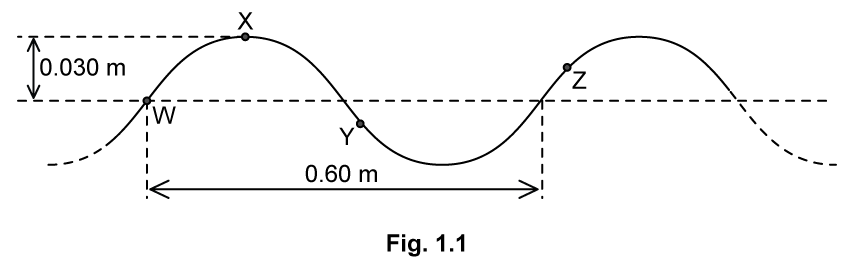
The mechanical oscillator has a steady frequency of 5.0 Hz. The wave has a wavelength of 0.60 m and an amplitude of 0.030 m.
On the axes of Fig. 1.2 sketch the graph of the displacement of point X over the period t = 0 to 0.40 s. Add suitable scales to the axes.
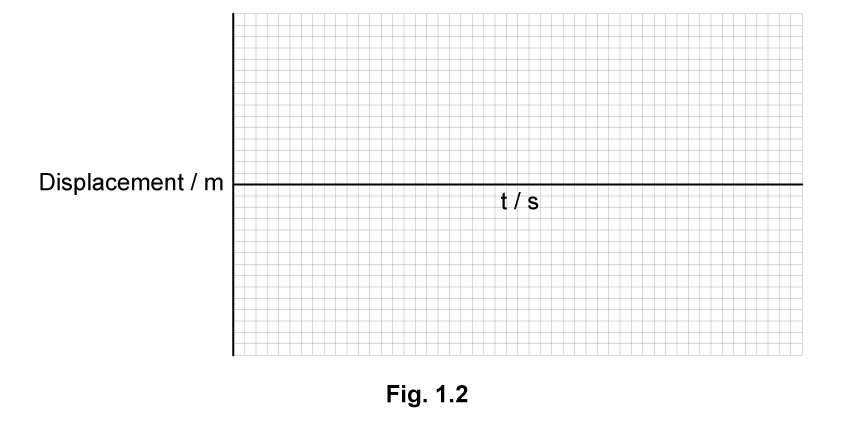
Extract:
An elastic cord is fixed at one end and attached to a mechanical oscillator at the other end. Fig. 1.1 shows, at time t = 0, the shape of a section of the cord as the wave travels from left to right. W, X, Y and Z are four marked points on the cord.
The mechanical oscillator has a steady frequency of 5.0 Hz. The wave has a wavelength of 0.60 m and an amplitude of 0.030 m.
For time t = 0, state which of the points W, X, Y and Z
i) is instantaneously at rest
(1 mark)
ii) has the greatest speed
(1 mark)
Extract:
An elastic cord is fixed at one end and attached to a mechanical oscillator at the other end. Fig. 1.1 shows, at time t = 0, the shape of a section of the cord as the wave travels from left to right. W, X, Y and Z are four marked points on the cord. The mechanical oscillator has a steady frequency of 5.0 Hz. The wave has a wavelength of 0.60 m and an amplitude of 0.030 m.
The speed of point W on the cord at t = 0 is 0.94 m s–1. With the cord at its original tension, the frequency of oscillation is now doubled to 10 Hz.
The amplitude is kept at 0.030 m. Calculate the new speed of point W at t = 0. Explain your reasoning.
Explain briefly how transmission of energy by a longitudinal wave differs from transmission of energy by a transverse wave. Give one example of a transverse wave.
With the aid of a clearly labelled diagram explain how a sound wave in air transmits energy away from its source.
Short pulses of sound are reflected from a wall 30 m from the sound source. The reflected pulses return to the source after 0.18 s.
Calculate the speed of sound.
Extract:
Short pulses of sound are reflected from a wall 30 m from the sound source. The reflected pulses return to the source after 0.18 s. Calculate the speed of sound. Speed = 333.3 = 330 m s^–1 (2 s.f.)
Fig.1.1 represents the sound wave from part (c).
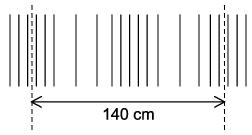
Fig. 1.1
Calculate the frequency of the sound wave.
A large water tank is set up so that a wave can be generated at each end of the tank. The two waves, A and B, travel towards each other at the same speed.
Fig. 1.1 shows the variation of displacement of the water surface with distance travelled at a particular instant.
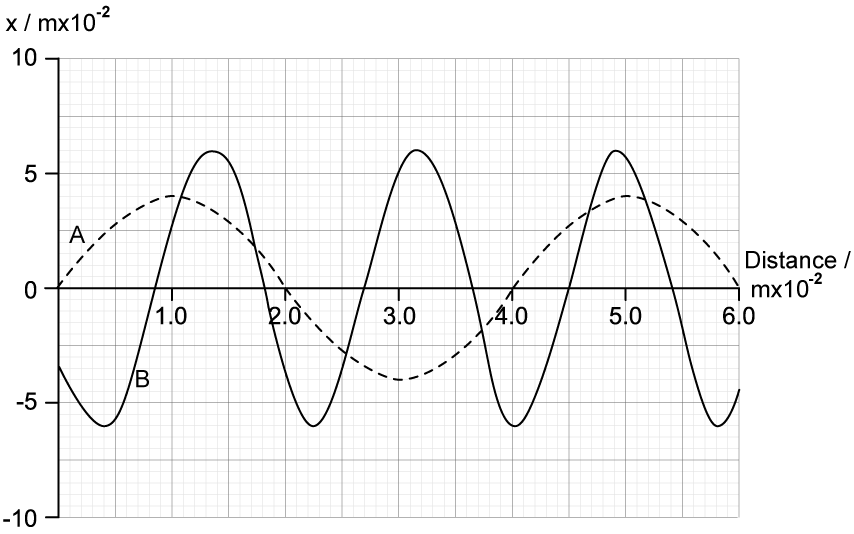
Fig. 1.1
Deduce how many times greater the amplitude of B is to the amplitude of A.
Extract:
A large water tank is set up so that a wave can be generated at each end of the tank. The two waves, A and B, travel towards each other at the same speed. Fig. 1.1 shows the variation of displacement of the water surface with distance travelled at a particular instant.
Wave A has a frequency of 8.0 Hz.
Fig. 1.1
(i) Calculate the velocity of wave A.
(2 marks)
(ii) Determine the frequency of wave B.
(2 marks)
Extract:
A large water tank is set up so that a wave can be generated at each end of the tank. The two waves, A and B, travel towards each other at the same speed.
Explain how the stationary wave is generated in the tank.