A small child does work on a large suitcase by pushing it along a smooth floor, as shown in Fig. 1.1.
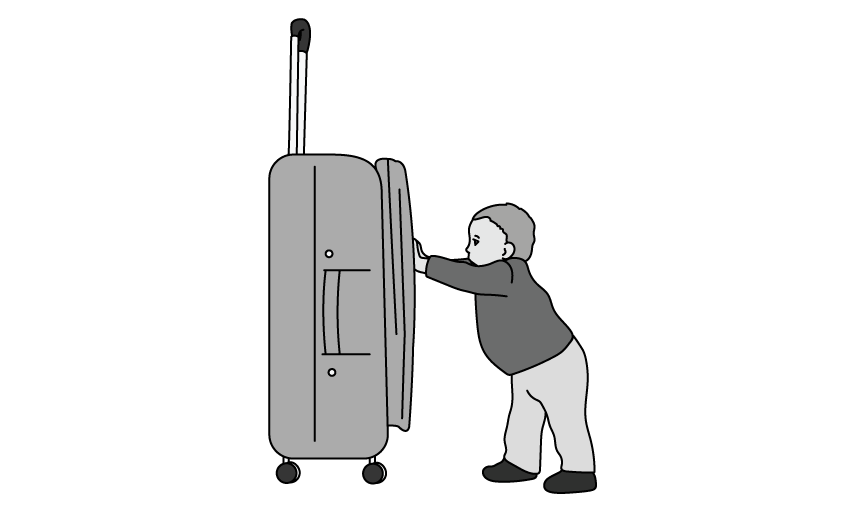
Fig. 1.1.
State the definition of work done and write the equation.
Extract:
A small child does work on a large suitcase by pushing it along a smooth floor, as shown in Fig. 1.1.
The suitcase is moved back to its original position by an adult who pulls it at an angle of 70° to the floor, as shown in Fig. 1.2.
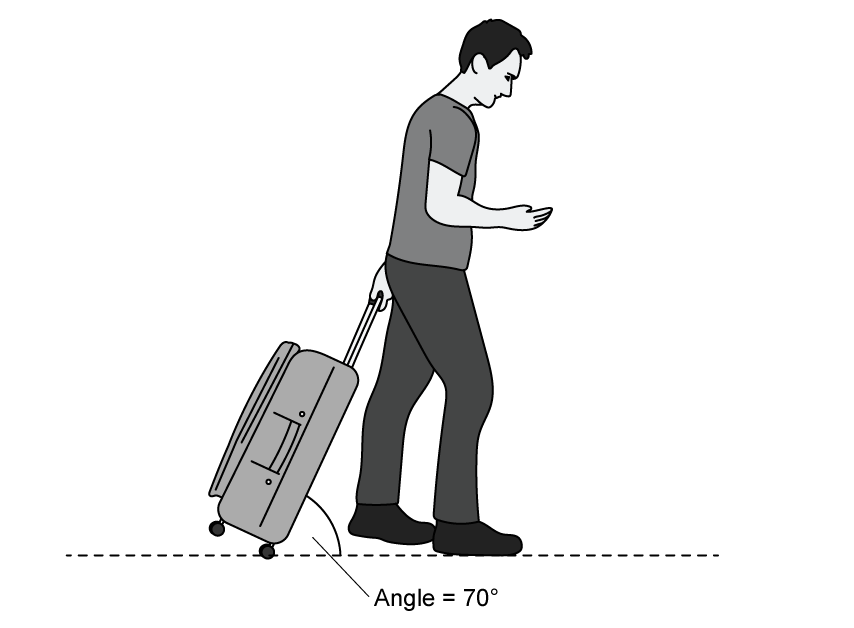
Fig. 1.2.
Write an expression for the work done on the suitcase by the adult in terms of force , distance and the angle 70°.
Extract:
The suitcase is moved back to its original position by an adult who pulls it at an angle of 70° to the floor, as shown in Fig. 1.2. Write an expression for the work done on the suitcase by the adult in terms of force F, distance s and the angle 70°. Work done on an incline: W = Fs cos θ
In moving the suitcase the child and adult both exerted equal forces of 20 N. They each move the suitcase a distance of 2.5 m.
Calculate the work done by
(i) the child
(2 marks)
(ii) the adult.
(2 marks)
Extract:
A small child does work on a large suitcase by pushing it along a smooth floor.
The suitcase is moved back to its original position by an adult who pulls it at an angle of 70° to the floor.
In moving the suitcase the child and adult both exerted equal forces of 20 N. They each move the suitcase a distance of 2.5 m.
Work done by the child: W = 20 × 2.5 = 50 J Work done by the adult: W = (20 × cos 70) × 2.5 = 17 J
State whether the child or the adult are more efficient at moving the suitcase, explaining your reasoning.