Harmonic Form (Cambridge International AS Mathematics)
Exam board Cambridge International · ASUpdated 2026-07-02
R addition formulae Rcos Rsin etc
Harmonic form
What is harmonic form?
-
If a and b are positive constants, then
- a sin x+ bcos x can be rewritten as R sin (x + α) - a sin x - bcos x can be rewritten as R sin ( x - α)
- a cos x+ bsin x can be rewritten as R cos (x - α) - a cos x - bsin x can be rewritten as R cos ( x + α)
-
The forms with R and α are called harmonic forms
- It is the reverse of expanding the right-hand side out using compound angle formulae
- It can be seen as factorising
-
In all four cases R > 0 and 0 < α < 90°, with:

-
To find α, first divide the b expression by the a expression
- The R's cancel
- Use the identity sin α / cos α = tan α
- You get b / a = tan **α **
- Then use** tan**-1(b/a) to find α
How do I write trigonometric expressions in harmonic form?
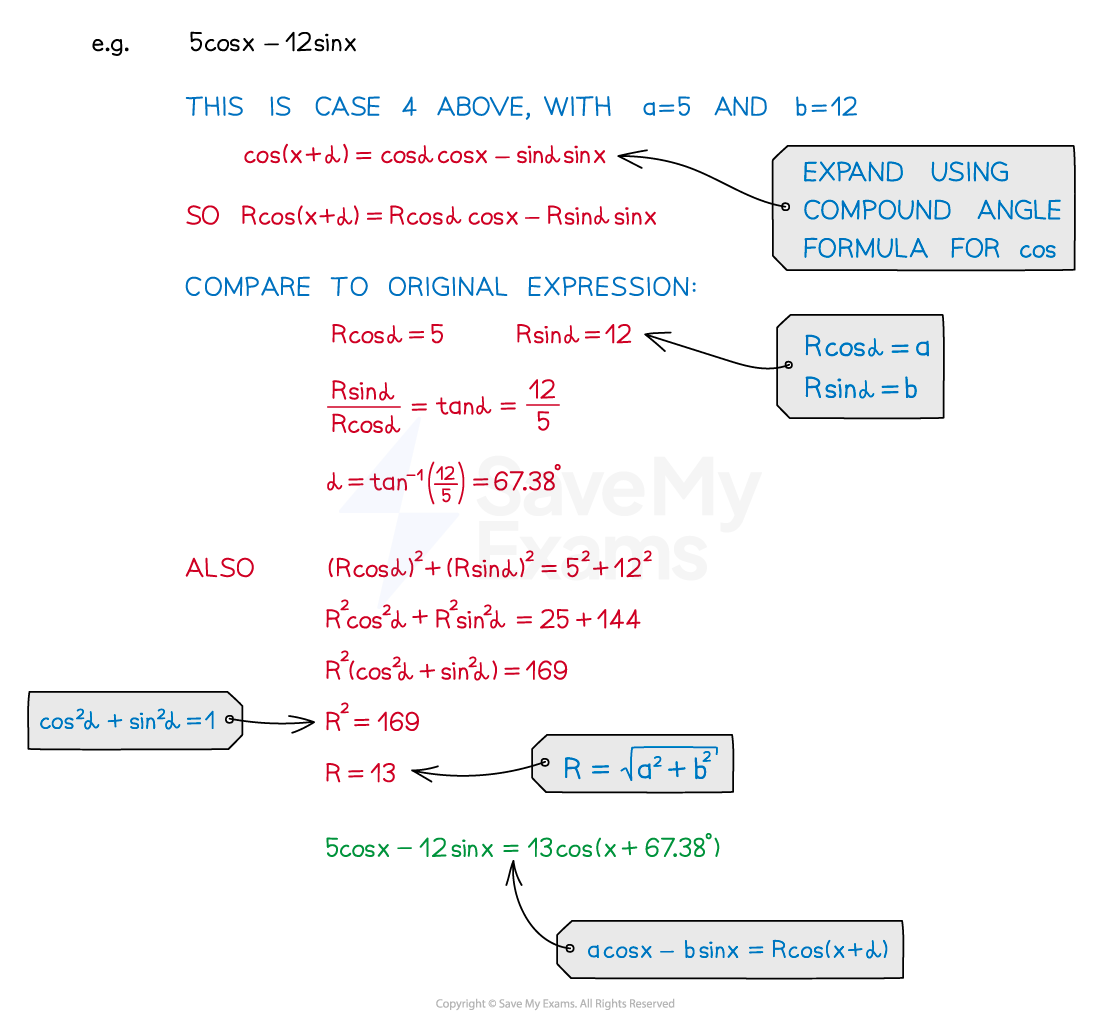
- To rewrite the expression use the appropriate compound angle formula and equate coefficients
Exam Hint
- There is more than one way to rewrite a given expression, and the question in the exam will tell you which form to use.
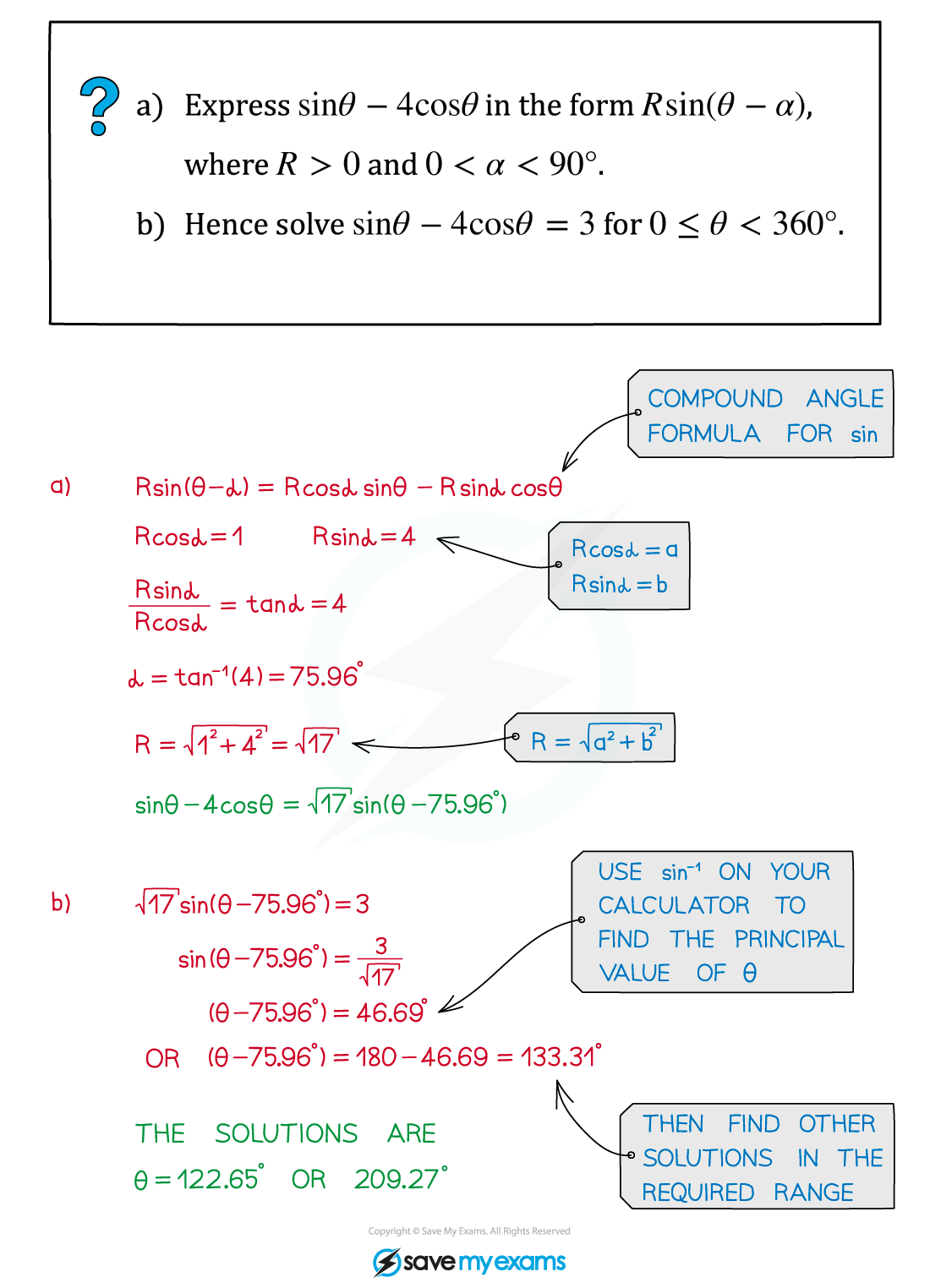
Worked Example
Was this revision note helpful?
Build on this topic