Scalars & Vectors (Cambridge International AS Mathematics)
Scalars & vectors
Mechanics uses a variety of different scalar and vector quantities.
What are scalars?
-
Scalars are quantities without direction, they only have a size (magnitude)
- e.g. a speed of 7 m/s, a distance of 5 m, a time of 15 s or a mass of 12 kg
-
Scalars can only be positive- you can’t have a negative distance or speed!
What are vectors?
-
Vectors are quantities which also have a direction, this is what makes them more than just a scalar
- e.g. two objects with velocities of 7 m/s and ‑7 m/s are travelling at the same speed but in opposite directions
-
Vector quantities can have positive or negative components
-
Some examples of vector quantities you may come across are displacement, velocity, acceleration, force/weight, momentum
- Displacement is the distance moved in a given direction from a starting point
- Velocity is a speed in a given direction (displacement over time)
- Acceleration is the change in velocity over time
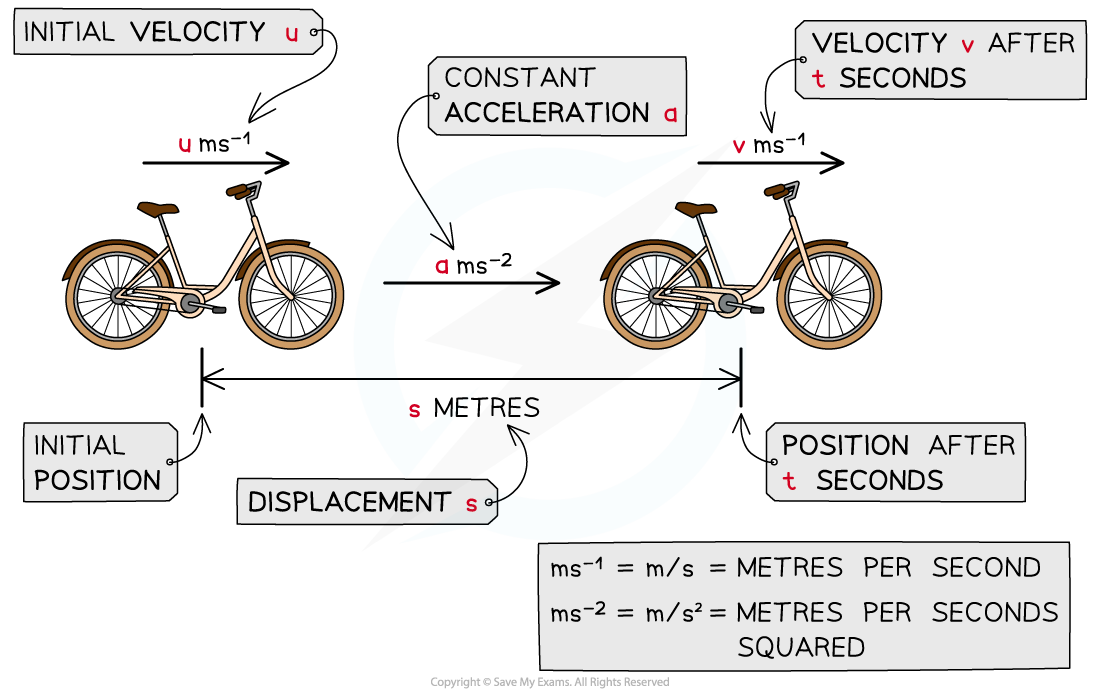
Vector quantities of displacement, velocity and acceleration
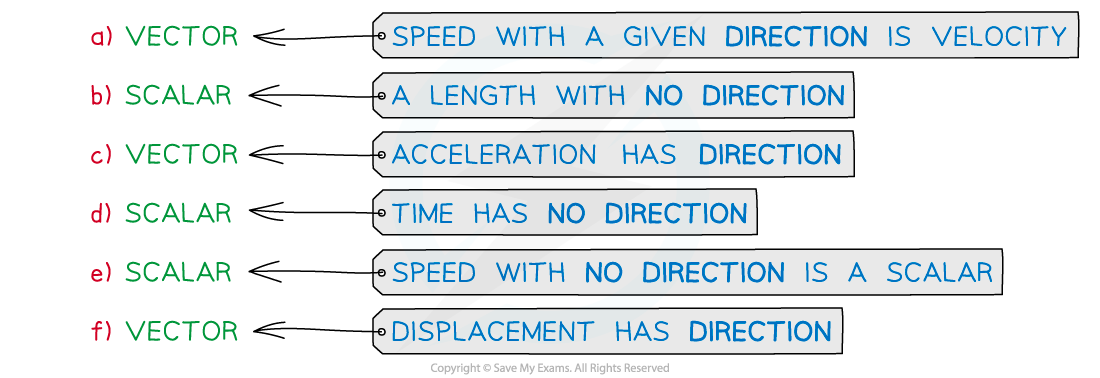
Worked Example State whether each of the following is a scalar or a vector quantity.
a) A speed boat travels at 3m/s on a bearing of 052o
b) A garden is 1.7 m wide
c) A car accelerates at 5.4 ms-2
d) A film lasts 2 hours 17 minutes
e) An athlete runs at an average speed of 10.44 ms-1
f) A ball rolls forwards 60 cm before stopping
Answer:
Exam Hint
- Make sure you fully understand the definitions of all the words in this section so that you can be clear about what your exam question is asking of you
- Vectors appear in bold (non-italic) font in textbooks, on exam papers, etc (i.e. F, α ) but in handwriting should be underlined (i.e.* F , α *)
Was this revision note helpful?
Build on this topic