Force Diagrams (Cambridge International AS Mathematics)
Force Diagrams
Why do we need force diagrams?
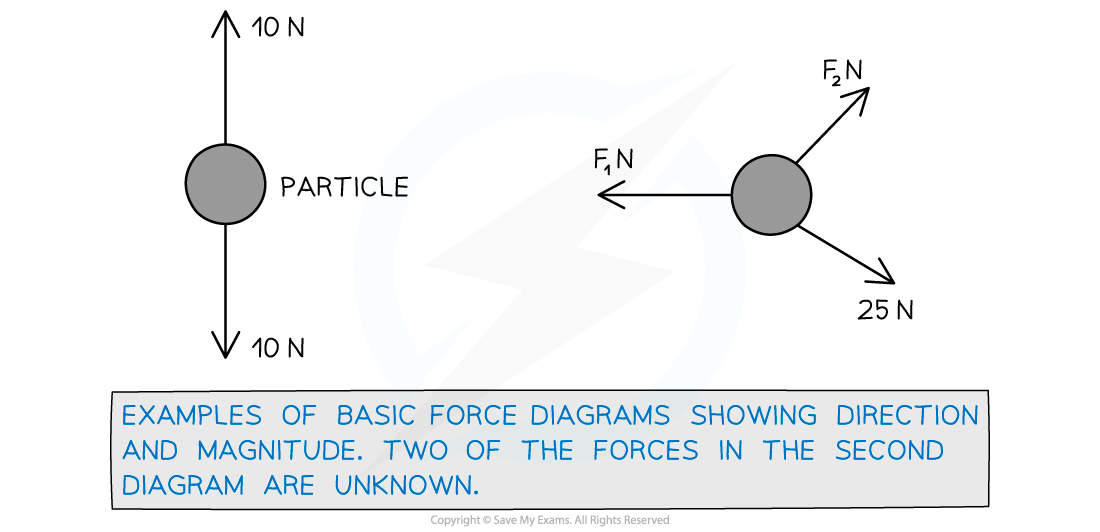
- Force diagrams are used to help understand a given scenario and show which forces are acting on which particles and in which direction they are acting
- In diagrams an arrow is used to represent a force acting on a particle which shows the direction in which the force is acting
- The magnitude of the force is normally written next to its arrow
What types of forces could be involved?
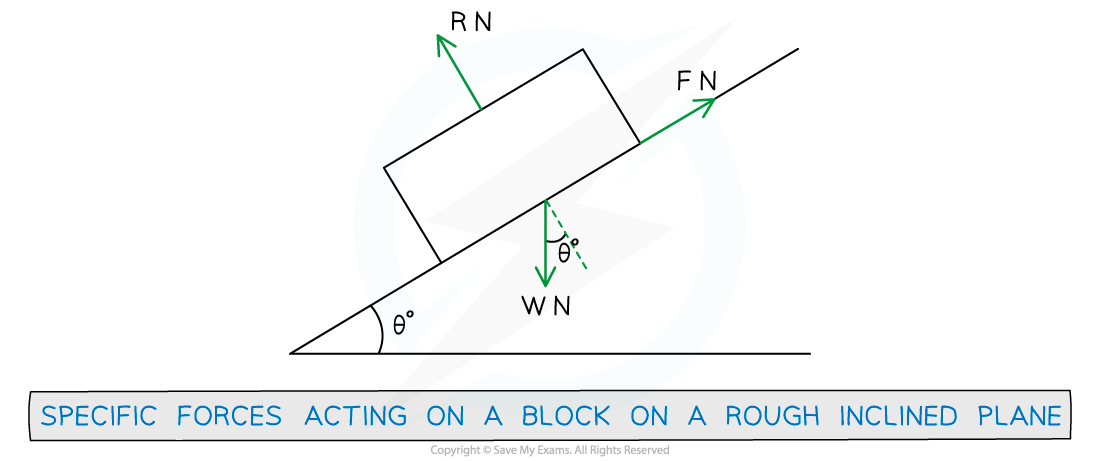
- Specific types of force encountered (which may not be mentioned in the question nor labelled on a given diagram) are: weight (W N), tension (T N), thrust (T N), friction (F N) and normal reaction ( R N)
-
Remember that the diagram is drawn to help understand the scenario - cars, blocks, etc are modelled as particles occupying a single point in space and so all forces acting on the car, block, etc act at that same single point
-
The main forces that you will see are:
- tension (a “pulling” force) acts away from a particle, thrust (a “pushing” force) acts towards it
- weight is *W = mg *where m kg is the mass of the particle and g is the acceleration due to gravity – In the CIE A Level Mechanics modules the value of is approximated to , unless told otherwise
- friction acts parallel to the surface in the opposite direction to motion
- the normal reaction acts perpendicular to the surface (and friction)
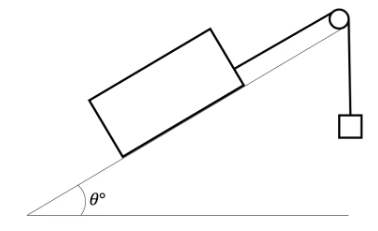
Worked Example The diagram below shows a block, of weight 52 N, at rest on a rough plane that is inclined at to the horizontal. The block is connected to a mass, m kg. via a light inextensible string that passes over a smooth pulley. The particle hangs at rest vertically below the pulley.
Add all forces (known and unknown) to the diagram that are acting on the block and the mass. Also indicate the direction of acceleration of any subsequent motion. (You may assume the block is heavier than the mass and so any subsequent motion would the block slide down the plane.)
Answer:
Exam Hint
- Always draw a force diagram if appropriate.
- If a diagram is already given then add to it as you progress through the question.
- If a diagram is too small or it gets too complicated then draw a new diagram.
- You may be able to manage with just drawing the section of the diagram you are dealing with in any particular question part.
Was this revision note helpful?
Build on this topic