Data protection (Cambridge International AS Computer Science)
Exam board Cambridge International · ASUpdated 2025-04-24
Data security techniques
Access rights
- Access rights control what users can see or do on a network
- They ensure that users can access the files and resources they need for their role, and can’t access information they shouldn’t
- Access rights are assigned based on a user’s role, responsibilities, or security clearance
| Access right | What it means |
|---|---|
| Full access | The user can open, create, edit, and delete files or folders |
| Read-only access | The user can open and view files but cannot edit or delete them |
| No access | The user cannot see or interact with the file or folder at all |
Example: access rights on a school network
| User group | Access rights |
|---|---|
| Administrators | Unrestricted access – Can access and control all files, folders, and settings |
| Teaching Staff | Partially restricted access – Can access student data but not other staff files |
| Students | Restricted access – Can only access their own files and folders |
- Users can be grouped(e.g. “Year 11”, “Staff”, “Admin”) and given access rights as a group
- Access rights can be assigned to files, folders, or whole systems
- This helps protect confidential data, improves network security, and supports efficient collaboration
Encryption
- Encryption is a method of scrambling data before being transmitted across a network in order to protect the contents from unauthorised access
- While encryption is important on both wired and wireless networks, it's even more critical on wireless networks due to the data being transmitted over radio waves, making it easy to intercept
How is wireless data encrypted?
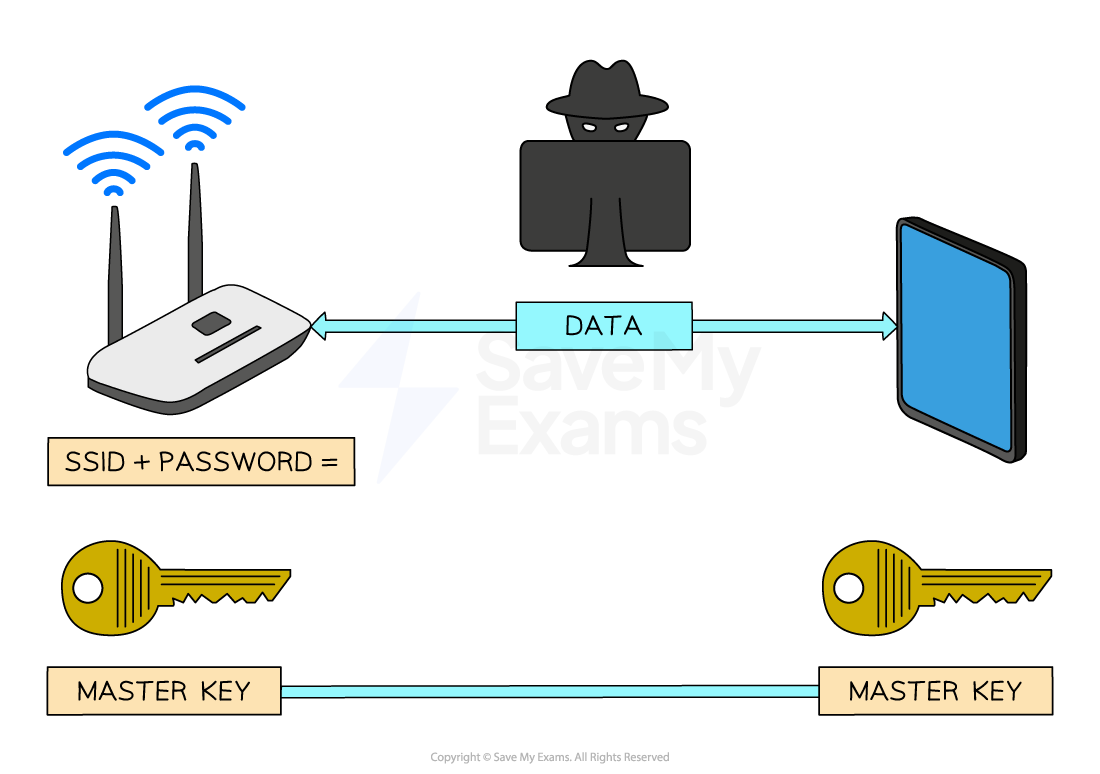
- Wireless networks are identified by a 'Service Set Identifier' (SSID) which along with a password is used to create a 'master key'
- When devices connect to the same wireless network using the SSID and password they are given a copy of the master key
- The master key is used to encrypt data into 'cipher text', before being transmitted
- The receiver uses the same master key to decrypt the cipher text back to 'plain text'
- To guarantee the security of data, the master key is never transmitted. Without it, any intercepted data is rendered useless
- Wireless networks use dedicated protocols like WPA2 specifically designed for Wi-Fi security
How is wired data encrypted?
- Wired networks are encrypted in a very similar way to a wireless network, using a master key to encrypt data and the same key to decrypt data
- Encryption on a wired network differs slightly as it is often left to individual applications to decide how encryption is used, for example HTTPS
Was this revision note helpful?
Build on this topic