Procedures & functions (Cambridge International AS Computer Science)
What are functions and procedures?
-
Functions and procedures are a type of sub program, a sequence of instructions that perform a specific task or set of tasks
-
Procedures and functions are defined at the start of the code
-
Sub programs are often used to simplify a program by breaking it into smaller, more manageable parts
-
Sub programs can be used to:
- Avoid duplicating code and can be reused throughout a program
- Improve the readability and maintainability of code
- Perform calculations, to retrieve data, or to make decisions based on input
-
Parameters are values that are passed into a sub program
- Parameters can be variables or values and they are located in brackets after the name of the sub program
- Example:
FUNCTION TaxCalculator(Pay : REAL, TaxCode : STRING) RETURNS REALORPROCEDURE TaxCalculator(Pay : REAL, TaxCode : STRING)
-
Sub programs can have multiple parameters
-
To use a sub program you 'call' it from the main program
What's the difference between a function and procedure?
- A Function returns a value whereas a procedure does not
Procedures
- Procedures are defined using the PROCEDURE keyword in pseudocode
- A procedure can be written as:
| Pseudocode | |
|---|---|
-
The identifier is used to call the procedure
-
To call a procedure, it can be written as:
-
When parameters are used,
value1, value2...must be of the correct data type and in the same sequence
Example code
PROCEDURE GreetUserdefines the procedure, which takes one parameter:Name- The procedure prints a personalised greeting
- The main program asks for the user’s name and then calls the procedure using
CALL
Functions
- Functions are defined using the FUNCTION keyword in pseudocode or def keyword in Python
- Functions always return a value so they do not use the
CALLkeyword; instead they are called as part of an expression, e.g.OUTPUT CalculateArea(5, 3) - A function can be written as:
| Pseudocode | |
|---|---|
Example code
- Defines a function called
CalculateArea - It takes two parameters:
LengthandWidth, both of typeINTEGER, and returns anINTEGER - A local variable
Areais declared and assigned the result ofLength * Width - The function returns the result to wherever it was called from (here, 15 is output)
Parameter passing
What is parameter passing?
-
Parameter passing is the method by which values or references are given to procedures or functions so they can use or modify data during execution
-
When writing procedures, you can control how parameters are passed using:
BYVAL– pass a copy of the value (default behaviour)BYREF– pass the actual variable, so changes inside the procedure affect the original
| Keyword | What it does |
|---|---|
BYVAL | Passes a copy of the value (no change to original) |
BYREF | Passes a reference to the variable (can be modified) |
- If no keyword is used, it is assumed to be
BYVAL - Functions should not use
BYREFparameters – only procedures should
Example – Swapping two values (Procedure with BYREF)
BYREFis written once but applies to both X and Y: when several parameters are passed by the same method, the keyword does not need to be repeated- So both original variables are changed by the procedure, which is why it swaps their values
- To pass a later parameter by value, write
BYVALin front of it, e.g.PROCEDURE AddOn(BYREF Total : INTEGER, BYVAL Amount : INTEGER)
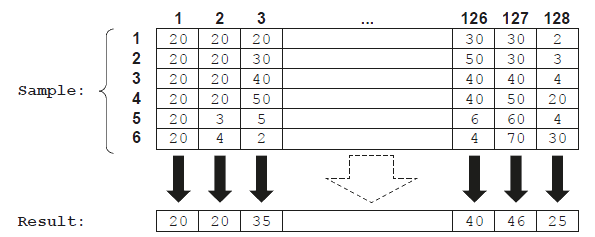
Worked Example A video-conferencing program supports up to six users. Speech from each user is sampled and digitised (converted from analogue to digital). Digitised values are stored in array
Sample.The array
Sampleconsists of 6 rows by 128 columns and is of type integer. Each row contains 128 digitised sound samples from one user.The digitised sound samples from each user are to be processed to produce a single value which will be stored in a 1D array
Resultof type integer. This process will be implemented by procedureMix().A procedure
Mix()will:
- calculate the average of each of the 6 sound samples in a column
- ignore sound sample values of 10 or less
- store the average value in the corresponding position in
Result- repeat for each column in array
SampleThe diagram uses example values to illustrate the process:
Write pseudocode for procedure
Mix().Assume
SampleandResultare global. [6]Final answer: Answer
- Declaration and initialisation before inner loop of
CountandTotal[1 mark]- Outer Loop for 128 iterations [1 mark]
- Inner loop for six iterations [1 mark]
- Test for sample > 10 in a loop [1 mark]
- and if true sum
Totaland incrementCount[1 mark]- Calculate average value and assign to
Resultarray after inner loop and within outer loop [1 mark]- Use of
INT()/ DIVto convert average to integer [1 mark]
Was this revision note helpful?
Build on this topic