Ideal Gases (Cambridge International AS Chemistry)
Ideal Gas Law
Kinetic theory of gases
-
The kinetic theory of gases states that molecules in gases are constantly moving
-
The theory makes the following assumptions:
- The gas molecules are moving very fast and randomly
- The molecules hardly have any volume
- The gas molecules do not attract or repel each other (no intermolecular forces)
- No kinetic energy is lost when the gas molecules collide with each other (elastic collisions)
- The temperature of the gas is related to the average kinetic energy of the molecules
-
Gases that follow the kinetic theory of gases are called ideal gases
-
However, in reality, gases do not fit this description exactly but may come very close and are called real gases
Ideal gases
-
The volume that an ideal gas occupies depends on:
- Its pressure
- Its temperature
-
When a gas is heated(at constant pressure) the particles gain more kinetic energy and undergo more frequent collisions with the container wall
-
To keep the pressure constant, the molecules must get further apart and therefore the volume increases
-
The volume is therefore directly proportional to the temperature(at constant pressure)
How the volume of a gas increases upon heating
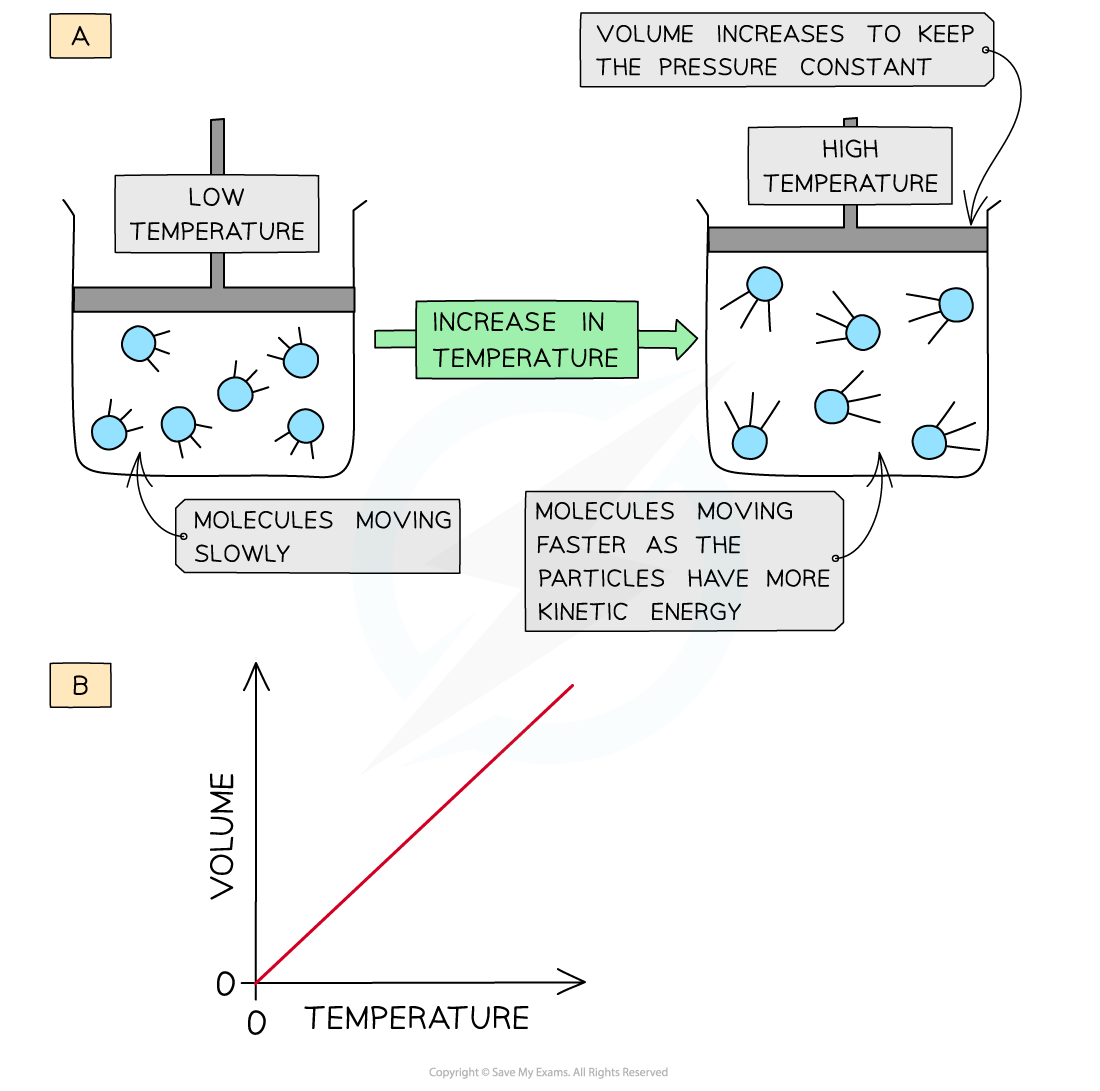
The volume of a gas increases upon heating to keep a constant pressure (a); volume is directly proportional to the temperature (b)
Limitations of the ideal gas law
-
At very high pressures and low temperatures real gases deviate from ideal gas behaviour because:
- The gas molecules are much closer together.
- Intermolecular forces (e.g. London forces or dipole-dipole attractions) become significant.
- The molecules’ own volume can no longer be ignored.
-
As a result, two key assumptions of the kinetic theory break down:
-
There are no intermolecular forces
- In reality, attractive forces between molecules pull them slightly inward
- So, they hit the container walls with less force than expected
- This makes the measured pressure lower than the ideal gas law predicts.
-
The volume of the gas molecules can be ignored
- In reality, the gas particles occupy space
- So, the actual free volume available for movement is less than predicted by the ideal gas law.
-
Ideal Gas Equation
Spec point —
4.1.3
-
The ideal gas equation shows the relationship between pressure, volume, temperature and number of moles of gas of an ideal gas:
- PV = nRT
P = pressure (pascals, Pa)
V = volume (m3)
n = number of moles of gas (mol)
R = gas constant (8.31 J K-1 mol-1)
T = temperature (kelvin, K)
- The ideal gas equation can also be used to calculate the molar mass (Mr) of a gas
Worked Example Calculating the volume of a gas
Calculate the volume occupied by 0.781 mol of oxygen at a pressure of 220 kPa and a temperature of 21 °C.
Answer
Step 1: Rearrange the ideal gas equation to find the volume of gas:
- V =
Step 2: Check that values have the correct units:
- P = 220 kPa = 220 000 Pa
- n = 0.781 mol
- R = 8.31 J K-1 mol-1
- T = 21 oC = 294 K
Step 3: Calculate the volume the oxygen gas occupies:
- V =
- V = 0.00867 m3
- V = 8.67 dm3
Worked Example Calculating the molar mass of a gas
A flask of volume 1000 cm3 contains 6.39 g of a gas. The pressure in the flask was 300 kPa and the temperature was 23 °C.
Calculate the relative molecular mass of the gas.
Answer
Step 1: Rearrange the ideal gas equation to find the number of moles of gas:
- n =
Step 2: Check that values have the correct units:
- P = 300 kPa = 300 000 Pa
- *V *= 1000 cm3 = 0.001 m3
- R = 8.31 J K-1 mol-1
- T = 23 oC = 296 K
Step 3: Calculate the number of moles of gas:
- *n *=
- *n *= 0.12 mol
Step 4: Calculate the molar mass using the number of moles of gas:
- *n *=
- molar mass =
- molar mass = 53.25 g mol-1
Exam Hint Ideal gases have zero particle volume(the particles are really small) and no intermolecular forces of attraction or repulsion.
To calculate the temperature in Kelvin, add 273 to the Celsius temperature, e.g. 100 oC is 373 Kelvin.
Remember: an ideal gas will have a volume that is directly proportional to the temperature and inversely proportional to the pressure.
Was this revision note helpful?