Hybridisation in Organic Molecules (Cambridge International AS Chemistry)
Hybridised Atoms: Shapes & Bond Angles in Molecules
-
Each carbon atom has four electrons in its outer shell (electronic configuration: 1s22s22p2)
-
Carbon atoms share these four electrons in four covalent bonds with other atoms to achieve a full outer shell configuration
-
These electrons are found in orbitals within the respective atoms
-
When forming a covalent bond, the orbitals overlap in such a way to form two types of bonds
- Sigma bonds (σ)
- Pi bonds (π)
Hybridisation: sp3
-
The electron pair in a σ bond is found in a region of space between the nuclei of the two atoms that are sharing the electrons
-
The electrostatic attraction between the electrons (negatively charged) and the two nuclei (positively charged) holds the two atoms together
-
Carbon atoms that form four σ bonds are said to be sp3 hybridised
-
The four pairs of electrons around each carbon repel each other forcing the molecule to adopt a configuration in which the bonding pairs of electrons are as far away from each other as possible
- The molecule adopts a tetrahedral arrangement with bond angles of 109.5o
Bonding in ethane

The diagram shows a molecule of ethane in which each carbon atom forms four σ bonds to adopt a tetrahedral configuration and minimise the repulsion between the bonding pairs of electrons
Hybridisation: sp2
-
When carbon atoms use only three of their electron pairs to form σ bonds, they are said to be sp2 hybridised
- Each carbon atom will have a p orbital which contains one spare electron
-
When the p orbitals of two carbon atoms overlap with each other, a π bond is formed (the π bond contains two electrons)
-
The two orbitals that form the π bond lie above and below the plane of the two carbon atoms to maximise bond overlap
-
The three bonding pairs of electrons are in the plane of the molecule and repel each other
-
The molecule adopts a planar arrangement with bond angles of 120o
Bonding in ethene
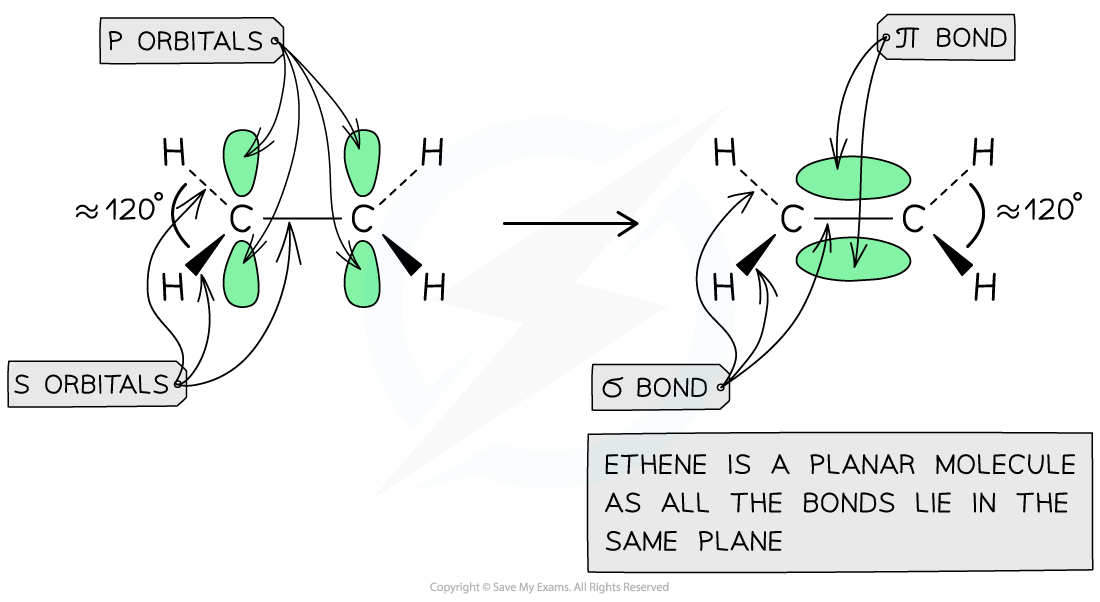
The overlap of the two p orbitals results in the formation of a π bond in ethene (sp2 hybridised molecule) in which the bonding pair of electrons repel each other to force the molecule into a planar configuration with bond angles of 120o
Hybridisation: sp
-
Carbon atoms can also use only two of their electron pairs to form σ bonds, in which case the carbon atoms are said to be sp hybridised
- Each carbon atom will have two p orbitals with one spare electron each
-
When the four p orbitals of the carbon atoms overlap with each other, two π bonds are formed (each π bond contains two electrons)
-
The two orbitals that form the π bond lie above and below the plane of the carbon atoms
-
The two orbitals of the other π bond lie in front and behind the plane of the atoms
- This maximises the overlap of the four p orbitals
-
The molecule adopts a linear arrangement with bond angles 180o
Bonding in ethyne
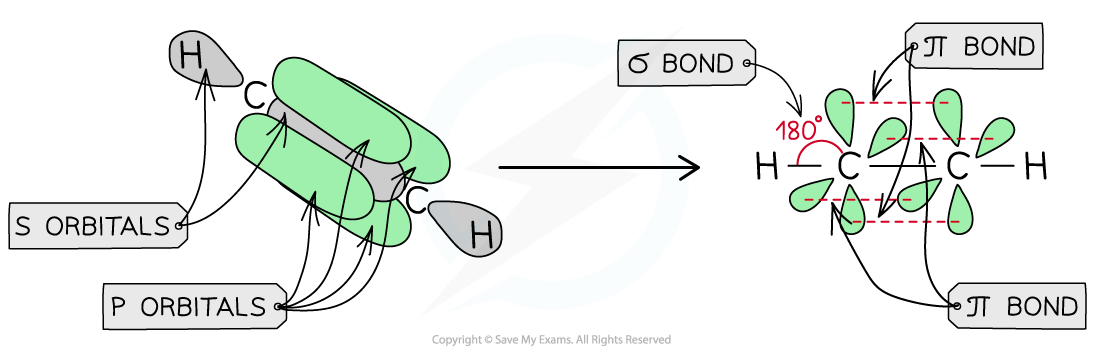
The overlap of the p orbitals results in the formation of two π bonds in ethyne (sp hybridised molecule) which adopts a linear arrangement with bond angles of 180o
Exam Hint A double bond is a combination of a σ and π bond and a triple bond is a combination of one σ and two π bonds
The strength of the bonds increases as follows: single < double < triple bond
This is due to the increased electron density around the C-C atom, making the bond stronger and more difficult to break.
Hybridised Atoms: σ & π Bonds in Molecules
Hybridised Atoms: σ and π Bonds in Molecules
σ bonds
-
Sigma bonds are formed from the end-on overlap of atomic orbitals
- S orbitals overlap this way as well as p orbitals
Forming sigma bonds
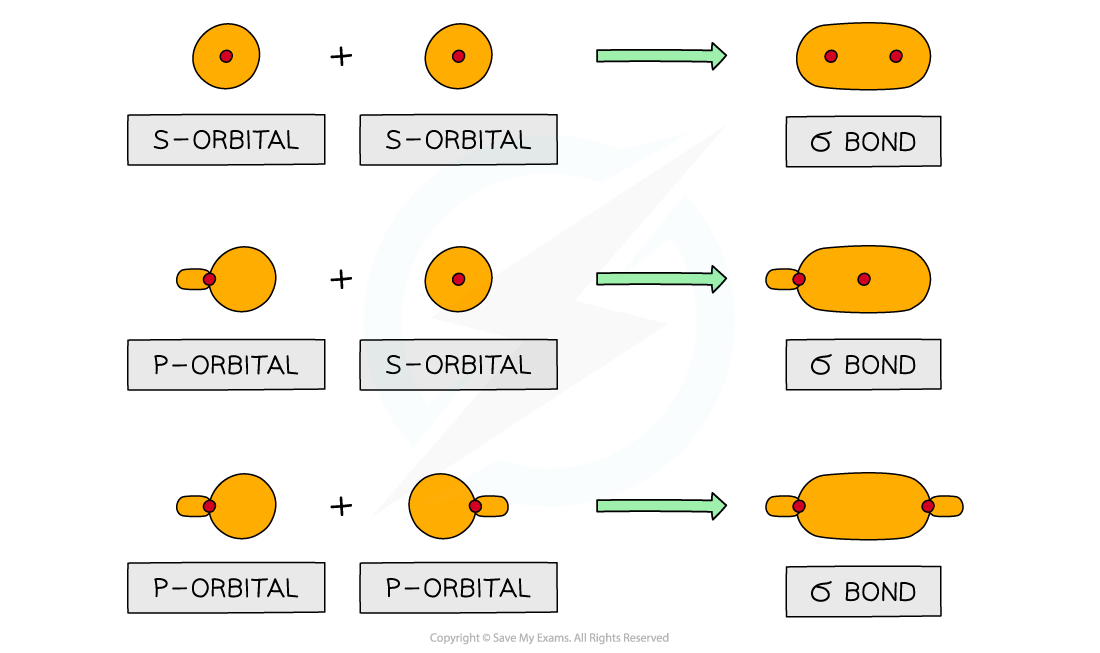
Sigma bonds can be formed from the end-on overlap of s or p orbitals
-
The electron density in a σ bond is symmetrical about a line joining the nuclei of the atoms forming the bond
- The pair of electrons is found between the nuclei of the two atoms
- The electrostatic attraction between the electrons and nuclei bonds the atoms to each other
The arrangement of the σ bond in sp3, sp2 and sp hybridised carbon atoms
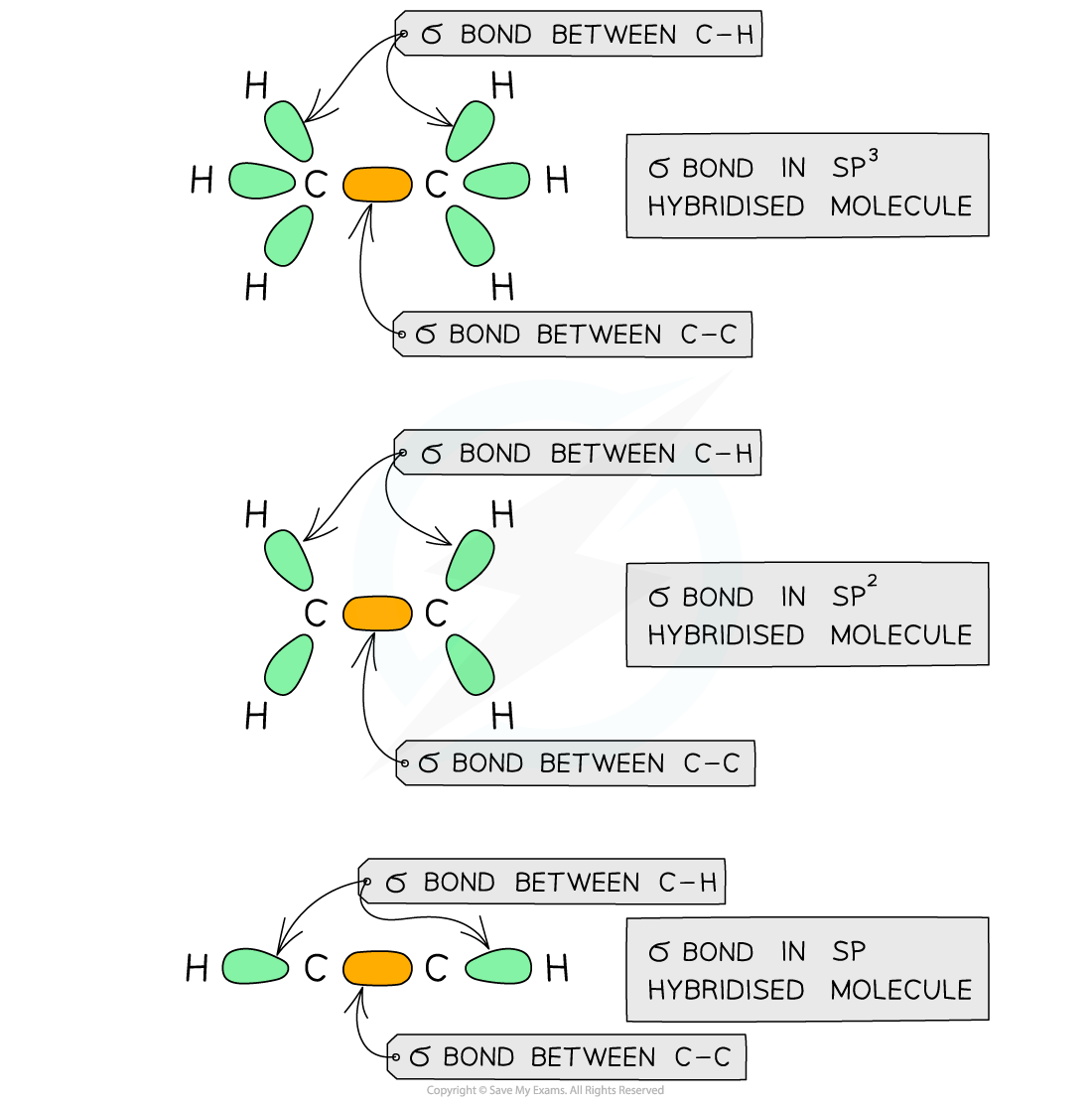
The σ orbitals are formed from the end-on overlap of the atomic orbitals resulting in symmetrical electron density on the atoms
π bonds
-
Pi (π) bonds are formed from the sideways overlap of p orbitals
-
The two lobes that make up the π bond lie above and below the plane of the atoms
- This maximises the overlap of the p orbitals
Forming pi bonds
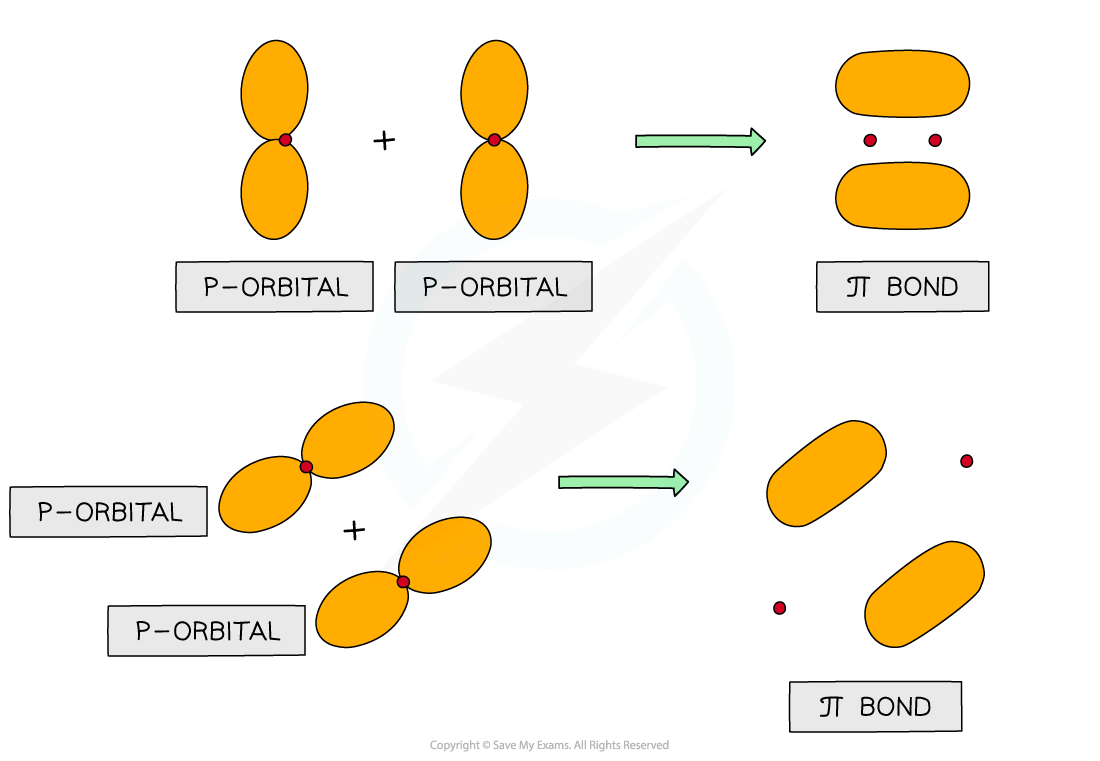
π bonds can be formed from the sideways overlap of p orbitals
-
In triple bonds, there is an additional overlap of p orbital
-
The two lobes of the π bond lie in front of and behind the plane of the atoms in the molecule
- This maximises the overlap of the p orbitals
The arrangement of the π bond in sp2 and sp hybridised carbon atoms
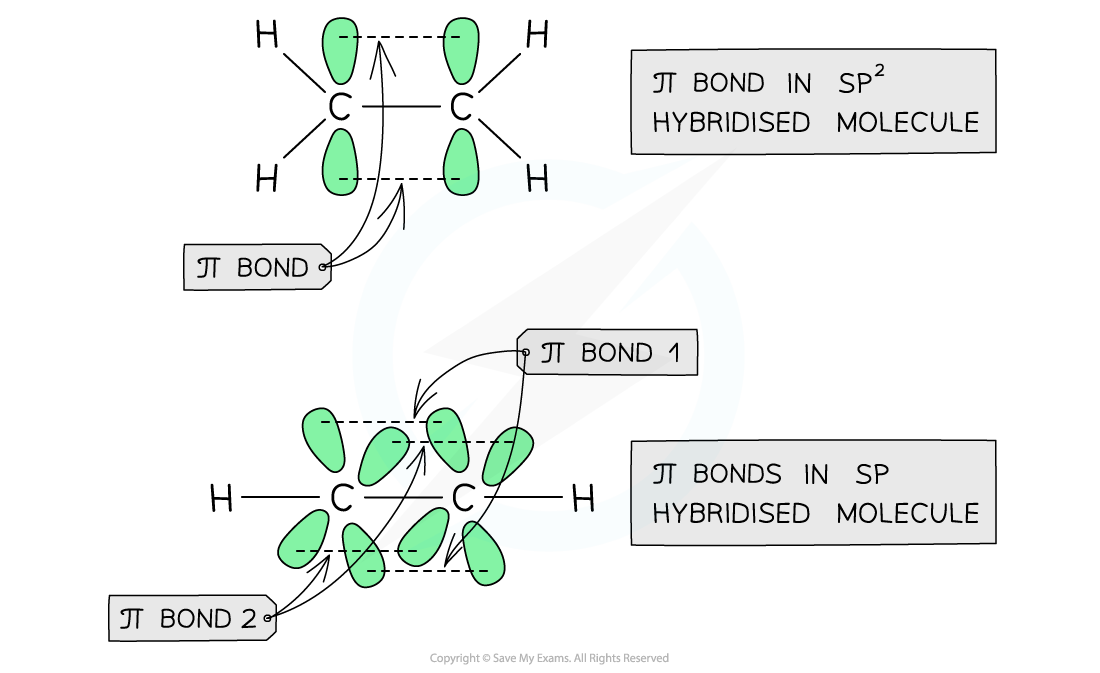
The π bonds are formed from the sideway overlap of the atomic orbitals
Exam Hint π bonds are drawn as two electron clouds, one arising from each lobe of the p orbitals
The two clouds of electrons in a π bond represent one bond consisting of two electrons (one from each orbital)
Was this revision note helpful?
Build on this topic